



About Angry Checkers
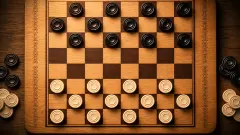
Most checkers games on the web spend their energy policing you. They grey out the squares you may not use, refuse any move that is not a diagonal, and make you take the jump when a jump is on. This one hands you a board, eight pieces and no opinion whatsoever about where they should go.
You pick up a checker, drag away from it, and let go. A white arrow stretches out of the piece while you hold, pointing the line it will take. Release, and it slides: into the other colour if you aimed well, into empty table if you did not, and off the edge entirely if you overcooked it. There is no square to land on, because landing is not a thing that happens here. Pieces stop where the collision stops them — straddling two squares, jammed against a rival, or hanging half over the border with most of the disc outside the board.
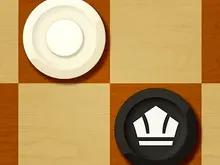
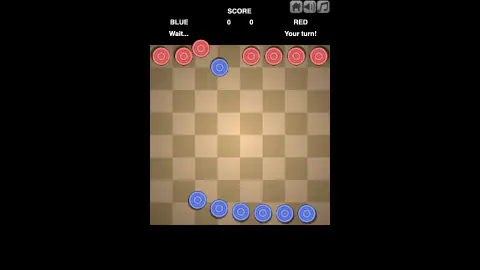
The chequered pattern underneath is scenery. In five captures of our session, not one piece is sitting in the middle of a square, and nothing about the light and dark tiles ever made any difference to a shot. What the board does supply is a frame to be knocked out of, which is the whole game.
The header carries everything else: SCORE across the top, BLUE on the left, RED on the right, and under each colour either "Your turn!" or "Wait...". Three small buttons sit above it — a house, a speaker and a music note — and that is the entire interface. No clock. No move list. No tray of captured pieces.
It is credited to Ivan Afanasyev, has been available since November 2024. We played a single sitting in SOLO and lost four rounds to nothing, which should tell you something about the opponent before you start.
What a chequerboard is for, and how little of this game needs it
A real draughts board is not decorated, it is engineered. Men move one diagonal step, and a diagonal step always lands you on a square of the same colour as the one you left. Put every piece on the dark squares and they will stay on the dark squares forever — which means half the board is doing nothing, and the game that remains is a tidy thirty-two squares where every piece can always, in principle, reach every other. The light squares are not unused by accident. They are the half that was never in play.
The rest of the standard rules build on that. Each side sets out twelve men on the dark squares of the three rows nearest them. Captures are made by hopping over a neighbour into the empty square beyond, and in the English game they are compulsory: if a capture is available you must take it, which is why checkers games collapse into forced sequences where neither player has a choice for five moves at a stretch. Reach the far row and your man is crowned, gaining the right to move backwards as well as forwards, and the endgame usually belongs to whoever has the kings.
That tight little rule set turns out to be exhaustible. In 2007 a team at the University of Alberta announced that draughts had been solved: with perfect play on both sides the game is a draw, every time, from the opening position. The board that looks like a toy next to a chess set is a puzzle with a known answer.
Now count what this game keeps. The 8x8 grid: kept, and ignored. Two colours taking turns: kept. Twelve men on dark squares: gone, replaced by eight in a straight line along the edge, sitting on light and dark alike. Diagonal steps: gone. Compulsory capture: gone, because there is no capture to compel — pieces are not jumped over, they are shoved off the side. Crowning: as far as we could see, gone too.
What is left is the one thing draughts does not have, which is a reason to aim. Real checkers is a game of complete information where the geometry does your arithmetic. Here the geometry is yours to find, and the arithmetic is done by a collision you only half control. The name is a fair warning: the angry part is the speed at which a well-struck piece crosses the table.
Eight against eight, and a score that counts rounds
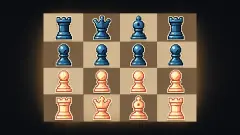
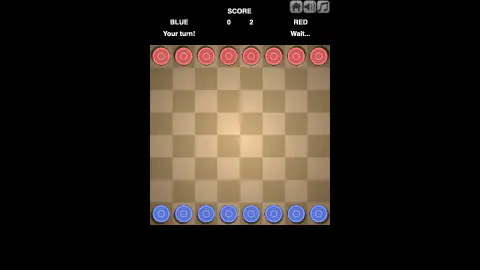
The opening position is worth looking at because it is unusual. Both sides line up on the outer edge of the board, one piece per file, eight across. Not a wedge, not three staggered rows — a wall. It makes the first move of a round feel like a break in snooker, with the difference that your own wall is the thing you are dismantling.
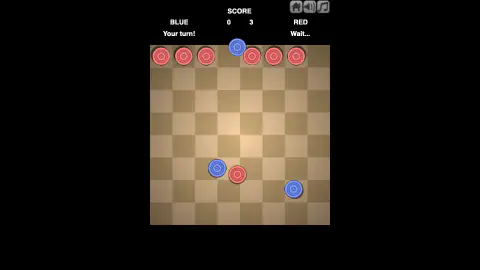
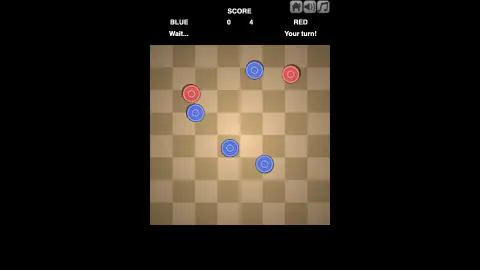
From there the board empties fast. In the middle of a round we had three pieces left against six, scattered loosely around the centre, with one blue checker stuck up among the red line where it was no use to anybody. Late on we were four against two and still losing, because by then red only needed to find one clean line.
The score itself took a while to read. It moved from nil-nil to one, two, three and four over the session, and every time we saw a number change, the board behind it was a fresh wall of eight against a fresh wall of eight. So a point is a whole round, not a captured piece. We never caught the instant a round ended — no screen we saw announced it — but the pattern was the same each time: the table clears, the score ticks, and both rows are back.
What is missing from the screen matters as much as what is on it. There is no timer, no shot counter, no limit on how long you spend lining one up. The only pressure the game applies is arithmetic: every piece you fire into open ground is a piece someone else can now reach.
More board games, and more from the same developer
Checkers Legend is the useful comparison, and the quickest way to feel what this game threw away: diagonals, dark squares, forced jumps and all. Play a round of each back to back and the difference between a rule you obey and a shot you aim becomes obvious in about a minute. Backgammon is the other old board game on our shelves that still plays the way it always did, dice and all. If what appeals here is two people at one keyboard rather than the board itself, 12 MiniBattles is built entirely around that. And Dress Up Anime Girl is Ivan Afanasyev's other game on our shelf, which has nothing in common with this one beyond the person who made it. The rest are in multiplayer games.
Screenshots
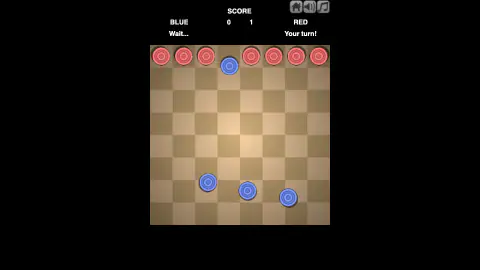
How to play Angry Checkers
- Pick a mode. The menu opens on a language screen, then offers SOLO against the computer and LOCAL PVP for two people at one screen, with an ABOUT page beside them.
- Click and hold one of your checkers. Any piece of your colour works. Nothing is locked to a row, and nothing is greyed out.
- Drag away from it to aim. The white arrow that appears is your line. Sight it through the piece you want to hit, not at the piece itself.
- Let go and watch. Your checker slides, hits what is in the way, and everything it touches moves too. The turn passes when the board stops moving.
- Clear the other colour off the board. Pieces that go over the edge do not come back, and the side that runs out loses the round.
What our session taught us:
- Aim through the target, not at it. A straight hit sends a rival the way you were already going. If the edge is behind it, that is a piece gone; if it is not, you have handed the opponent a free shot at a piece now sitting in the open.
- Your own pieces are ammunition and they are also liabilities. Nothing distinguishes the checker you fired from the ones you did not. Ours regularly ended up scattered in midboard, where the red side picked them off one at a time.
- The opening row is the safest place on the board. A full line of eight along your own edge is hard to attack, because a shot that reaches it has to survive the whole length of the table first. Every round we lost began with us breaking that line early.
- Stray pieces that end up on the far edge are stranded, not promoted. One of ours finished a round parked among the red row and did nothing there at all.
- There is no clock. Nothing moves while you think, so the aiming is as careful as you want to make it.
Controls
| Click and hold a checker | Picks it up to aim. Any piece of your colour will do; nothing is locked to a row or a square |
|---|---|
| Drag away from it | A white arrow stretches out of the checker while you hold, pointing the way it will travel. We could not measure whether pulling further hits harder, so we will not claim it does |
| Release | Lets the checker go. It slides across the board, hits whatever is in its line, and stops where the collision leaves it |
| Touch, hold and drag | The same three moves on a phone or tablet. The game is listed as playing on mobile and tablet; our own session was a desktop with a mouse |
| Keyboard | We tried the arrow keys and Enter and got nothing out of them. Treat this as a game you play entirely with the pointer |
| House, speaker and music buttons, above the board | Back to the menu, sound effects on or off, music on or off. The two audio switches are separate |
Features
- Eight checkers a side, laid in one unbroken row along the top and bottom edges of an 8x8 board
- Nothing snaps to a square: pieces come to rest straddling the lines, jammed against each other, or half over the border, wherever the collision leaves them
- Whose move it is is spelled out in words, with Your turn under one colour and Wait under the other
- Two modes on the menu, SOLO against the computer and LOCAL PVP for two people at one screen, plus an ABOUT page and a language picker
- The score counts rounds, not captures: every time the number moved, the board was back to eight against eight
- Nothing on screen but the board, the score and three buttons — no clock, no move list, no tray of captured pieces
- Made by Ivan Afanasyev, since November 2024
Game details
- Developer
- Ivan Afanasyev
- Release date
- November 2024
- Last updated
- August 10, 2026
- Added here
- March 2025
- Technology
- HTML5 (2D physics)
- Platforms
- Browser (desktop), Browser (mobile & tablet, touch)
- Classification
- Cards & Board , Multiplayer , Puzzle
- Download size
- 0.9 MB
- Ad requests
- 2 (few)
- Has a save
- Yes
- Saved progress
- Saving, when available, is managed by this game. Mava cannot confirm your level.
Measured by opening the game ourselves on 2026-09-10, not taken from the feed. Twelve seconds on a phone-sized screen, with ad requests counted and blocked rather than loaded.
FAQ
What is Angry Checkers?
It is a free browser board game that uses the furniture of draughts and almost none of its rules. Each side starts with eight checkers lined up along its own edge of an 8x8 board, and instead of stepping diagonally from square to square you drag a piece and let it slide, knocking the other colour out of the way. It needs no download and no account, and it plays in the browser on desktop and on mobile.
How do you play Angry Checkers?
With the pointer or a finger. Click and hold one of your checkers, drag away from it to aim, and let go: a white arrow shows the line while you hold. The piece slides until something stops it. The header above the board tells you whose move it is, and your job is to push the other colour off the board without being pushed off yourself.
Is Angry Checkers the same as normal checkers?
No. Real draughts puts twelve men a side on the dark squares only, moves them one diagonal step at a time, forces you to take a capture when one is available, and crowns a man that reaches the far row. This game keeps the chequered board, the two colours and the turn order, and drops every one of those rules. You aim where you like, and a collision decides what happens.
Can two people play Angry Checkers on the same computer?
The main menu offers LOCAL PVP next to SOLO, which is two players taking turns at one screen rather than an online match. Our own session was played in SOLO against the computer, so we can tell you the mode is there but not how it handles the handover between players. There was no sign of online matchmaking anywhere in the menu.
How do you win a round?
Checkers leave the board when they are pushed off it, and the side that runs out of pieces loses the round. Every time the score changed in our session, the board was back to a full eight against eight, so a point is a round rather than a single capture. We never caught the exact moment a round ended, so that is a reading of what we watched rather than a rule the game told us.
Do checkers get crowned or become kings?
We never saw it happen. One of our blue checkers was pushed right up onto the far edge, among the red pieces, which in real draughts is exactly where a man is crowned, and it looked identical to every other blue checker afterwards. Since pieces here do not step forward row by row, there is no back rank to reach in the usual sense.
Does Angry Checkers work on a phone?
It is listed for mobile and tablet as well as desktop, and the drag it asks for is a natural touch gesture. We played it on a desktop with a mouse, so we have not checked how the board scales on a small screen or how precise the aiming is with a thumb.
Who made Angry Checkers and when?
It is credited to Ivan Afanasyev, who also made the dressing-room game Dress Up Anime Girl among a shelf of around a dozen titles. The game was published in November 2024 with an update in August 2026. We found no studio website to check the name against a second source.