










About Master of 3 Tiles
Most tile-matching games keep the danger on the board. Master of 3 Tiles keeps it underneath. A row of seven slots sits below the stack, every tile you touch drops into one of them, and the only tiles that ever leave again are the ones that find two twins.
Seven is a tighter number than it looks. Three unfinished pairs and one lonely tile fill it exactly, and in that position nothing you can reach will clear anything. The board is not what runs out in this game. The queue is.
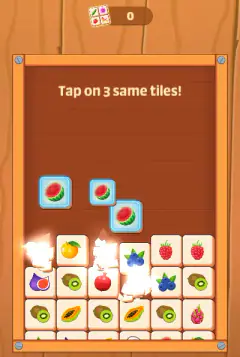
We spent a long stretch of our first visit trying to swap neighbouring tiles, the way a match-three game would want. Nothing swapped. Nothing here slides, falls or trades places: tiles travel one way only, from the stack down into the queue, and the game says so on the first card it shows you, "Tap on the tiles to place them in the queue".
The game is by Tiny Heart, a small studio that also publishes it as an Android app. The browser version was published in October 2024.
We should be plain about how much of it we have seen. We have opened the first level twice, cleared trios on both visits and finished it neither time. What follows is that level in detail, and a straight account of where our knowledge stops.
The queue is the clock, and it counts to seven
Everything else in this game is generous. The first stack is only four rows deep, the helpers are free, and no counter is ticking down. The queue is where it gets strict, and the arithmetic is worth doing once.
Treat a slot as a debt. A tile you send down with no twin waiting is one slot gone until the other two turn up, and they may be buried deep in the pile.
Two unfinished kinds are comfortable. A third is the edge: three pairs and a spare fill every slot there is, and a queue in that state has nothing left in it to clear.
So the skill is not spotting matches, it is refusing them. When a free trio is already sitting uncovered, take it before you start anything new, even if a half-finished pair is nagging at you from the queue. The fullest we have seen ours is five of seven. We have not watched it overflow, and we are not going to tell you what happens when it does.
Same stack, different food
Level 1 has a shape and it keeps it. The pile is six tiles across and four rows deep, with a notch bitten out of the middle of the top edge, and the upper tiles sit half a step off the ones beneath, so a single tile can pin the corners of several others at once.
What it does not keep is the menu. Our first run at the level was tacos, corn cobs, pomegranates, glasses of red wine and a bread stick. The level began again partway through the session, the same outline came back, and this time it was drawn with aubergines, apples, lemons, bananas and corn. The arrangement is something you can learn. The pictures are not.
The game explains itself in four short cards above the board, one after another, and then never mentions any of it again: "Tap on the tiles to place them in the queue", "Good luck!", "Collect 3 equal tiles to remove them from the playing field" and "You get points for cleaned tiles". That last card is all the scoring you are told about. The star counter does the rest, and each trio we cleared added five to it.
Where triple tile comes from: the layers are borrowed, the three is older
The stacked board is lifted from mahjong solitaire, which has an unusually well documented beginning. Brodie Lockard wrote the first computer version in 1981 for PLATO, a university computer network, and it was played on a touch screen. The standard board holds 144 tiles in four layers, you take them away in pairs, and a tile only counts as free if it could slide out to the left or the right.
Master of 3 Tiles keeps the layers and throws away the other two rules. A tile here is free the moment nothing is on top of it, and we lifted tiles with neighbours pressed hard against both sides all evening. Pairs are gone as well. You need three.
That number comes from the game the tiles belong to in the first place. In four-player mahjong, a set of three identical tiles is a pung, and hands are built largely out of threes.
Solitaire traded the pung for the pair, and the trade is what made solitaire safe: when tiles only leave in matched pairs, a wrong pick is not possible, because you either have the pair in front of you or you do not. Put the pung back and the odd tiles need somewhere to wait. That somewhere is the queue, and that is where this game moved the risk.
Three helpers, three uses each
Three orange buttons sit under the queue, each with a small 3 in the corner. The number is a count of uses, not a wait: we pressed the back arrow once and it dropped to two.
The back arrow undoes your last tap. The other two show a lightning bolt and a plus sign, and we have not spent either, so we are not going to guess what they do. All three have read three every time we have opened the level.
What we have not seen
We have not finished level 1, so there is no win screen in this account and no level 2 either. We have never filled the queue, so the losing side of the game is missing on purpose rather than by accident. No ad interrupted our session, which is not a promise that there are none. And we played on a computer with a mouse: the game is listed for phones in a tall portrait layout, which is clearly what it was built for. On a wide monitor the whole thing sits in a narrow column with purple mountains filling the rest of the screen.
Who will get on with it
Anyone who likes mahjong solitaire but wants a bad pick to cost something. Nothing moves unless you tap it, nothing is racing you, and the only pressure in the game is the row of slots you are filling yourself.
More triple-tile and mahjong games
Tile Valley is the closest relative we host, food tiles and all. Happy Zoo: Mahjong Triple Match swaps the groceries for animals, and Mahjong 3 hands you four helpers instead of three. Fresh Drop: Triple Match shortens the queue to five places, which changes the arithmetic completely. For the older rule, where tiles leave in pairs and the board is all there is, try Mahjong Lines. The rest are under puzzle games.
Screenshots
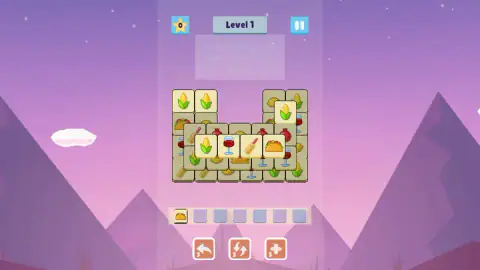
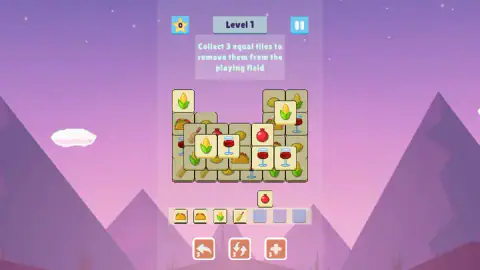
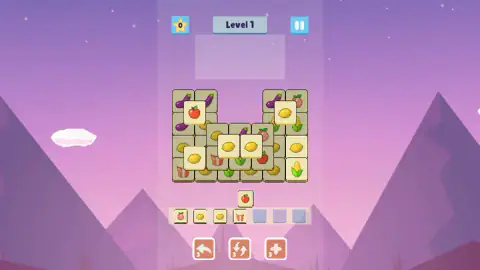
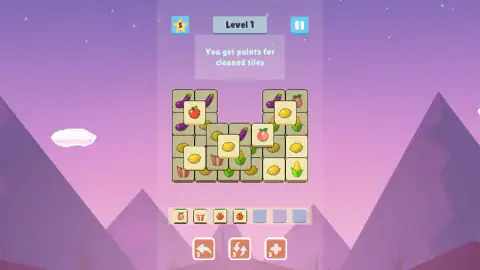
Taken by opening the game ourselves and letting it run — not supplied by the publisher, and not the same picture every other site shows.
How to play Master of 3 Tiles
- The opening panel has a single button. Past it, the game's own menu puts a green PLAY under a Level 1 badge.
- The level starts with an empty board and the word "Good luck!" in the middle of the screen. Then the stack appears, above seven waiting slots.
- Tap a bright tile and it flies down into the queue. Shaded tiles have another tile lying on them, and tapping one does nothing at all.
- Get three identical tiles into the queue and they go together. The star counter at the top left climbs.
- Keep uncovering and clearing until the stack is gone. If a tap was a mistake, the back-arrow button under the queue takes it back, and you start the level with three of those.
What two sittings taught us:
- The queue files by picture, not by arrival. Our second apple did not go to the end of the row. It slid in beside the apple already sitting there and pushed everything after it along one place. You never have to hunt through your own queue for a pair.
- Count before you open a fourth kind. Every new picture you bring down costs a slot until its other two arrive. Three kinds in progress already eat six of the seven.
- Look under a tile, not next to it. Lifting one fruit off the middle of the stack uncovered a banana that had been shaded a second earlier. The question worth asking is which tile is pinning the most others down, not which tile has a twin nearby.
- A dead tap is information. If nothing moves, the tile is covered. Go and find what is lying on top of it instead of tapping harder.
- Nothing is timed. There is no clock anywhere in the first level, so you can stop and work it out.
Controls
| Click or tap a bright tile | Sends it down into the queue; three identical tiles in the queue disappear |
|---|---|
| Click or tap a shaded tile | Nothing happens; something is lying on top of it |
| Back-arrow button, under the queue | Undo. It starts the level with three uses and the number drops as you spend them |
| Lightning and plus buttons, under the queue | Two more helpers with three uses each; we have not spent them |
| Pause button, top right | Pauses the level |
Features
- A queue of seven slots under the board, where three identical tiles clear at once
- Layered stacks where covered tiles are shaded and will not respond until what sits on them is gone
- A queue that files each new tile beside its twin instead of at the end of the row
- A star counter that went up five points with every trio we cleared
- Three helper buttons under the queue, each showing three uses at the start of the level
- A first level that keeps its shape between attempts and changes its food, from tacos and red wine to aubergines and bananas
- No clock anywhere in the first level
- Made by Tiny Heart
Game details
- Developer
- Tiny Heart
- Release date
- October 2024
- Last updated
- August 10, 2026
- Added here
- March 2025
- Technology
- HTML5 (Unity WebGL)
- Platforms
- Browser (desktop, mouse), Browser (mobile & tablet)
- Classification
- Cards & Board , Puzzle , Word & Trivia
- Saved progress
- Saving, when available, is managed by this game. Mava cannot confirm your level.
FAQ
How do you play Master of 3 Tiles?
You tap a tile that has nothing lying on top of it and it drops into a queue of seven slots under the board. When three identical tiles are in the queue they clear and your star counter goes up. The aim is to take the whole stack apart that way without filling the queue with tiles you cannot finish.
Is Master of 3 Tiles a match-3 game?
No, and it is easy to assume otherwise. Nothing here is swapped with its neighbour and nothing falls into a gap. We spent a long stretch of our first visit trying to trade adjacent tiles and not one of them moved. Tiles travel one way only, from the stack into the queue, where the matching happens.
What happens when the queue fills up in Master of 3 Tiles?
We cannot tell you, because we have never filled it. The queue has seven slots, and the fullest we have seen it is five, so we have not watched it overflow and we are not going to guess. What we can say is that seven slots hold exactly three unfinished pairs and one spare tile.
Who made Master of 3 Tiles?
Master of 3 Tiles is by Tiny Heart. The browser version was published in October 2024 and was last updated in August 2026.
What do the three buttons under the queue do?
They are helpers, and each one shows a 3 every time we have opened the first level. The button with a back arrow is an undo, and pressing it once took its number down to two, so the three is a count of uses rather than a wait. The other two show a lightning bolt and a plus sign; we have not pressed them, so we will not guess at what they do.
How do you score points in Master of 3 Tiles?
By clearing tiles. The game says as much on one of its opening cards, and the star counter sits at the top left of the screen. Every trio we cleared added five to it. We did not finish a level, so we cannot say whether an emptied board pays anything extra.
Does level 1 always look the same in Master of 3 Tiles?
The arrangement does, the pictures do not. Both times we opened it the stack was six tiles across and four rows deep with a notch out of the top middle, but the food changed completely: tacos, corn, pomegranates and glasses of red wine one time, aubergines, apples, lemons and bananas the next.
Is Master of 3 Tiles free, and does it work on a phone?
It is free in the browser, with no download and no account. It is listed for PC and Android in a portrait layout, and every action in the game is a single tap. We played on a computer with the mouse and have not tested a phone ourselves.