










About Patch Garden
Most number puzzles ask you to write something in a cell. Patch Garden asks you to draw a fence. Every number on the board is a seed, and the number says how many squares its patch has to cover. Not one more, not one fewer, and always a rectangle.
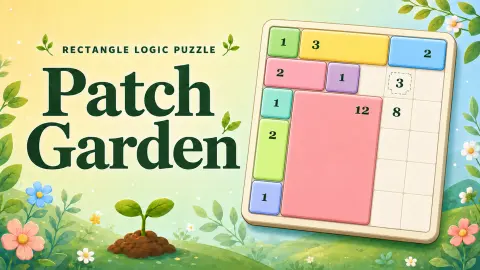
That is the whole rule, and it is older than the garden. It is Shikaku, a puzzle the Japanese magazine Nikoli has printed since 1989. Patch Garden does not use the name. Its title screen says "RECTANGLE LOGIC PUZZLE" in small capitals, paints the board in pastel colours, and adds a row of counters that keep score of how cleanly you solved it.
The game is credited to Westeren Games. It was published in June 2026.
Here is the honest size of our visit: about four minutes at a desktop screen, mouse in hand, all of it on level 1. We placed three of its four patches and left with half the board covered. We did not finish the level, and we did not open the Daily puzzle, the level list or the How to Play page.
Level 1, solved by logic rather than by arrows
The tutorial arrows will walk you through the first board, but it is worth solving it in your head, because the reasoning is the game. The board is four cells by four. That makes 16 cells, and the four seeds add up to 16.
| Seed | Where it sits | Its patch | Colour once placed |
|---|---|---|---|
| 1 | Top left corner | That one cell | Green |
| 3 | Top right corner | The three cells right of the 1 | Yellow |
| 4 | Second row, third cell | The whole second row | Blue |
| 8 | Bottom row, second cell | The two bottom rows | Not placed in our game |
Start with the largest number, because it has the fewest ways to fit. An 8 on this board is either two full rows or two full columns. Two columns through its cell would have to swallow either the 1 or the 4, and a patch may hold only one seed. So the 8 can only be the bottom two rows.
Everything else follows. The 3 sits in the top right corner. It cannot grow downward, because three cells down would run into the 8's ground. It has to stretch left, stopping just short of the 1. The 4 is left with the second row, end to end.
That is the habit the game is teaching: find the seed with one possible shape, draw it, and see what it forces on its neighbours. We placed the 1, the 3 and the 4 in that order, which is the tutorial's order, and stopped with the 8's arrow on screen.
Five counters, three buttons
A strip along the top keeps five numbers: moves, mistakes, hints, time and filled.
Filled is the easiest to read. It is the share of cells under a patch. After our single green cell it said 6%, which is one cell of sixteen. Two patches later it said 50%.
Moves counted patches, not attempts: it read 3 with three patches on the board. Mistakes and hints both stayed at 0 for us, so we cannot tell you what the game counts as a mistake.
Under the board sit three round buttons: Undo, Erase and Hint. The Hint button wore a small badge with a 3 on it. The game's instructions say Erase is a mode, switched on first and then pointed at a patch, and that when the free hints are gone an ad buys one more. They also list keyboard shortcuts: Ctrl+Z, E and H. We used none of the three buttons, so take that from the instructions, not from us.
The puzzle under the flowers dates from 1989
Shikaku has a paper trail. Wikipedia's article on it credits the invention to Yoshinao Anpuku, then a mathematics student at Kyoto University, and says Nikoli published it in 1989. The full Japanese name is Shikaku ni Kire, which English-language puzzle books turned into "Divide by Box" or simply "Rectangles".
The rule in that article is the rule on this board: cut the grid into rectangles so that each holds exactly one number, and the number equals the area. Patch Garden changes the vocabulary and nothing else. A number is a seed. A rectangle is a patch.
The same article notes one more thing. Deciding whether a Shikaku grid can be solved at all belongs to the class of problems computer scientists call NP-complete, meaning no quick general method is known. That says little about a four-by-four tutorial, and a good deal about why the puzzle has room to keep growing as boards get larger.
What we did not see, and who it is for
The game's own description promises hundreds of levels, larger boards, and two kinds of clue we never met: mystery seeds and exact-size clues. We cannot tell you what either does. The title screen has a Daily button, marked READY on our visit, and a Levels button. Both stayed closed.
It suits anyone who likes a puzzle with one rule and no luck. Nothing moves, nothing falls, and a wrong idea can be undone. It suits less a player who wants speed or surprise: the only thing running is a clock that never rings.
More logic puzzles to try next
If numbers that govern shapes are your thing, Nonogram uses them to paint a picture row by row. Lanternward and Akagram are two takes on Akari, another grid puzzle from the Nikoli stable, where you place lights instead of fences. CatDoku is built on a one-per-row rule, with cats where the digits would be. The rest are under puzzle games.
Screenshots
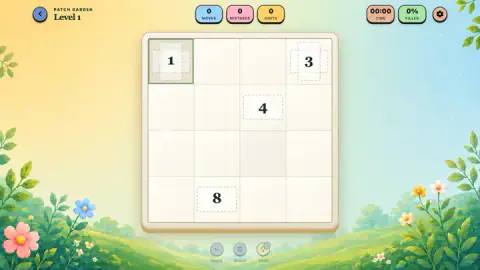
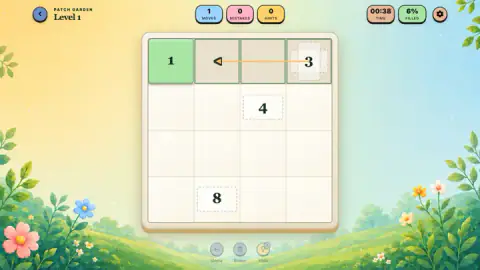
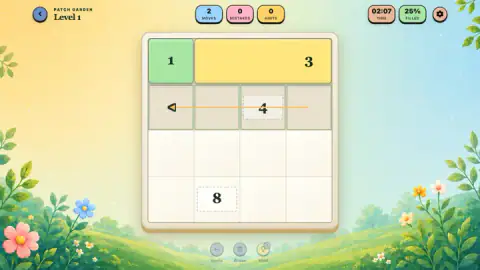
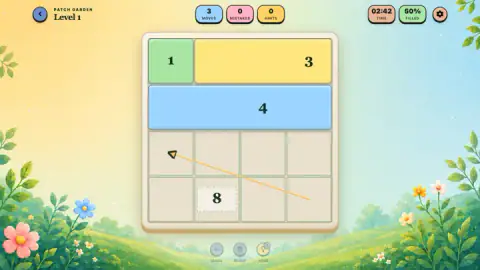
Taken by opening the game ourselves and letting it run — not supplied by the publisher, and not the same picture every other site shows.
How to play Patch Garden
- Press Play. The big button on the title screen shows the level you are on. Ours read LEVEL 1.
- Read the seeds. Each numbered cell needs a rectangle that contains it and covers exactly that many cells.
- Drag from corner to corner. Press on one corner cell of the patch you want, move to the opposite corner, and release. The patch fills with colour.
- Keep one seed in each patch. The game's instructions put it plainly: every clue belongs to exactly one rectangle, and patches cannot overlap.
- Cover every cell. By those same instructions, a level ends when nothing is left bare.
What level 1 taught us:
- A 1 is a free move. Its patch is its own cell. One click on it turned it green.
- Follow the orange arrow while it lasts. In the opening level a dashed arrow shows the exact drag for the next patch, and the cells it will cover go a shade darker.
- The drag can run diagonally. For the big patch, the arrow started in the bottom right cell and ended one row up on the far left: a single stroke for a block two cells tall.
- A drag that does not take costs nothing. Several of ours left the board as it was. The move counter stayed put and mistakes stayed at 0.
- The clock only counts. It runs up from 00:00. Ours passed two and a half minutes on a level that needs four drags, and nothing happened.
Controls
| Click and drag across the grid (left mouse button) | Draws a rectangular patch from the cell where you press to the cell where you release |
|---|---|
| Click a cell holding a 1 | Plants a one-cell patch; a single click was enough in our game |
| Undo, Erase and Hint buttons under the board | The game's instructions say they take back the last move, remove a placed patch you click, and highlight a helpful area |
| Ctrl+Z, E and H | Keyboard shortcuts for undo, erase mode and hint, according to the game's instructions; we did not try them |
Features
- One rule: every numbered seed gets a rectangle covering exactly that many cells
- A first level on a 4x4 board with four seeds: 1, 3, 4 and 8
- A dashed orange arrow that shows the drag for each patch of the opening level
- Five counters on top: moves, mistakes, hints, time and the share of the board filled
- Undo, Erase and Hint buttons, with 3 hints on the badge at the start
- A Daily puzzle and a level list on the title screen
- Made by Westeren Games
Game details
- Developer
- Westeren Games
- Release date
- June 2026
- Last updated
- July 14, 2026
- Added here
- April 2026
- Technology
- HTML5
- Platforms
- Browser (desktop, mouse), Browser (mobile & tablet, touch)
- Classification
- Puzzle
- Saved progress
- Saving, when available, is managed by this game. Mava cannot confirm your level.
FAQ
How do you play Patch Garden?
Each numbered cell is a seed, and the number is the size of the patch it needs. You click and drag across the grid to draw a rectangle that contains that seed and covers exactly that many cells. The game's instructions say a level is done when the whole board is covered with no overlaps and one seed in every patch.
Is Patch Garden the same puzzle as Shikaku?
The rule is the same. Shikaku, published by the Japanese magazine Nikoli since 1989, asks you to cut a grid into rectangles so that each holds one number equal to its area. Patch Garden never uses that name; its title screen calls it a rectangle logic puzzle and dresses the numbers as seeds.
What do the counters at the top of Patch Garden mean?
There are five: moves, mistakes, hints, time and filled. Moves went up by one each time a patch landed in our game, and filled is the share of cells covered, so one cell of sixteen read 6%. The clock counts up from zero and we saw no time limit.
How many hints do you get in Patch Garden?
The Hint button carried a small badge with a 3 when we started level 1. The game's instructions say that once the free hints run out, you can watch an ad to get one more. We did not use a hint, so we cannot describe what one looks like on the board.
How do you solve level 1 of Patch Garden?
Start with the 8. On a four-by-four board it has to be the two bottom rows, because the other way of making 8 would swallow a second seed. That leaves the 3 as the three cells to the right of the 1, and the 4 as the whole second row.
How many levels does Patch Garden have?
The game's own description speaks of hundreds of levels, with larger boards and special clue types later on. We played only level 1, so we cannot confirm the count or describe the later boards. The title screen also has a Daily button, which was marked as ready on our visit.
Who made Patch Garden?
It is credited to Westeren Games. It was published in June 2026. It is listed for PC, Android and iOS; we played it on a desktop computer with the mouse.