










About Lanternward
We spent three minutes on one small Lanternward puzzle and did not solve it. The game never punished us for that. It did something more useful: it kept one roof number painted red for most of the session, as a quiet reminder that the mistake was ours and was still on the board.
Lanternward is a version of Light Up, a pencil puzzle also known by its Japanese name, Akari. Here it is dressed as a harbour town at night. The grid is a block of streets and rooftops. You stand lanterns on the streets, each lantern lights its row and its column until a roof gets in the way, and the puzzle is done when no street square is left dark.
Two rules make that hard. No lantern may shine on another lantern. And some roofs carry a number, which fixes how many lanterns touch that roof's sides. Nothing moves, nothing is random, and the clock only counts up.
The game is credited to Morass Games and has been available since 22 September 2026. It is very new.
Everything below comes from that single puzzle, which the game labels Harbour 1-3, plus the two menus in front of it. Where we lean on the game's own description instead of our eyes, we say so.
Our three minutes on Harbour 1-3, mistake included
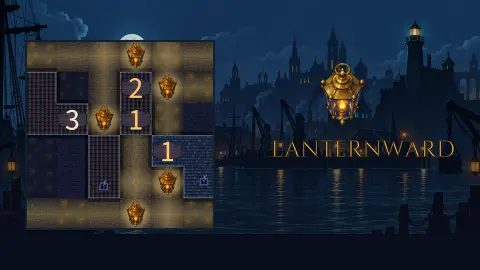
The board is six squares by six, with ten roofs on it. Three of them carry numbers: a 0 on the left edge, a 3 two squares to its right, and another 3 on the right edge.
Our first lantern went under the 3 on the right edge. Its light ran down to the bottom of the board and nowhere else, because a roof stood above it and another to its left. That is the first thing the game teaches: a lantern in a tight corner lights very little.
Our second decision was the bad one. Between the 0 and the middle 3 there is a single street square, and we put a lantern on it to feed the 3. The 0 turned red at once. That square touches the 0, so it can never hold a lantern, and we kept coming back to it anyway.
From there we added and removed lanterns around the same few squares. At one point two stood in the same column and both turned red. When the clock read 03:07 the board held three lanterns, two dots, a red 0 and a red pair. We stopped there. We never saw a solved board, so we cannot describe what the game does when you finish, or how it hands out stars.
What the board was telling us
Looking at the same puzzle afterwards, with no clock, the opening is forced, and it shows how the game expects you to think.
The 3 on the right edge has only three street squares around it, because its fourth side is the edge of the board. So all three get a lantern. The 0 forbids the three squares around it, including the one we kept using. That leaves the middle 3 with exactly three squares still allowed, so those are lanterns too. Six lanterns placed, and not one of them is a guess.
The rest follows from a different question: which squares are still dark, and who could light them? A dark square that can only be reached from one place settles that place.
The game's description promises that every puzzle has one solution and never needs a guess. On this board, at least, that held up on paper.
Hint, Mistake and the star they cost
Three buttons sit under the clock: Hint, Mistake and Reset.
We pressed Mistake once. A card came up reading: "Watch a short ad. Your wrong lanterns are marked until you fix them. Costs one star." Under it were two buttons, WATCH AD and CANCEL. We chose Cancel and the board came back as it was. This is worth knowing in advance, because the game's description says the browser edition shows no ads, and that card was the one place we met an offer of one.
We did not press Hint or Reset. According to the description, a hint places one correct lantern and also costs a star, and each puzzle is worth four stars depending on your time against a target. That matches the menus: every tile shows four small stars, and Harbour's counter reads 0/120, which would make 30 puzzles in the district.
The main menu also has a Daily button, with a line saying it opens once Market is unlocked. We did not get that far. Apart from one sound when the game opened, we heard nothing while playing.
The art gallery behind the lanterns
Light Up is published by Nikoli, the Japanese puzzle company, and one of its Japanese names is bijutsukan, which means art gallery. In the original the walls are black cells and you place light bulbs. Lanternward keeps every rule and changes the scenery.
The gallery name echoes a real question in geometry. In 1973 the mathematician Victor Klee asked how many guards it takes to watch every corner of a gallery with a given number of walls. Václav Chvátal answered within two years: one guard for every three corners is always enough. In 1978 Steve Fisk found a much shorter proof, by colouring the corners in three colours, and it is the one that ended up in a well-known collection of elegant proofs.
The link with the game is the line of sight. A guard, like a lantern, sees in straight lines until a wall stops him. Lanternward adds a twist the gallery never had: its guards must not see each other. That is why a lantern that lights a lot is not automatically a good one, and why our row of six lit squares was a mistake.
Who should play it
Lanternward suits people who like sudoku or nonograms and want a puzzle where every step can be justified. There is no countdown, a wrong lantern costs nothing to remove, and the colours tell you when a rule is broken.
It is a poor fit if you want action, or if you dislike working a problem out square by square. And if you would sooner not meet an ad offer at all, stay away from the Mistake button.
More logic puzzles
Akagram uses the same Light Up rules and adds totals for every row and column. Nonogram is the picture puzzle where numbers on the edges tell you which squares to fill. Two more come from the same Japanese tradition: Logic Islands, based on Nurikabe, and Kaku: Shikaku Logic Puzzle, where you cut the grid into rectangles. The rest are under puzzle games.
Screenshots
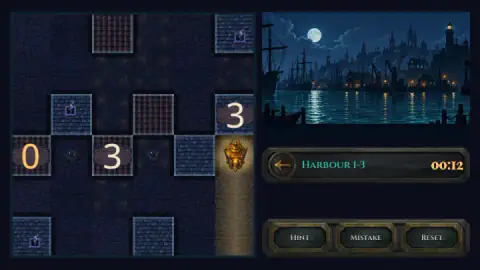
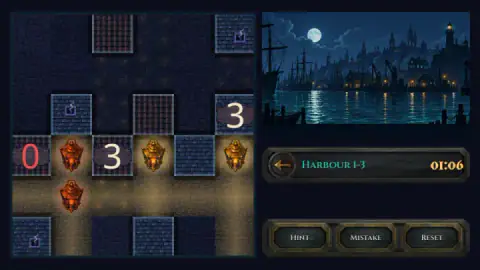
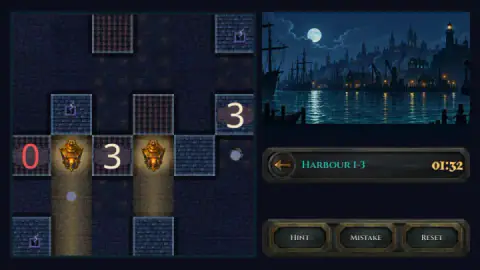
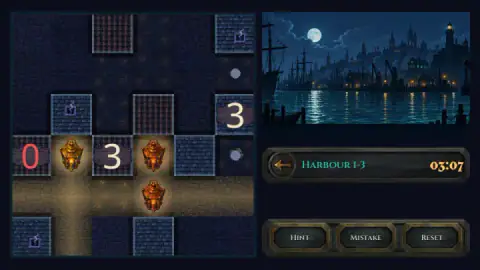
Taken by opening the game ourselves and letting it run — not supplied by the publisher, and not the same picture every other site shows.
How to play Lanternward
- Pick a district, then a puzzle. The district list opens with Harbour, with Market under it. Harbour shows a grid of numbered tiles, each with four small stars and an empty best time.
- Click a dark street square. A lantern appears and a warm strip of cobbles lights up along its row and column. The light stops at the first roof it meets in each direction.
- Click the lantern again to turn it into a dot. The dot is a note to yourself that no lantern belongs there. A third click empties the square. The game's own instructions add that holding the button marks a dot straight away.
- Obey the numbers. A numbered roof wants exactly that many lanterns on the squares touching its four sides. Diagonals do not count.
- Light every street square without letting two lanterns see each other.
Things we only understood after getting them wrong:
- Start from the 0, not from the biggest number. A 0 tells you where lanterns cannot go, and that is information you can use on every roof next to it. We ignored ours and paid for it all session.
- Read the colour of the numbers. Our 0 was gold while nothing stood beside it and red once a lantern did. Both 3s stayed white because we never completed them. Gold, red and white are the game marking your work as you go.
- Red lanterns come in pairs. When we stood one lantern directly under another, both went from gold to a darker red. The game does not say which of the two is wrong, only that they cannot both stay.
- A lit row can still be a wrong row. One of our lanterns lit an entire row of six squares at once. It looked like progress. It was also one of the two red ones.
Controls
| Click a street square | Places a lantern, which lights its row and column as far as the nearest roof |
|---|---|
| Click the same square again | Swaps the lantern for a dot that means "no lantern here"; a third click clears the square |
| Hold the mouse button | Marks a dot directly, according to the game's own instructions; we did not try it |
| Hint / Mistake / Reset (under the clock) | Mistake opened a card offering to mark wrong lanterns for one star and a short ad; we did not press Hint or Reset |
Features
- Light Up rules in a night city, where roofs are the walls and lanterns are the bulbs
- A number that turns gold when it is satisfied and red when a lantern breaks it
- Lanterns that turn red when two of them stand in the same open line
- A three-step click on every square, lantern, dot, empty, so you can note where a lantern cannot go
- A clock that counts up from zero, with no countdown and no way to lose on time
- Districts with a star counter each; Harbour, the first, shows 120 stars to earn
- Made by Morass Games, listed since September 2026
Game details
- Developer
- Morass Games
- Release date
- September 2026
- Last updated
- September 23, 2026
- Added here
- September 2026
- Technology
- HTML5
- Platforms
- Browser (desktop, mouse)
- Saved progress
- Saving, when available, is managed by this game. Mava cannot confirm your level.
FAQ
How do you play Lanternward?
Click a dark street square to place a lantern. It lights its whole row and column until a roof stops the light. A puzzle is solved when every street square is lit, no lantern shines on another, and each numbered roof has exactly that many lanterns on the squares touching its sides.
Is Lanternward the same as Light Up or Akari?
It uses the rules of Light Up, the logic puzzle published by the Japanese company Nikoli and also called Akari. Lanternward swaps the black cells for rooftops and the light bulbs for street lanterns, and adds colour signals that show when a number or a lantern is wrong.
What do the numbers on the roofs mean in Lanternward?
A number says how many lanterns stand on the squares directly above, below, left and right of that roof. A 0 means none of those squares may hold a lantern. In our session the 0 was gold while it was respected and turned red as soon as we put a lantern beside it.
Why did my lantern turn red in Lanternward?
Because another lantern can see it. Two lanterns in the same row or column with no roof between them break the rule, and the game colours both of them red. Move one, or find the roof that should stand between them.
Is there a time limit in Lanternward?
No. The clock starts at zero and counts up. We let it pass three minutes on one puzzle and nothing happened. The game's own description says the time decides how many of the four stars you earn.
Does Lanternward have ads?
The game's description says the browser edition shows none. In our session the Mistake button opened a card that offered a short ad in exchange for marking the wrong lanterns, at the cost of one star. We pressed Cancel and saw no ad anywhere else.
How many levels does Lanternward have?
The game's description says 300 puzzles in 10 districts, on boards from 6x6 to 14x14, plus an endless mode. We saw two districts on the menu, Harbour and Market, and played a single 6x6 Harbour puzzle, so we cannot confirm the total.
Who made Lanternward?
It is credited to Morass Games. It was published on 22 September 2026 and updated a day later. When we looked, too few to mean much yet.