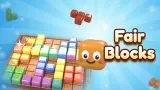
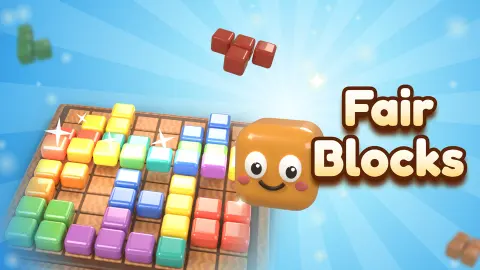




About Fair Blocks
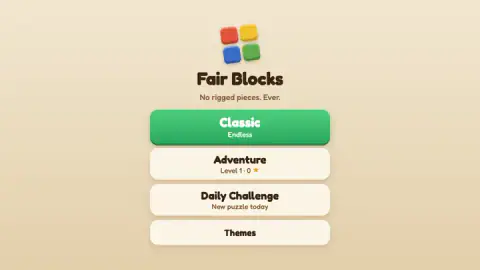
Every block puzzle with a tray of three pieces has the same quiet suspicion around it. When the board is nearly full and the game deals you three shapes that fit nowhere, was that bad luck, or was it chosen? Fair Blocks answers before you ask. Under the logo on its main menu, in small brown letters, it says No rigged pieces. Ever.
The rest is deliberately familiar. A wooden board of eight by eight cells, three pieces waiting on the right, and one rule: fill a whole row or a whole column and it clears. The pieces do not turn. Whatever facing an L or an S arrives in, that is the facing you have to place it in, and that one restriction is where most of the thinking happens.
Fair Blocks is credited to a developer named ajiri and was published on 24 October 2026. We played one short session with a mouse: part of the first Adventure level, where we did not reach the goal, and a Classic game that we left at 8 points before clearing a single line. So this page tells you how the game works and what the screen showed, and says plainly where the provider's description takes over.
A level with a budget: how Adventure differs from Classic
Classic is the version most people know. There is no goal and no limit, just a score at the top and your BEST under it, and the round lasts as long as your pieces keep fitting.
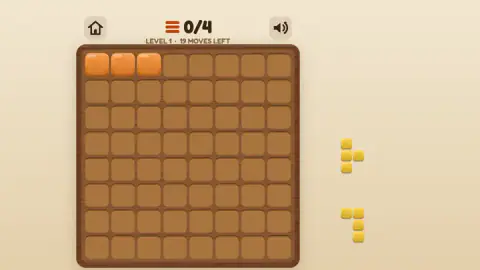
Adventure turns the same board into a puzzle with a budget. The first level showed 0/4 beside the lines icon and LEVEL 1 · 20 MOVES LEFT underneath: four lines to clear, twenty pieces to do it with. That changes how you play. In Classic a piece dropped in a corner is free; in Adventure it is one of your twenty, so every drop should be building towards a line.
The provider says later levels ask for other things, score, gems or stones, and that the trail runs through forests, caves and snowy peaks with a companion called Block Buddy. We stayed on level 1 and never saw any of that, so treat it as the game's description, not our report. The menu does keep a star count next to your level, which suggests each level is graded as well as passed.
One point per square
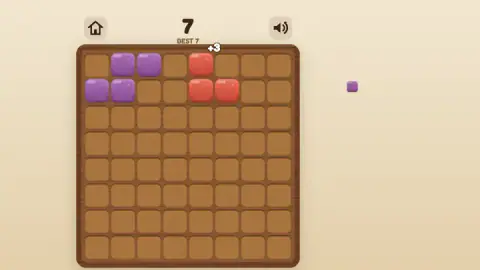
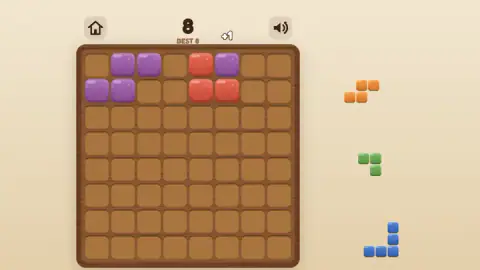
The scoring in Classic was the clearest thing on screen. We placed a purple four-square S and the score read 4. A red three-square L followed and a small +3 popped up over it, taking the score to 7. A single purple square added +1, and the score read 8, with BEST 8 under it.
So in our game every square that landed on the board was worth one point. That has a practical side: big pieces are not only awkward, they are also the ones that pay most just for fitting. What a cleared line or a combo is worth we cannot tell you, because we never completed one. The provider's description promises combos for chained clears.
Why the pieces have names older than video games
Every shape in the tray is a polyomino: squares joined edge to edge. The word was coined in 1953 by the American mathematician Solomon Golomb, in a talk to the Harvard Mathematics Club that was published the following year. He built it from domino, the two-square piece, so a three-square piece is a tromino, four squares make a tetromino and five a pentomino. The shapes are older than the name. The puzzle writer Henry Dudeney put a full set of the five-square pieces into a puzzle in his book The Canterbury Puzzles in 1907.
Mathematicians count these shapes two ways, and the difference is exactly what Fair Blocks plays with. If you may turn and flip a piece, there are only five different four-square shapes and twelve five-square ones. If you may not, every facing counts as its own piece, and the four-square shapes alone grow to nineteen.
That is the real effect of the no-rotation rule. In a game where you can turn pieces, an L is an L. Here, the L you need may come in the wrong facing three trays in a row, and the skill is keeping enough different gaps open that some facing of each shape still fits. The pieces we saw ran from a single square up to five-square bars and a five-square corner, so the game uses the whole family from one to five.
What we did not see
We did not clear a line, finish Adventure level 1, open the Daily Challenge or the Themes menu, or reach a game over. We cannot confirm the No rigged pieces promise either: checking it would take many full games and a close look at how often the deals leave you stuck, not eight points of Classic. We played on a computer, so the touch controls are the provider's description.
Who it is for
Fair Blocks is calm. There is no timer we met, the colours are soft wood and bright glossy blocks, and the menu is four plain buttons. Younger players can manage Classic as soon as someone shows them that pieces do not turn. Adventure, with its move budget, is the better test for players who already know the genre and want each drop to count.
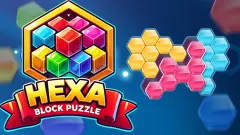
If you like this kind of board, Block Master Gem Puzzle uses the same 8x8 grid with gem pieces and a move-limited mode, and Block Puzzle: Jewel Block deals three pieces at a time with one-use helpers for a crowded board. Wood Block Journey moves to a 9x9 grid where 3x3 boxes clear as well, and Hexa Block Puzzle keeps the no-rotation rule on a honeycomb. More are in puzzle games.
Screenshots
How to play Fair Blocks
- Pick a mode. The menu has four buttons: Classic (marked Endless), Adventure (it shows your level and stars), Daily Challenge (marked New puzzle today) and Themes.
- Drag a piece onto the board. The first Adventure level even says so on a dark label: Drag a piece onto the board. A piece only stays if every one of its squares lands on an empty cell.
- Fill rows and columns. A full row or column clears. In Adventure that is what the counter at the top tracks, next to a small icon of stacked lines.
- Use all three pieces. The tray does not top up after each move. It refills with three new pieces only after you have placed the last one.
- Watch the end. The instructions say the game is over when none of the pieces in your tray fits anywhere, and in Adventure when the moves run out before the goal.
Tips from our session:
- Every placement in Adventure costs a move, even one that clears nothing. Our first piece took the counter from 20 to 19, so a level of 20 moves is really 20 pieces.
- Look at the facing before you drag. We spent several drops trying to push a yellow L into a gap it could only fill the other way round, and each time it went back to the tray. Since nothing rotates, find the gap that matches the shape.
- Keep a long gap open. The trays we saw included bars of four and five squares, and those are the pieces that end games when every row is broken up.
- Do not hunt for a rotate key. There is none: the screen has a home button, a sound button, the board and the tray.
Controls
| Drag with the mouse | Pick a piece from the tray on the right and drop it on the board. It stays only if every square lands on an empty cell |
|---|---|
| Drag with a finger | The same on a phone or tablet, per the game's instructions. We played with a mouse |
| Home button (top left) | Back to the main menu with the four modes |
| Speaker button (top right) | Sound on or off |
Features
- A wooden 8x8 board and a tray of three pieces on the right; the tray refills only when all three are placed
- Pieces cannot be turned, so every facing of an L or an S arrives as a different piece
- Shapes from a single square up to five-block bars and corners
- Classic is endless and keeps your BEST under the score; each square you put down was worth one point in our game
- Adventure gives each level a goal and a move budget: level 1 asks for 4 lines in 20 moves
- A Daily Challenge with a new puzzle every day, and a Themes menu for the look of the board
- The menu's own promise, printed under the logo: No rigged pieces. Ever.
Game details
- Developer
- ajiri
- Release date
- October 2026
- Last updated
- October 25, 2026
- Added here
- October 2026
- Technology
- HTML5 (2D)
- Platforms
- Browser (desktop), Browser (mobile & tablet, touch)
- Saved progress
- Saving, when available, is managed by this game. Mava cannot confirm your level.
FAQ
How do you play Fair Blocks?
Drag a piece from the tray on the right onto the wooden 8x8 board. Fill a whole row or a whole column and it clears, which frees room for more pieces. The tray holds three pieces and only refills when all three have been placed.
What does No rigged pieces mean in Fair Blocks?
It is the game's promise, printed under the logo on the main menu. The provider's description says the pieces are never rigged, meaning the game does not hand you shapes chosen to make you lose. We could not test that in a short session, so take it as the developer's claim.
Can you rotate pieces in Fair Blocks?
No. The game's instructions say pieces cannot be rotated, and in our session each facing of an L or an S came as a separate piece in the tray. Plan where each shape fits as it is, and leave room for long bars.
How does scoring work in Fair Blocks Classic?
In our game every square we put down added one point: a three-block piece showed +3 and a single square showed +1, taking us from 7 to 8. Your best score sits under the current one as BEST. We did not clear a line, so we cannot say what a clear or a combo adds.
How do you beat a level in Fair Blocks Adventure?
Each level shows a goal and a move counter at the top. Level 1 asks for 4 lines with 20 moves, and every piece you place costs one move. According to the instructions, later goals can also be score, gems or stones, always within the move limit.
What is the Daily Challenge in Fair Blocks?
It is the third mode on the menu, labelled New puzzle today. The provider says it is the same puzzle for every player each day. We did not open it in our session.
When is it game over in Fair Blocks?
According to the game's instructions, the game ends when none of the pieces in your tray fits anywhere on the board. That is why it pays to keep an open three-by-three area and a free row or column for the long bars.
Who made Fair Blocks?
The developer is listed as ajiri, and the game was published on 24 October 2026. It is a free browser game that runs on computers and, according to its instructions, on phones and tablets by touch.