






About Akagram
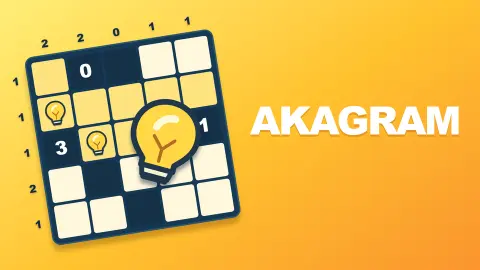
Most light-up puzzles give you walls with numbers on them and nothing else. Every deduction has to come from those few dark squares, and the rest of the board is a blank you light up by elimination. Akagram keeps every one of those rules and then prints a second set of clues around the outside of the grid: a number for each row and each column, telling you how many bulbs belong there.
That changes how a board opens up. On the first level we played, one column is marked 0, so three of its squares are out of the game before you place a single bulb. You are reading the board from two directions at once, the way you would in a nonogram, while the light rules of the original puzzle still apply.
The game is by CoaCrea. It was published in September 2026, and when we played it the rating.
Two clue systems on one board
Classic light-up has one source of information: numbered walls. Unnumbered walls only block light, and they tell you nothing about where bulbs go. That is why classic boards can be slow to start. You hunt for the one wall whose number forces a move.
Akagram's edge totals work differently. They count bulbs anywhere in the line, not next to a particular wall, so they are less precise but cover the whole board. The interesting part is how the two systems combine. A wall number tells you which squares are candidates. A line total tells you how many of those candidates in a row or column can actually hold a bulb.
There is one trap in that combination. The edge totals count bulbs, not lit squares. A row can be fully lit by a bulb standing in another row and still need a bulb of its own, because its total says so. The reverse catches people too: a line with its total met can still be dark in places. When a board looks finished but is not, check the totals before the walls.
Light Up, the Japanese puzzle underneath
The rules underneath Akagram are not new. The puzzle is known in English as Light Up and in Japanese as Akari, which means "light", or as bijutsukan, "art gallery". It is published by Nikoli, the Japanese puzzle company that gave sudoku its name. The gallery name fits the picture: rooms and corridors, with lamps placed so that every corner is seen and no lamp glares into another.
Light Up is harder than it looks, and that has been proved. In 2005, Brandon McPhail showed that deciding whether a Light Up board can be solved at all is NP-complete, a computer-science label for problems with no known shortcut. In plain words, no single trick cracks every board; on big ones you end up reasoning case by case.
That is exactly why the extra row and column totals matter. They do not change the rules of light, but they hand you more starting points, so a board can be solved by steady deduction instead of guessing. We read the name Akagram as Akari crossed with nonogram, though the developer does not say so anywhere we could find.
What the colours are telling you
Akagram checks your board as you play, and it does it by changing the colour of each clue.
- White on a wall, or dark at the edge, means the clue still needs bulbs.
- Grey means the clue is met right now.
- Red means the clue is broken.
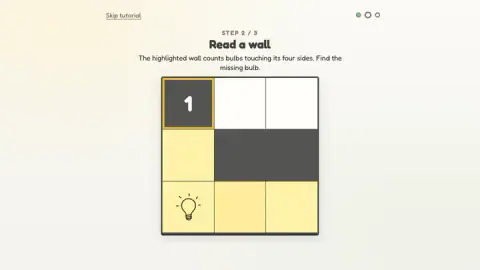
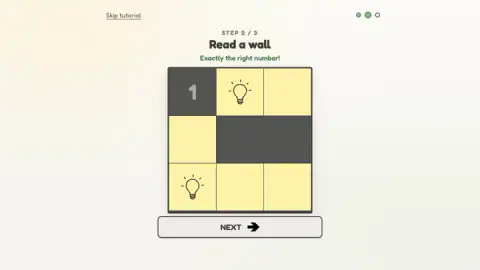
The tutorial shows the friendly side of this. On its second step, a 3x3 board with a single wall marked 1, we placed the missing bulb, the 1 faded to grey and the game said "Exactly the right number!".
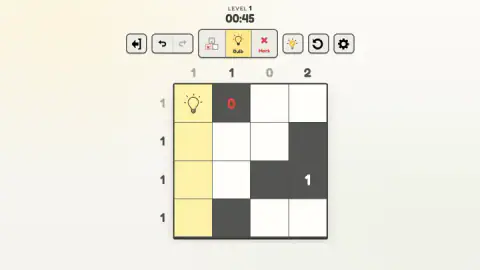
Level 1 showed the other side. Our first bulb went into the top-left corner, next to the wall marked 0, and the 0 went red at once.
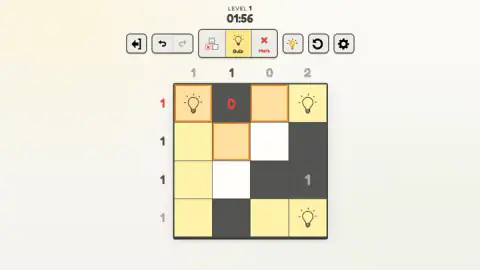
When rules collide, the game also outlines the squares involved in orange. At one point, with our bulb still beside the broken 0, the three squares around that wall were outlined. Later, when we put a second bulb in the same column as the first, with no wall between them, both bulbs turned red and the column was outlined from one to the other.
The upshot is that a mistake in Akagram does not stay hidden for long. The only thing it will not do is undo it for you.
Our run, and the board we should have solved
Level 1 is a square grid, four by four, with five walls. Only two carry numbers: a 0 in the top row and a 1 on the right-hand side.
Every row asks for exactly one bulb. The columns ask for one, one, none and two. The clock in the top bar counts up, and ours had passed two and a half minutes when we stopped.
We did not solve it. The bulb next to the 0 stayed where we had put it, and by the end the board held five bulbs, two of them clashing, with the top row, the first column and the empty column all showing red. Every white square was lit, which is the trap: a lit board is not a solved board.
Afterwards we worked the same grid through on paper, and it falls in four steps.
- The 1 on the right wall has only one white neighbour, the bottom-right square, so a bulb goes there.
- The last column asks for two bulbs and has only two white squares, so the top-right square takes the other.
- Row two cannot use the square under the 0 or the empty column, so its bulb goes in the first column.
- Row three's bulb then has to be in the second column, since the first column is full.
Four bulbs, every square lit, every clue grey. That is our deduction from the board, not something we watched the game accept, and we cannot promise level 1 is the same board for every player.
More logic puzzles to try
CoaCrea's other game in our catalogue is Up, Up, and Oops!, a fast arcade climb rather than a puzzle. If it is the row and column clues you enjoy, Nonogram and Grid Odyssey: Nonograms are puzzles made of nothing but those. For a calmer number grid, Relaxing Sudoku and Futushiki pairs sudoku with greater-than signs. The rest are in our puzzle games.
Screenshots
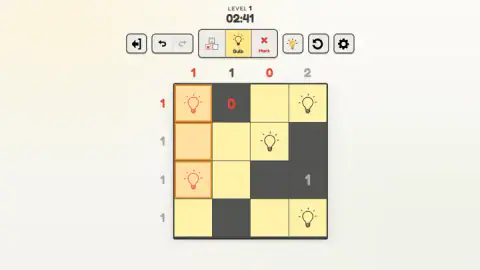
Taken by opening the game ourselves and letting it run — not supplied by the publisher, and not the same picture every other site shows.
How to play Akagram
- Pick the Bulb tool in the toolbar above the board (it is selected when the level opens) and click a white square to place a bulb.
- Watch the light: it runs along the row and the column, lighting squares pale yellow, and stops at the first dark wall.
- Read the walls. A number on a wall is the exact count of bulbs touching its four sides; diagonals do not count.
- Read the edges. The numbers above the columns and beside the rows are the bulb count for that line.
- Light every white square without any bulb shining on another, and with every number met.
Tips from our run:
- Start with the zeros. A wall marked 0 bans its neighbours, and a row or column marked 0 bans all its squares. On our first board those two clues alone removed five of the eleven white squares.
- A number turning grey means "met for now", not "solved". The 0 clues are grey on an empty board, and we turned one red with our very first bulb.
- Use undo rather than clicking around. It sits to the left of the tool selector and lights up as soon as you have made a move.
- If two bulbs turn red together, they can see each other. Look along the line between them for a wall that is not there.
Controls
| Click or tap a white square (Bulb tool) | Places a bulb, whose light runs along its row and column until it meets a wall |
|---|---|
| Mark tool (red cross) | Lets you cross out squares where you think no bulb belongs; we did not use it |
| Undo and redo arrows | Step back or forward through your moves; undo stays greyed out until you have made one |
| Circular arrow | Restarts the puzzle, according to the game's instructions; we did not press it |
Features
- Every white square has to be lit, and no bulb may shine on another bulb along a row or column
- Dark walls block light, and a number on a wall says exactly how many bulbs touch its four sides
- Numbers outside the grid give the bulb count for each row and column, a rule the classic puzzle does not have
- Clues turn grey while they are met and red the moment you break them, so a mistake shows up at once
- Two bulbs that see each other both turn red, with the squares between them outlined
- A three-step tutorial comes first, on a small 3x3 board in the step we played, and it can be skipped
- The first level is a 4x4 grid with five walls and a clock that counts up, not down
Game details
- Developer
- CoaCrea
- Release date
- September 2026
- Last updated
- September 23, 2026
- Added here
- September 2026
- Technology
- HTML5 (2D)
- Platforms
- Browser (desktop, mouse), Browser (mobile & tablet, touch)
- Saved progress
- Saving, when available, is managed by this game. Mava cannot confirm your level.
FAQ
How do you play Akagram?
Click a white square to put a bulb on it. Its light travels along the row and the column until it reaches a dark wall. You win by lighting every white square while meeting every number on the board, with no bulb shining on another.
What do the numbers mean in Akagram?
There are two kinds. A number on a dark wall counts the bulbs touching that wall on its four sides, never diagonally. A number outside the grid counts how many bulbs sit in that row or column, wherever they are.
Why did a number turn red in Akagram?
Red means that clue is broken right now. A wall turns red when too many bulbs touch it, and a row or column total turns red when it holds more bulbs than it asks for. Grey means the clue is met at the moment. Two bulbs that shine on each other also turn red.
Is Akagram the same as Light Up or Akari?
It uses the full rules of Light Up, the logic puzzle also known as Akari, published by the Japanese company Nikoli. Akagram adds bulb totals for every row and column, which gives you a second way to rule squares in or out.
Is there a time limit in Akagram?
Not in the first level we played. The clock above the board counts up from zero, so it measures how long you take rather than ending the game. The listing also mentions a timed mode, which we did not reach.
Did you solve Akagram?
Not in our run. We finished the tutorial step on walls, skipped the last step, and left level 1 unsolved after a little under three minutes, with a bulb in the wrong corner that we never took back. We later worked out the four-bulb answer to that board on paper.
Who made Akagram?
Akagram is made by CoaCrea. It was published in September 2026.
Can you play Akagram on a phone?
The game is listed as playable on phones and tablets, and it only needs single taps on squares and buttons. We played it on a computer with a mouse and did not test it on a touch screen ourselves.