


About Grid Hole Master
In almost every block puzzle ever made, the floor is the one thing you never think about. It is at the bottom. It stays at the bottom. Grid Hole Master takes that away in the first minute.
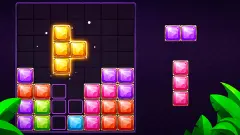
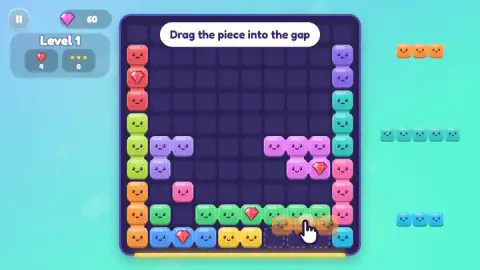
The board is a grid of ten cells by ten, dark purple, and around its edges sit rounded blocks that each have a tiny face on them. Three pieces wait in a tray beside it. You drag one on, fill a whole row or column, and the row vanishes — so far, this is every block puzzle you have played. Then the blocks left behind start to move, and they do not move down. They slide sideways, toward a bar of gold light running along one edge of the board. That bar is the floor. The game calls it the glowing wall.
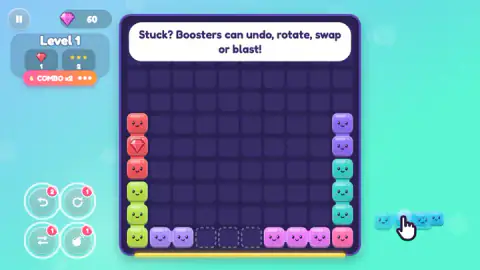
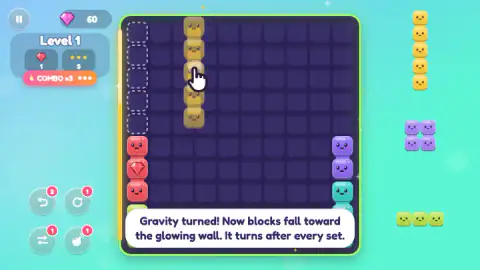
It also moves. Between our first two screenshots and the last two, the gold bar left the bottom of the board and reappeared down the left-hand side, and the game put the reason on screen in plain words: "Gravity turned! Now blocks fall toward the glowing wall. It turns after every set." A stack you built as a safe base is now a wall at right angles to the only direction that matters.
One thing before the rest. Our session ran about ten minutes and sixty-odd moves, and in all of it we never got past Level 1. We cleared lines, set chains off, took the ruby counter from four down to one and watched the wall swing a quarter turn. We did not finish the level.
The floor is one edge of the board, and it moves
Here is what actually changes when gravity stops pointing down.
In an ordinary block puzzle the grid is a bucket. You stack upward, the pile grows toward you, and the only question is whether the next piece fits the dents you left. Nothing rearranges itself.
Grid Hole Master breaks that twice over. The board compacts after every clear, so the shape in front of you is never the shape you built — it is the shape the fall left behind. And the direction of that fall is not a constant, so one arrangement of blocks has two completely different futures depending on which edge is lit.
Picture a column of five blocks in the middle of the board. With the gold bar underneath, that column is a tower: solid, settled, dependable. Move the light to the left-hand edge and those same five blocks are a row lying on its side, sliding toward the wall and landing somewhere you did not plan. Nothing about the blocks changed. The question the board is asking did. It is also why, in all four of our captures, the loose blocks had ended up hugging the two sides.
The game's own listing says the wall works through all four sides in turn — down, left, up, right. We only ever saw two of them, so the full circuit is its claim rather than our report.
The pieces do not turn, and that is a bigger rule than it looks
The booster in the bottom left corner with the curved arrow on it is the rotate button, and the red badge on its shoulder read 1. One rotation. After that, a piece is whatever orientation it arrived in.
That sounds like a small meanness. It is the whole difficulty setting, and there is a number behind it that mathematicians worked out long before anyone put faces on blocks.
Shapes made of squares joined edge to edge have a name — polyominoes — coined by Solomon Golomb in a talk at Harvard in 1953 and written up for the American Mathematical Monthly a year later. The five-square ones, the pentominoes, are what everybody has met in a puzzle box, and the count always quoted is twelve.
But twelve is only the count if you may turn the pieces over and around. Rotate them but never mirror them, and the set grows to eighteen. Forbid both, so that every piece is stuck in the orientation it was handed to you, and the same family of shapes becomes sixty-three separate objects to keep track of.
That is the problem Grid Hole Master sets you. A three-block bar lying flat and a three-block bar standing on end are not one piece you may turn; they are two pieces, and which you get is not up to you. Our screenshots show both kinds waiting in the tray — flat bars in one, upright columns in another, and a two-by-two square, the only shape here for which the question is moot. So the skill is not finding a gap for the piece you want. It is reading the gap you have against the piece you were dealt.
Four counters, and what each one did
The top left corner keeps a small stack of numbers, and they do not all behave as you would expect.
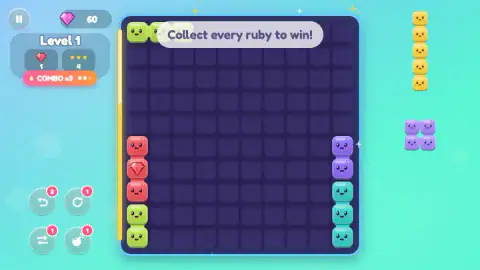
The ruby counter is the honest one. It is the level goal, confirmed by the banner that appears partway through — "Collect every ruby to win!" — and it counts down rather than up. Ours opened at four and sat at one for the rest of the session: three came loose early, almost by accident, while we were still learning which way things fell.
The diamond counter at the very top, a pink gem with a number beside it, is the purse, and it never moved. Sixty at the start, sixty at the end, sixty in every screenshot. We never found what it buys, because we never spent it.
The combo pill only shows up when one clear knocks something into another. It arrived as an orange badge with a flame on it reading COMBO x2, reached x3 later on, and carries three small dots beside the number. In our final capture one of those dots had gone dim, which is the game quietly telling you the multiplier is not yours to keep.
And then the tile with three gold stars, which is the one we cannot explain. The number under those stars climbed from nothing to two, then three, then four. Four is more than three, so whatever it counts, it is not stars earned out of three, and we would rather say that than invent a meaning.
What we never saw
The ledger, because it is short and it matters.
We never finished the first level, so we never saw the second, never met a boss, and cannot vouch for the hundred levels across five worlds the game's listing promises. We saw rubies; the listing also describes sapphires, emeralds and ice to break, and none appeared. We saw the wall at the bottom and at the left, not at the top or the right. We never used a booster, never spent a diamond, never ran out of room, and never opened the shop, the themes or the languages. We played with a mouse on a wide screen, so everything above about a phone is the listing talking rather than us.
What we can say is that the first level does its job unusually well. It hands you one rule at a time, in its own words, on a white banner that waits until you have done the thing before moving on — the gap, the chain, the gravity, the boosters, the goal. Five sentences, and by the end a nine-year-old knows the whole game.
More block puzzles to try
For the same grid with the floor nailed down where it belongs, Block Puzzle King is the straight version of this idea and makes a good control experiment. Block Combo Blast is the closest relative in our catalogue, pairing the same line-clearing with gems to dig out. ADHD Tetris is the opposite pole, where rotating is free and gravity never once changes its mind, and Block Blast is the plainest form of the genre. The rest are under puzzle games.
Screenshots
How to play Grid Hole Master
- Take a piece from the tray. On a wide screen the three pieces sit in a column to the right of the board.
- Look for the dotted cells. Empty squares the game wants filled are drawn as dotted outlines, and its first instruction is "Drag the piece into the gap".
- Complete a row or a column. Ten in a line, any colours, and the line goes.
- Watch where everything falls. The survivors slide toward the glowing edge, and if they land completing another line, that one clears too and the combo pill counts it.
- Collect what the level asks for. Ours wanted rubies, which sit inside ordinary blocks and come loose only when the line holding them clears.
What only sitting in front of it teaches:
- Check the gold bar first. Where it is decides which way your leftovers travel, and a row built parallel to it behaves nothing like a row built across it.
- You cannot turn a piece, so stop trying. Rotation is a booster with a number on it, not a key. The bar you were handed is the bar you place.
- The tray empties, and that is the clock. Three pieces, then a fresh three — by our last screenshot only two were left. The wall turns when the set runs out.
- A chain is worth more than a clear. The game says so itself — "Blocks fall after a clear. Chains score big!" — and one drop paid us a combo of two with a +25 attached.
Controls
| Click and drag, or a finger on a touchscreen | Lifts a piece out of the tray beside the board and drops it on the grid. This is the whole game, and it is the only control we used |
|---|---|
| 1, 2 and 3 | Pick the first, second or third piece in the tray without reaching for it, per the game's listed controls |
| Arrow keys, then Space or Enter | Slide the chosen piece around the grid and set it down. Declared by the game rather than something we leaned on |
| Z and R | Undo your last move and rotate the piece you are holding. Both also exist as buttons in the corner, and both have a number on them |
| Esc or P | Pause. The same thing sits as a round button in the very top left corner of the screen, next to the diamond counter |
Features
- The board is ten cells across and ten deep, and the pieces arrive three at a time in a tray beside it
- One edge of the board glows gold, and that edge is the floor: clear a line and everything still standing slides toward it
- The glowing edge changes side. In two of our captures it lay along the bottom of the board; in the other two it ran down the left
- Pieces come in the orientation they come in. Turning one is a booster with a number on it, sitting beside undo, swap and a bomb
- Level 1 is a guided tutorial that writes each new rule on screen as it arrives, from 'Drag the piece into the gap' to 'Collect every ruby to win'
- The thing you are chasing is rubies set inside ordinary blocks, not a score: our counter started at four and was down to one by the end
- A clear that knocks other blocks into new lines raises a combo pill, and we got it as high as three
Game details
- Developer
- Partner studio
- Release date
- October 2026
- Last updated
- October 25, 2026
- Added here
- October 2026
- Technology
- HTML5 (2D)
- Platforms
- Browser (desktop), Browser (mobile & tablet, touch)
- Saved progress
- Saving, when available, is managed by this game. Mava cannot confirm your level.
FAQ
How do you play Grid Hole Master?
You drag pieces out of a tray and drop them onto a ten-by-ten grid, filling a whole row or column to clear it. What makes it its own game is what happens next — the blocks left behind do not stay where they were, they fall toward the one edge of the board that is glowing, and if they land in a way that completes more lines, those clear too. The level is over when you have collected everything it asked for.
What is the glowing wall in Grid Hole Master?
It is the floor, drawn as a bar of gold light along one edge of the board. After a clear, every loose block falls toward it, which is why a chain is possible at all. It does not stay put, either — the game says in its own words that it turns after every set of pieces, and across our four captures it moved from the bottom of the board to the left-hand side.
Can you rotate the pieces in Grid Hole Master?
Not for free. Rotation is one of the four boosters in the bottom left corner, and the badge on it read one, so it is a thing you spend rather than a key you lean on. A bar lying flat and a bar standing on end are two different pieces here, and you plan around the one you were given instead of turning it to suit the gap.
What are the boosters in Grid Hole Master?
There are four, drawn as round buttons in the bottom left corner, and the game introduces them with a line of its own — "Stuck? Boosters can undo, rotate, swap or blast!" Each carries a small red badge with a number on it. In our session the undo badge read two and the other three read one each. We never spent any of them, so we cannot tell you whether they refill, or how.
How many levels does Grid Hole Master have?
The game's own listing promises a hundred levels spread across five worlds, with a harder stage every fifth one and a boss closing each world. We cannot confirm any of that, because we never finished the first level. Everything in this sheet comes from level one, which is a guided tutorial that teaches the whole rule set in a single sitting.
What do you have to collect to finish a level in Grid Hole Master?
In the level we played it was rubies — red gems set inside otherwise ordinary blocks, which drop into your total when the line holding them clears. The game states the goal outright partway through, in a banner reading "Collect every ruby to win!" The counter at the top left tracks how many are still on the board, and ours fell from four to one.
Does Grid Hole Master work on a phone?
The game lists mouse and touch as equal ways to play, and the whole thing is drag and drop, so there is nothing a finger cannot do that a mouse can. Our session was played on a computer at a wide screen size, where the three waiting pieces sit in a column to the right of the board. We have not checked how that tray is arranged on a narrow phone screen.
Is Grid Hole Master free, and who made it?
It is free and runs in a browser with nothing to install. The studio behind it is not recorded anywhere we can check, so this sheet names no author rather than guessing one. It reached our catalogue on 24 October 2026, which makes it a new title at the time of writing rather than something from the back catalogue.