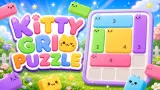









About Kitty Grid Puzzle
Kitty Grid Puzzle gives you the whole rule in one line, and the line stays on screen while you play: draw a rectangle around each number, matching its cell count. A 3 wants a room of three cells. A 4 wants four. Nothing is hidden, nothing is unlocked later. We still spent ten minutes on a board of nine squares and walked away without finishing it.
What beat us is not the part you would expect. The game is strict about size and says so immediately: drag across the wrong number of cells and the colour under the cursor simply goes out, and the board is grey again. It is generous about everything else. Draw a two-cell room around a 2 and it is accepted on the spot, a cat moves in, and the move is done — even when that particular two-cell room has just made the rest of the board impossible. The game is not a hand that slaps yours. It is one that says yes to the move that already cost you the level.
Under the cats this is Shikaku, a paper logic puzzle from Japan: cut a grid into rectangles so that each one holds a single number and covers exactly that many squares. Everything else here is costume, and the costume is good.
Kitty Grid Puzzle is by Drivix Games. It was published in July 2026. We have now played it twice on a desktop. Both times we cleared the first two tutorial boards and both times we got stuck on the third, so this page covers the rules and the opening in detail, and says plainly where our knowledge stops.
A room only sticks when the count is right
This is the part worth knowing before you start, and we had it wrong ourselves after our first session.
While the button is down, the cells you cross fill with a soft colour. That looks like a placed room, and it is not — it is a preview. We dragged a block of six cells across the third tutorial board over and over, watched it light up in yellow one time and orange the next, let go, and each time the board came back completely grey. Nothing is kept unless the count matches.
When the count does match, the change is unmistakable. The rectangle stops being a rectangle and becomes a cat: ears pushing out of the leading edge, two closed sleepy eyes at the far end, the number still printed across its middle, and a short burst of sparkles as it settles. A three-cell room drawn sideways is a long flat cat. The same three cells drawn downwards is a tall thin one.
The colour means nothing, and it is worth saying because it looks as though it should. The very same three-cell room on the first board came out yellow one time and purple the next. The two-cell room on the third board was green. Do not read the colours as a hint; read the count.
There is also nothing chasing you. We found no clock, no move counter and no lives on any board, and ten minutes on three small grids never triggered anything. Get a room wrong and you lose the drag, and that is the entire penalty.
The 2 that quietly locks the board
The third tutorial is a grid of three by three with a 2 at the top centre, a 3 at the middle right and a 4 in the bottom left corner. The three numbers add up to nine, and the grid has nine cells, so every cell belongs to a room and the sizes are fixed.
Our first move was to give the 2 a vertical pair: its own cell and the one directly below it, down the middle column. Two cells for a 2. The game accepted it without hesitation and a green cat moved in.
That move ends the level, and it takes a minute with the board to see why. With the centre cell gone, the only three-in-a-line that still reaches the 3 is the whole right-hand column. That leaves the 4 with the two left-hand cells and the bottom middle one — four cells in an L, and an L is not a rectangle. The board is dead, the cat is sitting there looking pleased, and nothing on screen says a word.
The solution we worked out, which we have still not tested in the game, runs the other way round:
- The 4 must be the two-by-two block in the bottom left, because a line of four does not fit on a board three cells wide.
- The 3 takes the whole right-hand column, the only line of three left that reaches it.
- The 2 takes the top row's two left-hand cells, which is all that remains.
So the 2 wanted to go sideways, not down. Both shapes satisfy its number; only one satisfies the board.
Shikaku, the paper puzzle under the cats
Shikaku was first published in 1989 by Nikoli, a Japanese puzzle publisher. Its original name is Shikaku ni Kire, and in English it also goes by Divide by Box.
The rules of the paper puzzle are exactly the ones these three tutorials teach: each rectangle holds one number, and the number is the rectangle's area. What Kitty Grid Puzzle adds is a reason to care about the rectangle after you have drawn it. On paper you pencil a box and move on. Here the box becomes a cat with a face, stretched to the shape you chose, and the win screen gathers them all on a white plate.
Knowing the name is useful beyond the trivia. If you get stuck, any guide to Shikaku applies to this game word for word, and the standard opening is the one above: place the numbers that can only sit one way, and let them squeeze the rest.
What we have not seen
Any board past the third tutorial. We do not know how many levels there are, how large the grids get, or whether later boards add anything to the one rule. The game's own instructions promise they get harder; we cannot confirm it.
We did not open the gear menu, and we did not press the skip button at the top right. It carries a small video badge, which we read as a level skip in exchange for a clip, but we have not tried it.
We have only played with a mouse. The game is listed for phones and tablets, where every drag would be a finger swipe, and we have not tested that ourselves.
Who it is for
People who like sudoku, nonograms and other pencil puzzles and want one with no clock attached. It also suits a child who is learning multiplication, because every room is a small area sum with a visible answer: a 4 is two by two or one by four, and nothing else.
It is not for anyone who wants to be told when they have slipped. This game checks one thing, checks it instantly, and stays quiet about everything that matters more.
More logic puzzles on a grid
Nonogram is the closest relative we have: number clues again, but you paint squares to make a picture. Lanternward and Akagram are two takes on Light Up, where numbered walls tell you how many lamps touch them. Binary Drop swaps the grid for rows of lights worth 4, 2 and 1. The rest are in the puzzle games category.
Screenshots
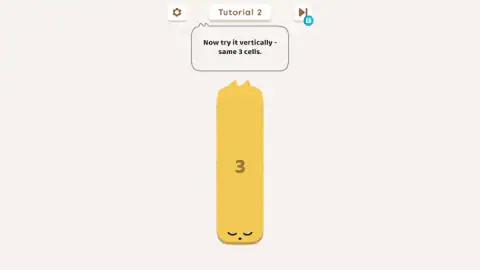
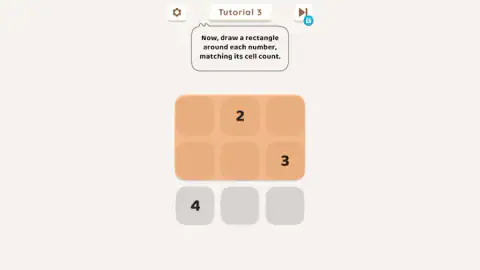

Taken by opening the game ourselves and letting it run — not supplied by the publisher, and not the same picture every other site shows.
How to play Kitty Grid Puzzle
- Find the numbers. Most cells on the board are plain grey, and a few carry a number.
- Press the mouse button on a cell and drag along a row or a column. The cells you cross light up as one translucent block while you hold.
- Let go. If the block covers exactly as many cells as the number inside it, it stays. If not, it disappears and nothing has changed.
- A room that stays turns into a cat shaped like the rectangle, with the number printed on its side, and sparkles when it lands.
- When every number has its cat and no grey cell is left, a Well Done ribbon appears over a plate of cats. Click Next Level.
Tips from our sessions:
- Every move is a drag. Pressing a cell and releasing without moving did nothing for us, on any board. Neither did diagonal drags.
- Start the drag on an end cell. On the first board the 3 sits in the middle of a row of three. A drag starting on it and running off the side of the row did nothing; a drag from the left cell to the right cell cleared the board.
- Before you take a small room, look at what it leaves. A rectangle can be the right size and still be the wrong rectangle. This is the whole difficulty, and the game will not warn you.
- Place the biggest number first. It has the fewest places to go, so it decides the board. On a grid three cells wide, a 4 cannot be a line, so it has to be a two-by-two block, and usually only one such block touches it.
Controls
| Hold the left mouse button and drag across cells | Lights up the rectangle between the cell you pressed and the cell you are over, as a preview |
|---|---|
| Let go of the button | Keeps the rectangle if it covers exactly as many cells as the number inside it, and clears it if it does not |
| Click Next Level | Moves on from the Well Done screen to the next board |
| Gear and the skip button at the top | Not used in our sessions |
Features
- A grid of grey cells with a few numbers, and one rule, a rectangle around each number covering exactly that many cells
- Three tutorial boards before anything else, a row of three, a column of three and a 3 by 3 grid
- Rooms that only stick when the count matches, so a wrong drag costs you nothing but the drag
- A finished room turns into a cat that fills it exactly, with the number printed on its side
- Room colours that vary from one attempt to the next and carry no meaning
- No timer, move counter or lives on screen in any board we played
- A Well Done ribbon over a plate of cats after each board
Game details
- Developer
- Drivix Games
- Release date
- July 2026
- Last updated
- July 21, 2026
- Added here
- June 2026
- Technology
- HTML5
- Platforms
- Browser (desktop, mouse), Browser (mobile & tablet)
- Saved progress
- Saving, when available, is managed by this game. Mava cannot confirm your level.
FAQ
How do you play Kitty Grid Puzzle?
Some cells of the grid carry a number. You hold the mouse button and drag across cells to draw a rectangle around each number, and the rectangle has to cover exactly as many cells as the number says. If the count matches, the rectangle stays and a cat moves into it. The game's instructions add that rooms cannot overlap and that every cell of the grid must end up inside one.
Why does nothing happen when I drag in Kitty Grid Puzzle?
The rectangle you drew did not match a number. The cells light up while you hold the button, which looks like a move, but on release anything that is the wrong size disappears and the board goes back to grey. Diagonal drags and single clicks never did anything for us either, so every move is a straight drag along a row or a column.
Why does the level not finish in Kitty Grid Puzzle?
Usually because a room that the game accepted was still the wrong room. Size is the only thing it checks on the spot, so a correctly sized rectangle in the wrong place is placed happily and can leave a gap that no rectangle fits. That is exactly how we failed the third tutorial, twice.
What is the solution to Tutorial 3 in Kitty Grid Puzzle?
This is our own working from the board, and we have not tested it in the game. The 4 in the bottom left corner takes the two by two block around it, the 3 takes the whole right-hand column, and the 2 takes the two left-hand cells of the top row. That uses all nine cells. Giving the 2 a vertical pair down the middle also fits its number, but it makes the rest impossible.
Is Kitty Grid Puzzle the same as Shikaku?
The rules match. Shikaku is a logic puzzle published by the Japanese puzzle house Nikoli in 1989, in which a grid is cut into rectangles that each hold one number equal to their area. Kitty Grid Puzzle asks for the same thing and gives each rectangle a cat.
Does Kitty Grid Puzzle have a timer?
We saw none. The boards we played showed a gear, the level name and a skip button at the top, and no clock, move counter or lives. We spent ten minutes across the three tutorial boards and nothing ever ran out.
Can you play Kitty Grid Puzzle on a phone?
It is listed for PC, Android and iOS, in portrait. We played on a desktop with a mouse, where every move is a single drag. We did not try it on a phone ourselves.
Who made Kitty Grid Puzzle?
The game is credited to Drivix Games. It was published in July 2026, and when we checked in October 2026.