


About Slidey: Sliding Cat Puzzle
In most block puzzles you are handed a piece and asked where to put it. Slidey never hands you anything. Every cat is already on the board, lying on its side with its eyes shut, and the only thing you are allowed to do is push one sideways along the row it is already in. Nothing is placed, nothing is dropped from above, nothing turns.
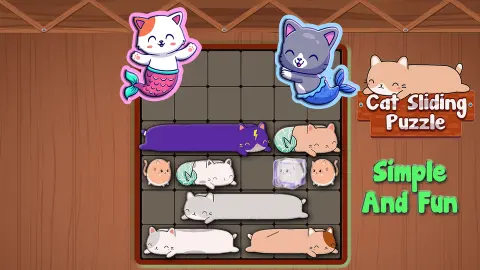
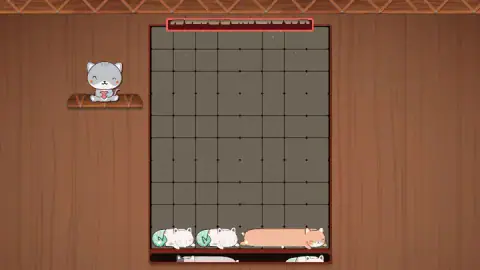
The grid is eight cells across and ten deep, drawn dark against a wall of brown planks. The cats in it come in lengths: some fill a single cell, some stretch over three. Along the top edge runs a narrow strip outlined in red — the only red thing on the screen. Underneath the frame there is a dark slot, and in it you can see the tops of more cats. That is next. Every time you slide, the slot empties into the grid and the stack climbs a row.
The developer is listed as Anna Inc, a studio with a long shelf of classic casual puzzles on the same platform: a nonogram, a sudoku-block hybrid, mahjong solitaire, two bubble shooters, word games. Slidey went up in February 2026, was last touched in August. Our own session ran about four minutes on a desktop, and it is worth being blunt about where it got to: we finished the tutorial, we never cleared a row, and the score still read zero when we stopped. Everything below says which part we watched and which part we did not.
Every slide raises the floor
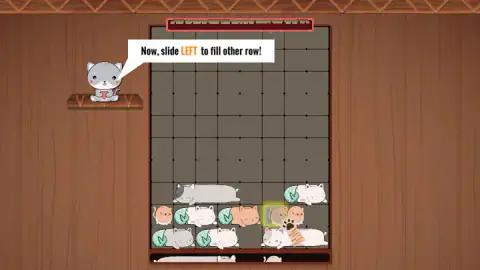
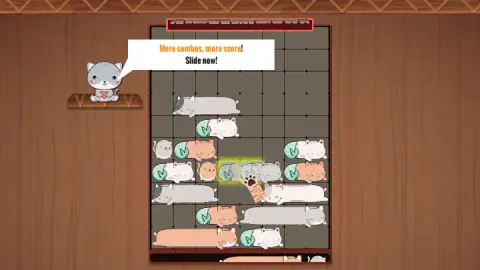
Put our captures in order and the board tells its own story. First frame: three cats asleep on an otherwise empty grid. Half a minute later: three rows deep, with a long grey cat across the middle and a ginger one lit up waiting to be moved. Half a minute after that: two thirds of the grid, cats in white, grey and ginger packed flat across six or seven rows.
We were not trying to lose. We were sliding, and sliding is what fills the board. This is the trade the game is built on and it is not a soft one: a falling-block puzzle gives you a piece and a free choice of where it goes, and in exchange you have to take it quickly. Slidey inverts both halves. You get all the time in the world to think, and no choice at all about what arrives or where.
Which makes that dark slot under the frame the most underused thing on the screen. The next row is already visible in it before it rises. Knowing that the cat about to arrive is three cells long changes which gap is worth making now, and we worked that out roughly four minutes too late.
As for the red strip at the top — it was still clear when we stopped, and we never came near it. We can tell you the game draws that line and draws nothing else like it. We cannot tell you what it is like to hit it.
A cat three cells long is three cells long forever
Puzzles where pieces slide rather than get placed are an old family, and they share one rule: you may push a piece, you may not lift it, and you may not turn it. The best-known one in a box is Rush Hour, a plastic tray of cars and lorries in which the only legal move is forward or back along the lane a vehicle is already in. The Japanese puzzle designer Nob Yoshigahara devised it in the 1970s; Binary Arts, now ThinkFun, put it on American shelves in 1996, and it has since sold past a million copies.
That single restriction is what makes the family hard, and it is the restriction Slidey borrows wholesale. The ginger cat stretched across three cells arrived three cells long and will stay three cells long. You do not own its shape or its row. You own one number: how far along that row it sits. A one-cell gap can only ever be closed by something one cell wide that is already in that row and has a clear path to it — and if there is a cat in the way, the real move is to shift the cat in the way first.
That is the mental switch, and it is why the game feels unresponsive for the first minute or two. You are not looking for a place to put something. You are looking for which cat is blocking which, and working backwards from the row you want to finish to the push that unblocks it.
Then Slidey adds the thing Rush Hour does not have. A cardboard sliding puzzle will wait for you all afternoon; the board is the same board when you look up. Here, the board you are solving is one row taller than it was before you touched it. The puzzle is traditional. The clock made out of cats is not.
What four minutes could not tell us
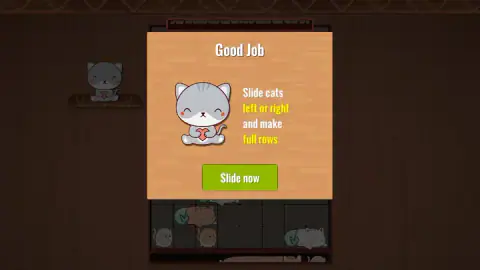
The tutorial takes up most of a short session. It escalates in steps — fill this row, now fill the other row, now fill two rows in one move — before a wooden panel comes up reading Good Job and spells the rule out once more: "Slide cats left or right and make full rows." Press the green Slide now button and the board comes back nearly empty, with Score and Best both reading zero.
Which is where our honesty runs out. The score never moved off zero, and we never watched a single row vanish. The combo this whole game is pointed at — two rows going at once, the thing every later bubble is nagging you about — we can describe from the game's own instructions and not from having pulled one off. If that matters to you, and it should, read this as a careful account of how the board behaves rather than a verdict on how it pays.
There is one more thing we cannot explain. Partway through, a small circled 1 appeared above the cat on the shelf and stayed there. It may be a level, it may be a counter, it may be something else. We do not know, and we would rather say so than guess.
More from the same shelf
Anna Inc's other puzzles are here too, and they run to the classics rather than to anything like this one: Nonogram and Sudoku Block Puzzle are both grid-and-logic games from the same studio, QBlock Puzzle is its other take on blocks, and Bubble Pop Legend is the shooter. If it was the sliding rather than the cats that brought you, Slide Block Jam is the nearest neighbour in our catalogue. The rest are in puzzle games.
Screenshots
How to play Slidey: Sliding Cat Puzzle
- Click into the game. It took us a handful of clicks and key presses before the board appeared.
- Read the bubble from the cat on the shelf. It names the move in plain words — ours said "Now, slide LEFT to fill other row!" with the direction in orange.
- Press on a cat and drag it left or right. It slides along its own row until something blocks it.
- Fill a whole row across. That is what every bubble is pointing at, and the later ones go further: arrange a push that fills two rows at once and the game calls it a combo.
- Keep an eye on the slot under the board, because what is in it is about to be in the grid.
Things we only found out by being there:
- "Left or right" is the entire instruction, literally. We dragged cats upward, downward and diagonally, and we reached for the arrow keys more than once. The board did not move. Several minutes of our session went on moves that did nothing at all, simply because we assumed a grid this shape would let us.
- The piece the tutorial wants is marked. It glows yellow-green and carries a paw print. If a move is not working, look for the paw before trying a different cat.
- A wasted move is not free. Every slide raises a row whether or not it achieved anything, so the cost of experimenting is paid in height.
- The slot under the board is a free look at the future. We ignored it for the whole session. In hindsight that is the one thing we would do differently.
- Nothing is on a clock. There is no timer in either corner. You can sit and look for as long as you like; what you cannot do is move and change your mind.
Controls
| Drag a cat left or right | The only move there is. A cat slides along the row it is already in; we never got one to change rows or to turn |
|---|---|
| Drag up, down or diagonally | Nothing. We tried all three repeatedly and the board did not change, which is the single most useful thing to know before you start |
| Arrow keys | Nothing moved on screen when we pressed them. This is a pointer game end to end |
| Slide now (green button) | Closes the Good Job panel and hands the board back to you |
| The cog in the top right | Settings, beside the Best score. We left it alone |
Features
- Eight cells across and ten deep, and nothing is ever placed into it: every cat is already on the board, and all you may do is push one sideways
- Cats lie flat and never turn, so a long cat stays long — which is exactly what makes a full row hard to assemble
- Each slide lifts a fresh row up from the slot under the board, so a move that achieves nothing still costs you space
- The tops of the next row's cats are visible in that slot before it rises: the game tells you what is coming, for free
- A narrow strip outlined in red runs along the top of the grid. It is the only thing on screen drawn in red
- A grey cat on a shelf narrates in speech bubbles, and the piece it wants is the one lit yellow with a paw print on it
- Score sits in one top corner and Best in the other, with a settings cog beside it. Nothing anywhere is counting down
- Free in the browser with nothing to install, laid out tall for a phone and played here with a mouse
Game details
- Developer
- Anna Inc
- Release date
- February 2026
- Last updated
- October 23, 2026
- Added here
- December 2025
- Technology
- HTML5
- Platforms
- Browser (desktop), Browser (mobile & tablet, touch)
- Classification
- Puzzle
- Saved progress
- Saving, when available, is managed by this game. Mava cannot confirm your level.
FAQ
What is Slidey: Sliding Cat Puzzle?
It is a browser block puzzle in which the blocks are sleeping cats. They lie flat on a grid eight cells wide and ten deep, and the one legal move is to push a cat left or right along the row it is already in. Filling a complete row is what every bubble points you at, and filling two of them with a single push is what the game calls a combo. Each move you make lifts another row of cats into the grid from below.
How do you play Slidey?
You drag. Pick a cat, pull it left or right, and it slides until something stops it. The aim is to get a whole row filled across, and the tutorial pushes you past that almost immediately: fill two rows with one push and it calls that a combo, which is where the score is supposed to be.
Can you move the cats up or down in Slidey?
No. We spent a good part of our session trying — dragging upward, dragging diagonally, reaching for the arrow keys — and the board did not move once. The panel the game shows you at the end of the tutorial is not a summary of the controls, it is the complete list: slide cats left or right.
What happens when the board fills up in Slidey?
A narrow strip outlined in red runs along the top edge of the grid, and it is the only red thing on the screen, which makes its purpose fairly clear. We never came close to it, so we will not pretend to know what reaching it looks like. In four minutes the stack never got past two thirds of the way up.
Who made Slidey: Sliding Cat Puzzle and when did it come out?
The developer is listed as Anna Inc, a studio whose shelf is a run of classic casual puzzles — a nonogram, a sudoku-block hybrid, mahjong solitaire, bubble shooters and word games. The game was published in February 2026 and was last updated in August 2026. There is no studio website we could find.
Is Slidey free, and does it work on a phone?
It is free and it runs in a browser on this page with nothing to install. The layout is built tall, for a phone held upright, and it is listed for desktop, mobile and tablet alike. We played it with a mouse on a desktop, so how the drag feels under a thumb is still its claim rather than ours.
Is there a timer in Slidey?
There is no clock anywhere on the screen. The corners hold the score and the best score, and beside them sits a settings cog — nothing counts down. The pressure comes from the board instead: every slide raises a new row of cats, so you are never standing still even when you are thinking.
How long does a game of Slidey take?
The tutorial that opens it ran about two minutes for us, bubble by bubble, and the game proper has no end point we could see. Treat it as something to pick up for five minutes rather than a set of levels to finish.