





About Find a Pair 3D
A game of pairs usually means cards face down and a memory test. Find a Pair 3D hides nothing behind a card. It hides things behind other things.
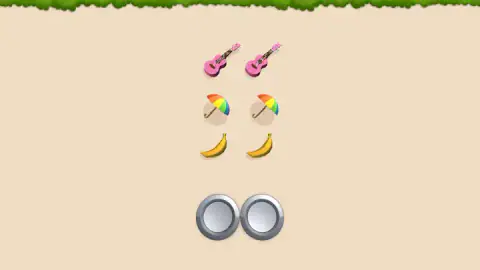
The first screen is not the game. Six objects lie on pale, sand-coloured ground under a strip of green leaves: two pink guitars, two rainbow umbrellas, two bananas. Two round metal dishes wait below. There is no clock on that screen, no level number, no star counter and no pause button. It is a warm-up, and the only thing it teaches is where a pair is supposed to go.
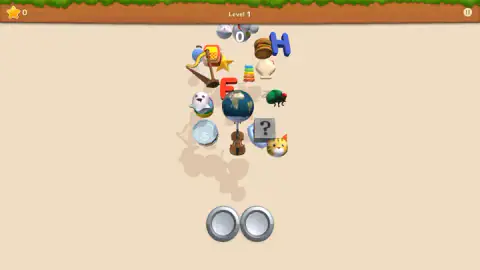
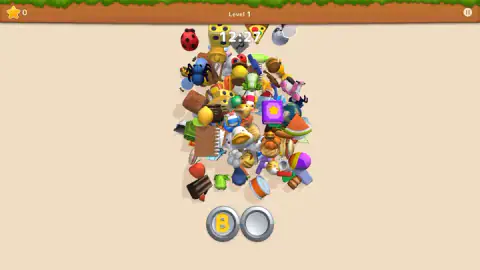
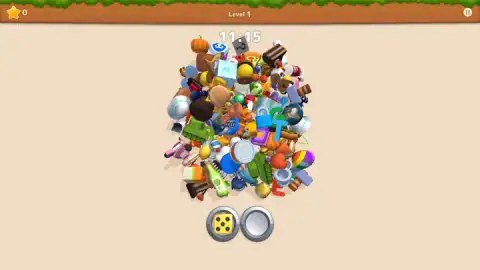
Then the real level loads, and the screen fills up. Objects rain down into the middle of the board and settle into a heap several layers deep: a pumpkin, a yellow die, a harp, a slice of pizza, a padlock, a globe, a hamburger, a chocolate bar, a giraffe's head, loose letters of the alphabet. A wooden bar slides across the top with Level 1 on it, a star counter at the left and a pause button at the right, and a countdown appears under it. That heap is what the game actually is, and the step up from three pairs to it happens in a single screen.
The game's listing credits Mirra Games. It has been available since December 2025.
The heap is the difficulty, and it builds itself
Watch a level start and you see where the challenge comes from. The board is empty for a moment, then objects drop in from above, bounce, and come to rest on top of one another. Nothing is placed; everything lands. By the time it settles you are looking at a mound of dozens of things, and most of them are showing you a corner, an edge or a handle rather than a whole shape.
That is a different job from the warm-up. Two pink guitars lying side by side take no thought at all. A pink guitar neck poking out between a barrel and a hot dog, with its twin buried on the far side of the mound, takes a careful look.
The mixture is deliberately scattershot: food, toys, tools, furniture, animals, household junk and single letters of the alphabet, all at the same cartoon scale, so a watermelon is the same size as a toilet. Nothing groups itself by type, which means you cannot narrow the search by looking in one region of the pile. You just look.
The dishes still make the pair
The two round metal dishes stay below the heap on every level, and they work exactly as they did on the warm-up board. Think of them as a set of scales: you put one object on each side and the game compares them.
That detour is the rule most new players miss, and the game never explains it. The reason for it seems to be the 3D. If pairs cleared the moment two twins touched, a crowded heap would solve itself by accident every time you dragged something across it. With the dishes, every pair is two separate decisions.
A wrong pair costs nothing visible. Both dishes empty, both objects go back, and no life is lost. There is one small price: a returned object does not always go home. It may come to rest somewhere else entirely, lying at a new angle, which on the warm-up board turns a tidy two-column layout into a scattered one.
Over twelve minutes, and a star counter that has to be earned
The clock on level 1 read past twelve minutes once the heap had settled, and from there it fell in real seconds. That is a generous allowance for a children's game, and it is the only pressure on screen.
The star counter in the corner is the other half of the scoring, and the listing says a star comes with each pair you merge. We cannot confirm it from our own play, because we never got a pair out of the heap: ours read zero from the first drop to the last. Carrying a die down to a dish is easy. Finding the second die in a mound of a hundred shapes, inside a window we kept spending on the wrong objects, is the actual game.
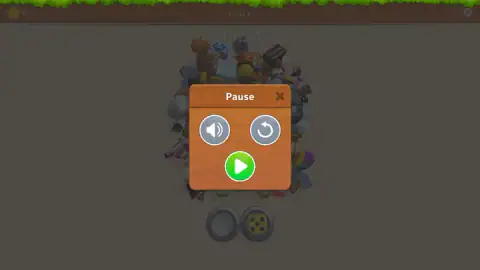
The pause button in the top right corner opens a small wooden panel over a dimmed board, with a sound button, a restart button and a green resume button. The countdown behind it holds still while the panel is open, so a pause is a real pause and not a penalty.
Why the same umbrella can look like a different one
On the warm-up board the twins lie in the same pose and matching them takes no thought. Once objects have been picked up and put back, they stop lying the same way. One of our umbrellas came back lying face up, showing pink and light blue panels that the side view had hidden, and next to its twin it looked like another object altogether. A banana came back flipped, curving the opposite way to the one beside it.
Psychologists have a name for the skill this asks of you: mental rotation, turning an object around in your head to check it against another. A well-known experiment from 1971 showed people pairs of 3D shapes and timed how long they took to say whether the two were the same. The more one shape was turned away from the other, the longer the answer took, in steady step with the angle.
That is the "3D" in the title doing its job. On a heap it is doubled: the object is both rotated and partly covered, so you are rebuilding a shape from a fragment and then rotating it to compare.
What we still have not seen
The end of a level. We left level 1 with the heap intact and the clock still running, so we cannot tell you what happens when the pile empties, what the second level looks like, or what the game does when the countdown reaches zero.
The listing speaks of new objects on later levels and of a leaderboard. Neither turned up on the one level we reached. We found no use for the keyboard, and we did not try a phone or a touch screen, although the listing offers both.
Who it is for
Young children, first of all. There is nothing to read, the objects are things a four-year-old can name out loud, and a wrong guess is forgiven on the spot. An adult sitting alongside will want to show the dishes once, because the game does not.
Older players will find more here than the warm-up board suggests. A heap of a hundred objects with a clock over it is a proper hidden-object search, and if that is the part you like, Blackriver Mystery. Hidden Objects from the same studio hides its objects in a drawn scene instead of a pile. For timed matching in threes rather than pairs, there is Find Match 3D.
More pairs, and more from Mirra Games
The same studio name is on Coloring by Numbers. Pixel Room, which has no clock on it at all. For pairs in the classic sense, cards turned face down, there is Memorya. Block Match 3D takes a cube of picture blocks apart piece by piece, which is the same recognition problem from the other side. The rest are under kids games.
Screenshots
Taken by opening the game ourselves and letting it run — not supplied by the publisher, and not the same picture every other site shows.
How to play Find a Pair 3D
- Find two objects of the same kind. On the warm-up board they sit side by side; in the heap, most of them are half-buried.
- Hold the left mouse button on one of them, drag it down and let go over either round dish. It stays there.
- Drag its twin to the other dish.
- A match clears the pair and frees both dishes. A mismatch sends both objects back.
- Keep going until the heap is empty or the clock runs out.
What ten minutes taught us:
- Clicking does nothing. Not on the warm-up board, not on the heap. We clicked the same part of the pile over and over and not one object moved.
- Twin on twin does nothing. Drop one guitar onto the other and they simply stack.
- The dishes are the whole game. A pair only counts with one object on each dish, and that holds in the heap too.
- Either dish takes either object. We used the left one and the right one and both held.
- A dish will wait for you. We parked a yellow die on the right-hand dish and went hunting for its twin. It was still sitting there two and a half minutes later, with nothing to hurry it along.
- Start the drag on the object. A drag that begins on bare ground moves nothing.
- Pause stops the clock. The countdown behind the panel read the same when we closed it as when we opened it.
Controls
| Left mouse button, hold and drag | Picks up an object and carries it; let go over a round dish to set it down |
|---|---|
| Drag a second object to the other dish | A matching twin clears the pair; a different object sends both back |
| Single click | Does nothing, either on the warm-up board or on the heap |
| Pause button, top right of the wooden bar | Opens a panel with sound, restart and resume, and stops the countdown while it is open |
Features
- A warm-up board of three pairs in plain sight, then a level that drops dozens of mixed objects into one heap
- Objects rain down and settle at the start of a level, so the heap is never stacked the same way twice
- A wooden bar across the top carrying the level number, a star counter and a pause button
- A countdown that reads over twelve minutes when the heap settles and falls in real seconds
- Two round metal dishes below the heap, still the only way to make a pair
- Toys, food, household things, animals and letters of the alphabet, all half-buried in each other
- A wrong pair costs nothing but the time it took, both objects simply go back
Game details
- Developer
- Mirra Games
- Release date
- December 2025
- Added here
- October 2025
- Technology
- HTML5 (Unity)
- Platforms
- Browser (desktop)
- Saved progress
- Saving, when available, is managed by this game. Mava cannot confirm your level.
FAQ
What is Find a Pair 3D?
It is a matching game by Mirra Games played with the mouse. Small 3D objects lie on pale sandy ground and two round metal dishes wait at the bottom. You drag one object to each dish, and if the two are the same they clear. After a short board with three pairs, the game drops a heap of dozens of objects on you and starts a clock.
How do you play Find a Pair 3D?
Hold the left mouse button on an object, drag it down and let go over one of the two round dishes. Then drag its twin to the other dish. Clicking an object does nothing, and dropping one twin on top of the other does nothing either. Only the dishes make a pair.
Is there a timer in Find a Pair 3D?
Yes, on the numbered levels. On level 1 the clock showed over twelve minutes once the heap had settled and then counted down in real seconds. The short warm-up board before it has no clock at all, and no level number or star counter either. Opening the pause panel stops the countdown.
What are the stars in Find a Pair 3D for?
A star counter sits in the top left corner of the wooden bar on every numbered level. The listing says you earn one star for each pair you merge. We never cleared a pair inside the heap on level 1, so ours stayed at zero the whole time and we cannot say what the stars are spent on.
Why does nothing happen when I click an object in Find a Pair 3D?
Because clicking is not a move in this game. We clicked the same part of the heap again and again and nothing shifted. Dragging one object on top of its twin does not work either. An object only counts once you have dragged it down onto one of the two round dishes.
What happens if you put two different objects on the dishes in Find a Pair 3D?
Both dishes empty and the two objects go back. We did it many times on the warm-up board with a banana and an umbrella, and saw no lost life and no warning. The only cost is the time, and the fact that a returned object may land somewhere else and at a new angle.
Is Find a Pair 3D a memory game?
Not in the card-flipping sense, because nothing is face down. The difficulty comes from the heap instead. Objects lie on top of each other at every angle, so half of each one is hidden behind its neighbours and you have to recognise a shape from the sliver of it you can see.
Who made Find a Pair 3D?
The game's listing credits Mirra Games. The game was published in December 2025. The same studio name is on Coloring by Numbers. Pixel Room and Blackriver Mystery. Hidden Objects.