







About Card Quest
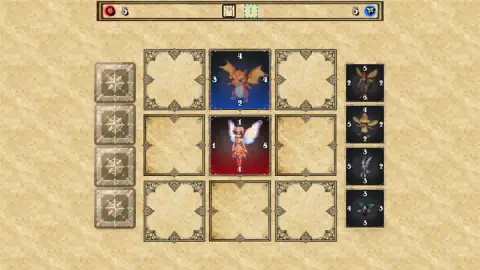
The top bar of a Card Quest match shows a 5 on the left, a 5 on the right and a green 1 in the middle. It reads like a score and a turn counter. It is neither. The fives are there before anyone has played a card, and the 1 never moves.
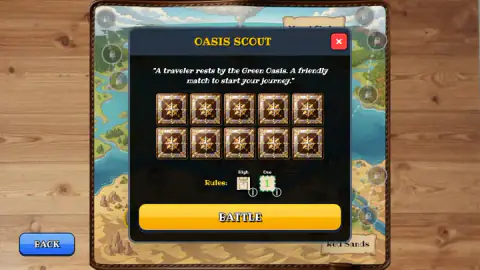
The green 1 is a rule badge, not a turn counter. You meet it one screen earlier, on the panel that introduces your opponent, with a single word above it: One.
The game under that bar is small and exact. Two players, nine squares, five cards each. Every card has a number on each of its four edges, and you take turns laying a card on an empty square. Where two cards touch, the numbers on the touching edges are compared.
We played for about four minutes with a mouse. Most of that time went on choosing a hand in the card book, and the match itself got as far as one card each. So this page covers the book, the map, the first opponent and the opening of a match, and it says so wherever our knowledge stops.
The game is credited to Konstantin Steinmiller. It was published in June 2026.
The top bar, read correctly: two fives and a rule badge
Each side has an icon in the bar, red on the left for the rival and blue on the right for you, with a number beside it. Both numbers were 5 on an empty board. After we had placed one card and the rival had placed one, both were still 5.
So the bar counts the cards each side owns, on the board and in hand together. Nobody had captured anything, so nobody's total had moved. If a card of yours is turned, expect your 5 to become a 4 and theirs a 6.
Between the two totals sit two small icons. They are the rules of the match, copied from the opponent's panel. The first is labelled High and shows a 3 stacked on a 4: the bigger number wins. The second is the green 1, labelled One.
Each icon has a small "i" beside it on the panel. We did not open them, and we regret it, because One is the label the game never explains on the board.
The card book: five pages, and a hand of five
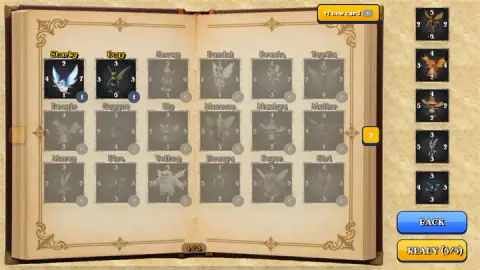
The book is where a match is won or lost before it starts. Its first page holds 18 creatures in three rows, and the page counter at the bottom reads 1/5. Each card has a name above it, its four numbers, and a small badge that says how many copies you own.
Six cards on our first page were in colour with a 1 on the badge: Dragir the orange dragon, a mushroom creature, Merry, Pira, Sharky and Bogy. A seventh, a red-haired fairy, was already in our hand. Everything else was grey with a zero, including Snowy, Dandal and a round white beast called Yethog.
Grey cards still show their numbers, so the book doubles as a scouting report. Dandal has a 1 on three edges and an 8 on the fourth. It turned up in the rival's hand two minutes later.
A yellow button at the top of the book offers "+1 new card" beside a small video icon, the usual sign of a reward for watching an advert. We left it alone.
Oasis Scout: one card each, and where the board stood
The first opponent is Oasis Scout, introduced as a traveller resting by the Green Oasis and offering "a friendly match to start your journey". The panel shows ten face-down cards in two rows of five, the two rule icons and the BATTLE button. Behind it, most points on the map wear a padlock.
On the board we dragged Dragir to the middle square of the top row. It landed on a blue background, our colour. The rival replied with Dandal in the centre, directly underneath, on red.
Look at what touched. Dragir's bottom edge is a 2, and Dandal's top edge is a 1. The rival had attacked a 2 with a 1, and under High that takes nothing. Both totals stayed at 5.
The more interesting number was Dandal's 8, pointing right at an empty square. Nothing in our hand could beat it from that side, and nothing needed to. Dandal's left and bottom edges are both 1, and every card we held had a higher number to put against them. Our session ended with that move still waiting to be played, so we cannot tell you how the capture looks. We can only say the opening was there.
The rules come from a card game inside a 1999 role-playing game
The game's listing says Card Quest uses the rules of Triple Triad. That game began in 1999 as a side game inside a Japanese role-playing game, where characters around the world could be challenged to a match, and it has been borrowed by other games ever since.
Its basics are the ones on this page: nine squares, five cards a side, four numbers a card, higher number captures. One detail explains the top bar. Ten cards go into a match and the board has nine squares, so one card never gets played. The count therefore includes cards still in hand, which is why both sides start at 5 and not at zero.
The other detail explains the green 1, or may do. In Triple Triad the players agree beforehand what the winner takes, and the mildest version, where the winner picks a single card from the loser, is called One. That would fit a game built around filling a book. We did not finish a match, so treat it as a likely reading and check the "i" button.
Who it is for
Players who like a short puzzle with an opponent in it. Nine squares is a board you can hold in your head, and a child who can compare two numbers can play a legal game.
It is slower to start than it looks. You pass a book, a map and a panel before the first card goes down, and the book assumes you know to pick five. If you want a card game with a familiar deck and no collecting, this is the wrong shelf.
More card and board games
Durak is another card duel against the computer, played with a 36-card deck and a trump suit. Checkmate sets chess puzzles on boards as small as three squares by three. Domino Battle is a one-on-one match of dominoes, and Solitaire is the place for Klondike and Spider. The rest are under strategy games.
Screenshots
Taken by opening the game ourselves and letting it run — not supplied by the publisher, and not the same picture every other site shows.
How to play Card Quest
- Press Play on the title screen. A card book opens.
- Click cards printed in colour to move them into your hand, the column on the right. The grey ones are cards you do not own yet.
- When the button in the corner reads READY (5/5) and turns yellow, press it.
- On the map, open the first opponent, read the panel and press BATTLE.
- Drag a card from your hand onto an empty square. Your rival answers with one of theirs.
What the first match taught us:
- Five, not fewer. The READY button stays grey at four cards. We lost time pressing it early.
- Read all four numbers before you choose. We filled our hand from the front of the page and left Sharky in the book. Its right edge is a 7, the highest number on any card we owned.
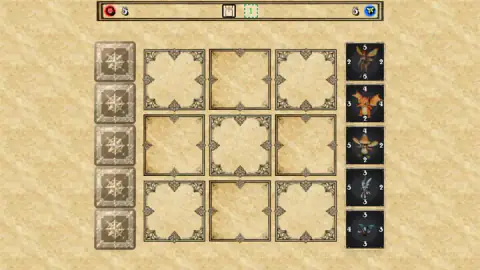
- Your cards are the ones on the right. The face-down column on the left is the rival's hand. You do not see a card of theirs until it lands.
- Dragging works. Clicking the top card of our hand lit it with a blue glow, and a blue arrow dropped from our icon in the bar. The card that reached the board was one we dragged there.
- Nothing rushed us. We saw no clock on the board.
Controls
| Left click on a coloured card in the book | Moves it to your hand, the column on the right; the READY button counts up to five |
|---|---|
| Yellow arrow at the edge of the book | Turns to the next of the five pages |
| READY (5/5) | Grey until the hand is full, yellow once it is; it takes you on to the map |
| BATTLE | Starts the match from the opponent's panel |
| Drag a card from your hand to an empty square | Places it on the board; this is how our card went down |
| Small "i" beside each rule icon | Should explain the rule; we did not open them |
| Keyboard | Enter and Escape did nothing we could see |
Features
- A board of nine squares and a hand of five cards for each side
- Four numbers on every card, one for each edge
- A card book of five pages, 18 creatures on the first, that greys out what you do not own
- A map of opponents, most of them padlocked at the start
- Rule icons on each opponent's panel, repeated in the top bar during the match
- The rival's hand stays face down until each card is played
Game details
- Developer
- Konstantin Steinmiller
- Release date
- June 2026
- Added here
- April 2026
- Technology
- HTML5 (Unity WebGL)
- Platforms
- Browser (desktop)
- Classification
- Adventure , Cards & Board
- Saved progress
- Saving, when available, is managed by this game. Mava cannot confirm your level.
FAQ
How do you play Card Quest?
You pick five creature cards from a book, then you and one rival take turns placing a card on a board of nine squares. Every card has a number on each of its four edges. The first match is played under a rule labelled High, where the higher of two touching numbers wins and the losing card changes sides. We played one card each and saw no capture, so that last part is the rule as the game labels it, not something we watched happen.
What do the numbers on the cards mean in Card Quest?
Each card carries four numbers, one at the top, one at the bottom and one on each side. A number only matters against the card lying next to that edge. Our dragon, Dragir, had a 4 on top and a 2 underneath, so it is strong towards the top of the board and weak below.
What do the 5 and the green 1 at the top of the screen mean?
The two fives were on screen before either side had played, and they were still there after one card each, so they count the cards each side owns and not points scored. The green 1 is a rule badge. It is the same icon that appears, labelled One, on the opponent's panel before the match.
How many cards are there in Card Quest?
We cannot give a total. The card book has five pages and the first one holds 18 creatures, each with its own name and numbers. Seven cards were ours to choose from in our session, and the rest of the first page was grey with a zero beside each one.
Is Card Quest the same as Triple Triad?
It is a different game with its own creatures, but the game's listing says it uses Triple Triad rules, and what we saw matches that, down to a nine-square board, five cards a side and four numbers on each card. The optional rules of that older game may or may not all be here. We saw two rule labels, High and One.
Is this the Card Quest with dungeons and character classes?
No. Several unrelated games share the name, and one of them is a dungeon card game for PC. This Card Quest is the 2026 browser game with fairy creatures and a nine-square board, credited to Konstantin Steinmiller.
Can you play Card Quest on a phone?
It is listed for PC, Android and iOS, in both landscape and portrait. We played on a desktop with a mouse only, so the phone version is the listing's word and not something we tested.