


About Draft Arena: Battle Cards
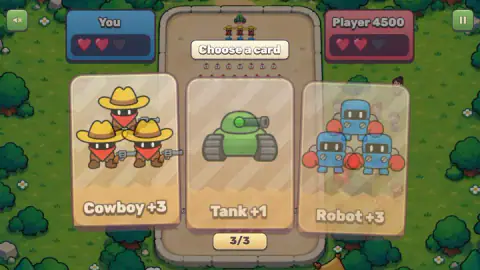
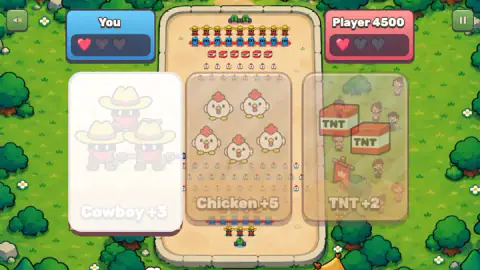
Most games that put cards in front of you want you to build a deck first. Choose your thirty, shuffle, sit down, play it out. Draft Arena: Battle Cards never gives you a deck. It stops the fight, drops three cards in the middle of the screen with the words Choose a card above them, and waits. You take one. The other two vanish, and you will not see that offer again.
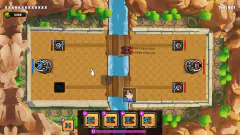
Then it takes the controls away. The fighters you just bought walk up a rectangular dirt pitch, meet the other army coming the other way, and settle it between themselves. There is nothing to click while that happens. You lose a heart or they do, three hearts a side, and the next offer arrives.
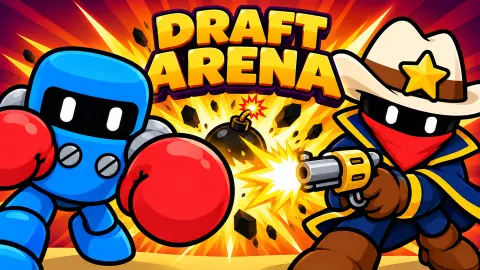
Here is the thing that makes it a game rather than a slot machine, and it took enlarging a screenshot to see properly. The army at the far end is made of exactly the same five fighters as yours. The menu lists five — a boxing robot, a cowboy, a chicken, a crate of TNT and a tank — and in our last-heart capture the other end of the pitch was two tanks, nine cowboys, nine robots, six TNT crates and seven chickens. Our five. Nobody can buy a better army here. They can only have chosen better.
One thing before the rest, because it shapes this page. We never pressed the UPGRADE button, never unlocked the lightning, never left the first arena, and never got a sixth fighter to appear. Four matches, two won, two lost, all on a computer with a mouse.
A draft is a real format, and this one borrows half of it
The word in the title is doing work. A draft is a specific way of handing things out: there is one common pool, picks are taken in turn, and a pick cannot be undone. It is the same word used for conscription, and for the way sports leagues hand out new players — the first of those was held in Philadelphia in 1936, after Bert Bell proposed it the year before, and the stated reason was that no club should be able to simply outbid the others for talent. Make the pool common and the pick compulsory and the skill moves from paying to choosing.
That is precisely the shape of this game, and the screen proves it. One pool of five fighters, both ends of the pitch drawing from it, no currency involved in the drafting at all. The reason your army looks different from theirs is not that you spent more. It is that you were shown different threes and you took different ones.
The honest half it does not borrow: in a real draft, the thing you take is taken away from everybody else. Here it is not. The opponent is being offered its own three somewhere out of sight, and nothing you pick denies it anything. So the only thing your choice costs you is the other two cards in front of you — which is a smaller, quieter decision than a real draft, and it is why a match takes a couple of minutes rather than an afternoon.
Plus five is not better than plus one
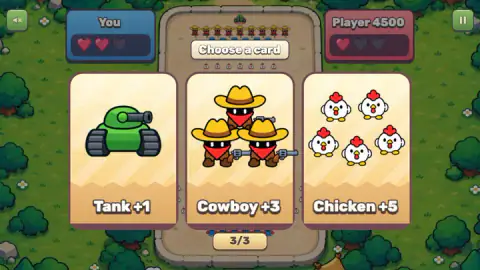
Every card we were offered carried a fixed number, and across the whole session those numbers never moved: Chicken +5, Cowboy +3, Robot +3, TNT +2, Tank +1. It reads like a strength rating. It is the opposite — it is how many bodies the card is willing to give you, and the generous cards are generous because the body is worth little.
We learned this the slow way. Offered the chicken card again and again, we took it again and again, and our end of the pitch filled with four full rows of chickens. The capture of that moment is the one worth looking at: a wall of poultry, one heart left, facing ranks of cowboys and robots with one heart left themselves. A big army is not the same thing as a winning one.
The useful reading is that the five cards are a conversion rate between quantity and quality, and the right answer changes with the board. Behind a thin line, take the five. Against a line that is already thick, the single tank is the card that changes something.
A hundred coins is the price of everything
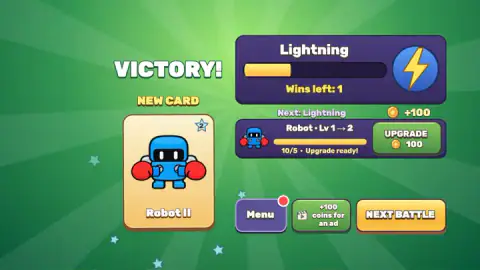
The victory screen is the clearest screen in the game, because it shows the whole economy at once. A win pays a gold +100. Levelling a fighter up costs 100. And the green button beside them offers "+100 coins for an ad" — an optional video worth exactly one victory, which is a fairly honest piece of pricing.
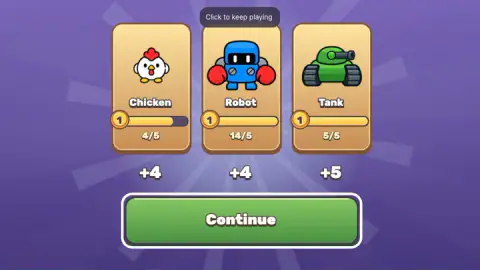
Underneath that sits the part that surprised us. Each fighter has a bar of parts that wins fill, and ours read "Robot · Lv 1 → 2" over a bar marked, in the game's own words, "10/5 · Upgrade ready!". A later screen showed the robot at fourteen parts against a requirement of five, still on level one, with a chicken at four and a tank at five beside it. Parts are not the gate. They pile up past the point they are useful and wait. Coins are the gate, and coins come from winning.
So the progression is not a treadmill you can grind. The game pays you for the thing it is already asking you to do, at a rate of one upgrade per victory, and the ad button exists for people who would rather not wait.
Who Player 4500 is, as far as we can tell
Before each match a screen slides a red half and a blue half together. On the red side are three names — Player 30, Player 53, Player 7 — all three wearing the same robot avatar. On the blue side is You. Underneath, in small letters, it says Searching for opponent...
What we were actually given, across four matches, were opponents called Player 4490, Player 4500, Player 4497 and Player 4451. Not one of the three names the search screen had just shown us. Four-digit numbers, all within fifty of each other.
We are not going to tell you whether there is a person at the other end, because we did not see anything that settled it. What we can tell you is that the matches behaved identically whatever the number was, that nobody ever took longer to pick than instantly, and that the opponent's army was always built from our five fighters. The listing calls it an arena. The screen calls it a search. We saw a name and a pitch.
More armies that fight without you
If the appeal here is assembling something and then letting go of it, Build Your Zombie Horde runs the same bargain with the undead, and Epic Battle Simulator scales it up until the two lines meeting in the middle are the whole spectacle. For the card half rather than the army half, Card Quest puts real deck rules behind its fights, and TCG Shop: Dino Adventure is the one about packs, coins and a league ladder. The rest are in strategy games.
Screenshots
How to play Draft Arena: Battle Cards
- Wait for the three cards. They arrive on their own, under a cream pill reading "Choose a card", and the fighting pauses until you pick.
- Click or tap one. Its fighters join the rank at your end of the pitch, and the number on the card is how many of them you get.
- Watch. Neither army is steerable. When one side breaks, somebody loses a heart — red hearts sit in the corners and turn grey as they go.
- Spend the bomb if the fight is slipping away. It is the yellow button in the bottom right, marked "Bomb · 1", and it is the only thing you can do mid-fight.
- Take three hearts off the other side to win the match, or lose your three and the screen reads "Match lost".
What only sitting in front of it teaches:
- Read the number as a price, not a score. Five chickens and one tank are the same card slot. The game is telling you how cheap a chicken is.
- The bomb has an escape hatch. Once armed, the arena prints Aim, then release · outside cancels. Let go outside the pitch and you keep it. Nothing is wasted by trying the aim.
- Count the other end before you choose. It is drawn in neat ranks, so nine cowboys read as nine cowboys at a glance. If their front rank just doubled, yours needs bodies and not quality.
- A grey pill reading "Click to keep playing" is the game pausing itself, not a prompt from anything else. One click anywhere and the match resumes.
- A win and an upgrade cost the same. Which means you leave each victory with the choice of banking it or spending it, never both.
Controls
| Click or tap a card | Takes that card and adds its fighters to your army. The other two offers disappear |
|---|---|
| Click or tap the Bomb button | Arms the bomb. The arena then reads "Aim, then release · outside cancels" and a dotted line shows where it will land |
| Release inside the pitch | Drops the bomb there. Releasing outside the pitch, or pressing Cancel, puts it away unused |
| The pause button, top right | Pauses the match. A grey pill reading "Click to keep playing" is the game pausing itself, and one click anywhere starts it again |
| The speaker button, top left | Mutes and unmutes the game |
Features
- Both armies are built out of the same five fighters — robot, cowboy, chicken, TNT crate and tank — so neither side can field anything the other cannot
- Every offer is one of three cards, and the number on the card is bodies rather than strength: Chicken +5, Cowboy +3, Robot +3, TNT +2, Tank +1
- Nothing is steered once the fighting starts. The armies walk up a dirt pitch and settle it between themselves while you watch
- Three hearts a side, drawn as little red hearts that go grey as you lose them. There is no health bar anywhere
- A victory pays a hundred coins and levelling a fighter costs exactly a hundred, so each win buys one upgrade and no more
- Fighter parts pile up past the point they are needed — our robot sat at fourteen out of five and stayed on level one — because coins, not parts, are the gate
- One bomb per match, aimed with a dotted line and cancelled by letting go outside the pitch
Game details
- Developer
- Partner studio
- Release date
- October 2026
- Last updated
- October 25, 2026
- Added here
- October 2026
- Technology
- HTML5 (2D)
- Platforms
- Browser (desktop), Browser (mobile & tablet, touch)
- Classification
- Action , Adventure , Arcade , Cards & Board , Multiplayer , Strategy
- Saved progress
- Saving, when available, is managed by this game. Mava cannot confirm your level.
FAQ
How do you play Draft Arena: Battle Cards?
Each round the game stops and offers you three cards. You click or tap one, its fighters join your army, and then both armies walk up a dirt pitch and fight without any further input from you. Win the fight and the other side loses a heart; lose three hearts of your own and the match is over. The whole game is which of the three cards you take.
What are the cards in Draft Arena: Battle Cards?
We saw five fighters and the menu screen lists exactly five: a boxing robot, a cowboy, a chicken, a crate of TNT and a tank. Each comes with a fixed number — Chicken +5, Cowboy +3, Robot +3, TNT +2 and Tank +1 — which is how many of that fighter the card adds. The game's own description mentions twelve fighters in all, which is more than we ever reached.
Which card should you pick in Draft Arena: Battle Cards?
Not automatically the biggest number. The scale runs the other way: a chicken card gives you five bodies and a tank card gives you one, because a chicken is worth very little and a tank is worth a lot. We took the five-chicken card nearly every time it appeared and ended that match on our last heart against an army of cowboys and robots.
Is Draft Arena: Battle Cards multiplayer?
We cannot say that it is. Before each match a screen reads "Searching for opponent..." and shows three names — Player 30, Player 53, Player 7 — all with the same avatar, and the opponents we were actually given were called Player 4490, Player 4500, Player 4497 and Player 4451. Nothing we saw proved a person on the other end, and nothing proved there was not one.
How do you upgrade fighters in Draft Arena: Battle Cards?
Two things have to line up. Winning fills a small bar of parts under each fighter, and when it is full the victory screen offers an UPGRADE button — but that button costs a hundred coins, and a victory pays a hundred coins. Parts alone do nothing: one of our fighters reached fourteen parts against a requirement of five and stayed on level one.
Are there ads in Draft Arena: Battle Cards?
The two we met were both optional and both on the screens between matches. After a win there is a green button reading "+100 coins for an ad", which offers exactly what the victory itself paid. After a loss there is one offering fighter parts. Neither is in the way of playing, and we declined both.
What is the bomb in Draft Arena: Battle Cards?
A one-use ability sitting in the bottom right corner labelled "Bomb · 1". Pressing it arms the throw, the top of the arena reads "Aim, then release · outside cancels", and a short dotted line shows where it will go. Releasing outside the pitch or pressing Cancel puts it back unused. The game's description also mentions lightning, which stayed locked for us behind one more win.
Is Draft Arena: Battle Cards free, and who made it?
It is free and runs in a browser with nothing to install. The studio behind it is not recorded anywhere we can check, so this sheet names no author rather than guessing one. It reached our catalogue on 24 October 2026, which makes it days old at the time of writing rather than a back-catalogue title.