

About We not survive
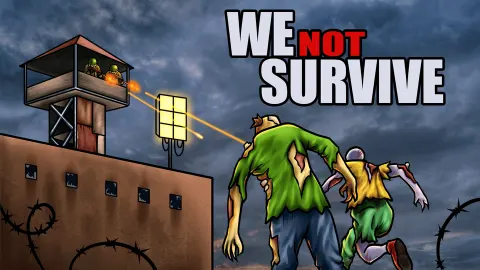
Most tower defense games hand you a map, a path and a box of towers, and the game is deciding where each tower goes. We not survive hands you one building and nothing to place. A concrete bunker sits in the middle of a red desert with a gun mounted at its front, zombies walk in from the edges of the screen, and the gun picks its own targets. You never aim. You never even click on the battlefield.
What you do is shop. Every kill pays coins, and a row of seven tiles along the bottom turns coins into a stronger bunker: faster reloads, more health, more damage, longer reach. The whole game is the order in which you press those tiles, and how long you can afford to wait for an expensive one.
The game is credited to Studio9856. It was published in November 2024.
The honest part first. We played one run for about four minutes, at normal speed, from wave 2 to wave 9, and the base was still standing when we stopped. We bought a single upgrade, Attack, three times. So this page can tell you exactly what the screen shows, what each tile does and how prices climb. It cannot tell you what wave 30 looks like.
The seven tiles, and what each one cost us
These are the values and prices the Tower tab showed at wave 2, before we bought anything.
| Tile | Value | Price | What the game's help says |
|---|---|---|---|
| Reloading | 3% | 41 | Reloading becomes faster |
| Health | 26 | 44 | Health value |
| Heal | 33 | 108 | Restore your health on each wave start |
| Attack | 12 | 63 | Weapon's damage |
| Attack range | 3.41 | 72 | Increases attack range |
| Grenade | padlocked | 148 | Damage (the help only repeats the word) |
| Boss | padlocked | 99 | More boss income |
Grenade and Boss kept their padlocks all the way to wave 9. We did not find out what opens them, and we never saw a boss.
A second tab, Armory, sits next to Tower. We did not open it.
Attack gets expensive faster than it gets strong
Attack was the only tile we bought, so it is the only price curve we can draw. The damage went up by five or six points each time. The price did not behave so politely.
| Purchase | Damage | Price paid |
|---|---|---|
| First | 12 to 17 | 63 |
| Second | 17 to 23 | 170 |
| Third | 23 to 29 | 330 |
| Fourth (not bought) | from 29 | 544 |
The third level cost five times the first and added about the same damage. By then we had put 563 coins into one tile while Reloading, Health and Attack range still sat at their opening prices. We cannot tell you those are better buys, because we did not test them. We can tell you that by wave 9 a single extra level of Attack cost more than all three of them together.
Attack alone was enough for the stretch we played. The only damage we saw the base take was in wave 6, when the heart dropped from 26 to 17.
The heal you already own
That lost health came back without us doing anything. At the start of wave 8 the bunker flashed green, a hammer and a heart floated up beside it, and a green +33 appeared over the wall. The heart counter read 26 again. One of the photos on this page catches that exact moment.
This is the Heal tile at work, and the numbers on it hide a small trap. Heal starts at 33. Health starts at 26. The free repair at the top of each wave is already bigger than the whole health bar, so a level of Heal, at 108 coins the dearest unlocked tile on the row, should buy nothing you can use until Health has grown past it. That is our reading of the two numbers, not something we tested by buying.
The two buttons with a film icon
Under the counters there are two more hexagons, each with a small film-strip plate below it, the usual mark of a reward you get for watching an ad. One says X3 SPEED. The other shows a coin and a number.
That number moves. While we held fewer than 200 coins it read 200. Later it read 602 when we had 602 coins, and from then on it always matched our own total. In other words, once you are past the floor it offers to double what you are carrying.
We pressed it once, in wave 5. Both buttons then vanished for a couple of waves before coming back.
The speed toggle at the top left is a different thing. It read x1 for our whole run and has no film icon.
A game you cannot win is an old arcade idea
The title is a promise, and it is a very old one. In June 1980 Atari released Missile Command, designed by Dave Theurer: six cities at the bottom of the screen, missiles raining down, and three batteries to stop them. Wikipedia's account of the game is blunt about how it ends. There is no way to win; the attack only gets faster, and the game is a contest in how long you last. When the last city goes, the screen reads "The End" where other cabinets said "Game Over".
Wikipedia's article on the tower defense genre traces the family back to Missile Command and gives the 1990 arcade game Rampart the credit for the form most people know, with defenses the player places and separate phases to build and to repair.
We not survive sits closer to the 1980 branch. There is nothing to place and no build phase. There is one thing to protect, an attack that keeps coming, and a Results screen that measures you in kills and keeps your record. The repair phase survives too, shrunk to a green flash at the start of each wave.
Who it is for
It suits anyone who likes watching numbers go up and making one small decision every few seconds. A run asks for no reflexes and the screen is easy to read.
It is less suited to players who want to aim, or who expect tower defense to mean planning a maze. And if ad-reward buttons parked next to the health counter bother you, know that two of them are on screen most of the time.
More games about holding the line
AOD - Art Of Defense is the nearest in setting, a post-apocalyptic defense game where you do place the towers. Grow Empire is the same shop-between-attacks loop with a Roman city wall, and Hero Defense King puts a hero you command on top of the tower. For the classic version with a path and build spots there is Tower Defense. The rest are under strategy games.
Screenshots
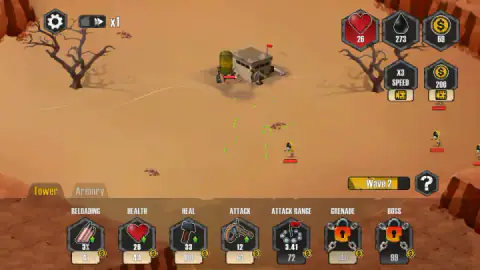
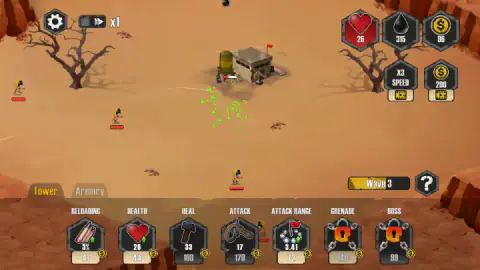
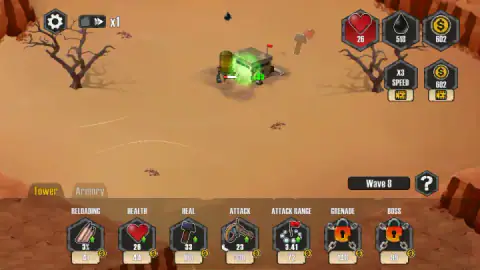
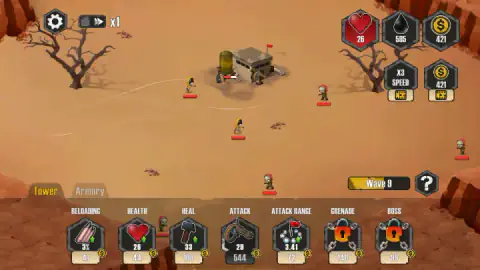
Taken by opening the game ourselves and letting it run — not supplied by the publisher, and not the same picture every other site shows.
How to play We not survive
- Let the bunker shoot. It fires at whatever comes into range. We clicked on the sand and on the zombies themselves several times and nothing we could see changed.
- Watch the three counters at the top right. The red heart is your health, the yellow coin is what you can spend right now, and the black drop is a second currency that this screen never asks for.
- Click a tile to buy a level. The number inside the tile is its current value; the number on the plate below is the price in coins.
- Read the wave bar. It sits at the bottom right and fills with yellow as the wave goes by. When it empties and the number goes up, the next wave has started.
- Lose, and count. When the base falls you get a Results screen with your kills, your record, and two buttons: Restart and Upgrade.
What our run taught us:
- Press "?" before you spend anything. It replaces the icons on all seven tiles with a line of text each. That is how we learned that Heal works by itself, once per wave.
- Waves are short. At normal speed each one lasted about twenty-five seconds for us. There is no shop break between them, so you buy while the shooting goes on.
- A dark price plate means you cannot pay. In the last photo on this page the Attack plate is dark: it asks for 544 coins and we held 421.
- The keyboard is not needed. We tried the arrow keys, Space and Enter and saw no response. Everything is done with the pointer.
Controls
| Click an upgrade tile (bottom row) | Buys one level of that upgrade if you have the coins printed under it |
|---|---|
| ? button (right, next to the wave bar) | Swaps the icons on the seven tiles for a one-line explanation of each |
| Tower / Armory tabs | Switch the bottom panel; we stayed on Tower the whole run |
| Speed toggle (top left, reads x1) | Changes the pace of the attack, according to the developer; we left it at x1 |
| Film-icon buttons (top right) | X3 SPEED and a coin bonus, both marked as ad rewards |
Features
- One base in the middle of the screen and enemies walking in from the edges; the gun picks its own targets
- Seven upgrade tiles on the Tower tab, two of them padlocked at the start (Grenade and Boss)
- Three counters at the top right; health, black drops and coins
- A wave bar that fills as the wave goes by; we went from wave 2 to wave 9 in about three minutes
- A Results screen that counts kills and keeps your record
- Made by Studio9856
Game details
- Developer
- Studio9856
- Release date
- November 2024
- Last updated
- August 10, 2026
- Added here
- March 2025
- Technology
- HTML5 (Unity WebGL)
- Platforms
- Browser (desktop, mouse), Browser (mobile & tablet)
- Saved progress
- Saving, when available, is managed by this game. Mava cannot confirm your level.
FAQ
How do you play We not survive?
You do not aim or shoot. A bunker in the middle of the desert fires by itself at the zombies walking towards it, and every kill pays coins. Your job is to spend those coins on the row of upgrade tiles at the bottom of the screen so the bunker keeps up with each new wave.
Can you win We not survive?
We did not find an ending. The game counts waves upward and, when the base falls, shows a Results screen with your kills and your record. We reached wave 9 with the base intact and stopped there, so we cannot say whether a final wave exists.
What do the upgrades in We not survive do?
The game's own help lists them. Reloading makes the gun reload faster, Health raises your maximum health, Heal restores health at the start of each wave, Attack is the weapon's damage and Attack range lets it reach further. Grenade adds grenade damage and Boss raises what bosses pay, but both were padlocked in our run.
Which upgrade should you buy first in We not survive?
We bought Attack three times and nothing else, and that carried the base to wave 9 at full health. Be aware that its price climbs fast: 63 coins, then 170, then 330, then 544. Reloading, Health and Attack range were still at 41, 44 and 72 coins when we stopped, so they are the cheap levels we left untested.
Is Heal worth buying in We not survive?
Not at the start, as far as we can tell. Heal began at 33 and the base's health at 26, so the free heal at the start of a wave already refilled the bar completely. Raising Heal should only matter once Health has gone past it.
What are the X3 SPEED and coin buttons in We not survive?
They sit under the counters at the top right and both carry a film-strip icon, the usual mark of a reward you get for watching an ad. One triples the game speed. The other offers coins: it read 200 while we had fewer than that, and later matched our own coin total.
What are the black drops for in We not survive?
We do not know for certain. The drop counter rose all through our run, from 273 to 595, and nothing on the Tower tab spends it. Our guess is that it pays for the Armory tab or the Upgrade button on the Results screen, neither of which we opened.
Who made We not survive?
It is credited to Studio9856. It was published on 19 November 2024 and was last updated on 10 August 2026.