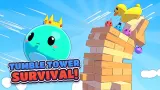



About Tumble Tower Survival
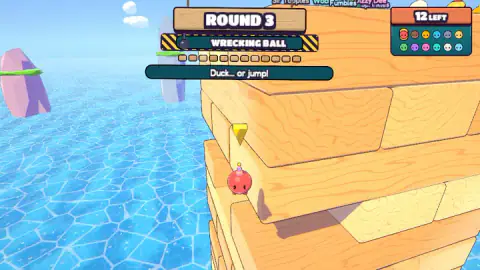
Twelve start. One is left. A hundred other browser games will tell you that much, and most spring their hazards as a surprise, because surprise is cheap. This one hangs a wooden sign over the arena and tells you what is coming: WRECKING BALL, and underneath, in plain words, "Duck... or jump!"
The number twelve is not fixed either, the detail nobody mentions. Press nothing on the title screen and look right instead: a panel headed MATCH SETUP holds the word TUMBLERS with an arrow on each side of the figure 12, and under it BOT SKILL with another pair of arrows around the word NORMAL. The size of the field you are fighting and the quality of the opposition are both dials, sitting there before the first round starts.
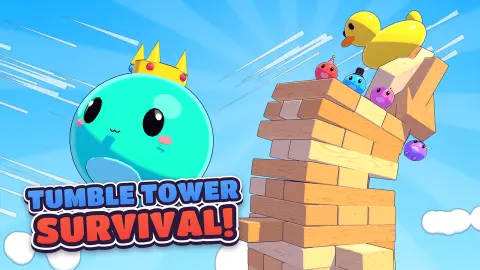
What you are fighting on is the top of a tower. The game's own how-to-play box calls it a giant wobbly tower of blocks, and the title screen shows it: a tall staggered stack of planks rising out of a rock in a turquoise sea. The flat top of that stack is the arena. You are a small round character with a name floating over your head — Butterfingers, Sir Topples, Professor Pop, Tumbleweed — and so are the eleven others, most of them in hats. Fall in the water and you are out, a rule the menu prints in yellow: "Last tumbler standing wins!"
One thing before the rest, because it shapes this page. We never won a round outright and we were never the last tumbler standing. Our best finish in ten minutes was #11 of 12.
Every disaster has a name, and the name is half the instruction
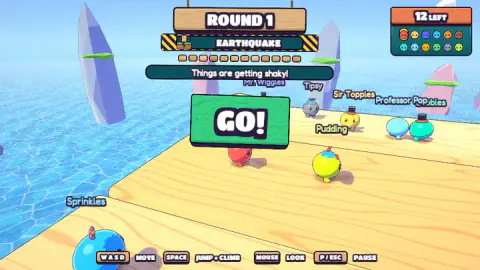
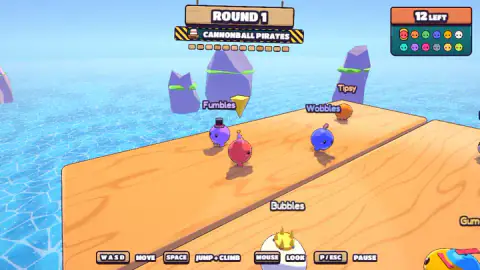
Eight turned up in one session, each announced the same way: a round number on a hanging board, then a striped bar carrying the hazard's name and a small drawing of it — a tornado, a goo drop, a bowling ball, a cannon, a bomb on a chain.
Four of the eight also printed a line of advice, and the advice is literal. WRECKING BALL says "Duck... or jump!", and a ball on a chain comes through at body height. TORNADO says "Hold onto your hats!" SLIME TIDE says "The goo is rising. Climb!" — which is the one round where the Space key stops being a jump and starts being a ladder. EARTHQUAKE only warns you that "Things are getting shaky!", and the floor obliges.
The other four we caught after their line had cleared, so we cannot quote them. CANNONBALL PIRATES fires red balls across the deck, BOWLING BASH rolls something considerably larger, and DUCK DOWNPOUR drops giant rubber ducks onto the planks. THE HAND we met twice and never saw properly, because both times it was the round that put us out.
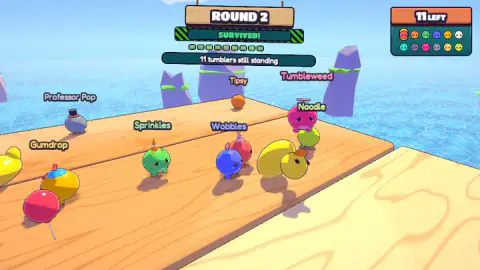
Between rounds the striped bar turns green and reads SURVIVED, with the head count underneath — 11 tumblers still standing — and the tile row green instead of tan. That bar is the only congratulation the game gives you for still being alive.
Twelve tumblers, one survivor, and the arithmetic of that
Here is the part worth doing on paper. In a knockout where everyone is equally matched and luck decides, a field of twelve gives every player the same one-in-twelve chance of winning — a little over eight per cent — and an average finish of six and a half. Dead last is as likely as first. That is why real tournaments bother with seeding: an unseeded knockout does not reward being better, it sorts.
Which makes our own record informative rather than embarrassing. We finished #12 of 12 again and again, and once reached #11. Luck alone would have landed us mid-table sooner or later. Finishing at the bottom that consistently is evidence that position on the planks is a skill, and that standing still in the wrong square is a decision the game punishes.
It also makes MATCH SETUP the most interesting button on the title screen: reduce the field and you raise your share of the one win on offer. We left it on twelve all session.
The rubber ducks falling into the sea in round two really happened
DUCK DOWNPOUR looks most like a joke: bath ducks the size of a tumbler, raining out of a blue sky onto a wooden platform and bouncing players into the water. It is also the round with a true story behind it.
On 10 January 1992, a storm in the North Pacific near the International Date Line swept twelve shipping containers off the deck of the Ever Laurel, bound from Hong Kong to Tacoma. One of them held 28,800 plastic bath toys — yellow ducks, blue turtles, green frogs and red beavers, in equal numbers. They did not sink. The toys were moulded without holes, so they took on no water, which is precisely why they mattered.
Two Seattle oceanographers, Curtis Ebbesmeyer and James Ingraham, were building a model of ocean surface currents at the time and realised what had been handed to them: tens of thousands of identical floating markers, released at a known point on a known day. Ten toys came ashore near Sitka, Alaska, that November, some 3,200 kilometres from the spill, and around four hundred were recovered along the Gulf of Alaska within eighteen months. A few are reckoned to have drifted more than 27,000 kilometres, spending years locked in Arctic ice.
So the round has the physics the right way round. Those ducks float, stubbornly, for decades — and in this game floating is the one thing that saves nobody, because the water is the line between still in and out.
Losing still counts: tumble points and the knockout card
The corner of the title screen carries a plaque reading LEVEL 1 and, below it, a bar labelled TUMBLE POINTS. Ours began empty, at zero of a hundred and twenty. Several matches later, having finished last in every one of them, it read thirty with a green sliver filled in. Taking part pays, slowly.
The knockout card is where the game asks for something back. YOU'RE OUT comes with your placing, SPECTATE, PLAY AGAIN, MENU — and a green button reading WATCH AD: DOUBLE TUMBLE POINTS. It is an offer, not a toll, and PLAY AGAIN sits right underneath it. Beyond that, a portal like this one runs an advert slot between games. Nothing inside a round ever interrupted us.
Two things the game promises that we cannot vouch for: the power-ups its own listing calls life-saving, and the hats and colours behind the CUSTOMIZE button. Tumblers around us wore top hats, chef's hats and party hats, and one a small gold crown — but we never opened that screen, so what is in it is the listing's account, not ours.
More last-one-standing games
If the thinning field is what brought you, Run Royale Knockout runs the same idea as an obstacle course, and Ragdoll Battle Royale: Throw Down the Enemy keeps the platform and the water but lets you do the pushing. Survival Race swaps the planks for a hexagonal arena whose tiles collapse as you drive over them, the same tension at speed, and Break a Tower: Obby is about the block stack rather than the people on it. The rest are in action games.
Screenshots
How to play Tumble Tower Survival
- Press the yellow PLAY button on the title screen — but set TUMBLERS and BOT SKILL in the panel beside it first, because that is the only moment they can be changed.
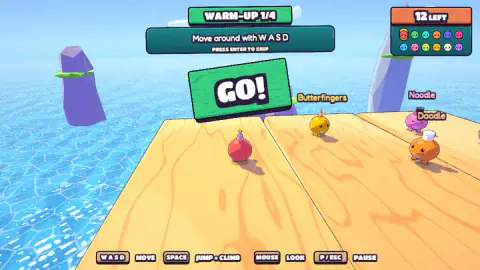
- Take the warm-up. It is labelled WARM-UP 1/4 and its first lesson prints "Move around with W A S D" across the screen. Enter skips it, which is what we did, so we never saw lessons two to four.
- Read the sign before you move. The round number hangs on wood, the disaster's name sits on a hazard-striped bar underneath with a little pictogram of itself, and any instruction comes in a dark pill below that.
- Move with W, A, S and D, jump and climb with Space, and swing the camera with the mouse. The full legend never leaves the bottom edge of the screen.
- When you do go in the water, the card reads YOU'RE OUT and gives you your placing. SPECTATE follows the survivors, PLAY AGAIN deals a fresh match.
What only sitting in front of it teaches:
- The gold ring in the corner panel is you. Twelve faces sit in a six-by-two grid under the count of who is left, and exactly one of them wears a gold ring. Everyone who has gone in the water keeps their slot, with their eyes crossed out.
- The tile row is the round's clock. Twelve small tan tiles appear under the disaster's name when it is announced. We counted five of them part-way through one round and three, glowing red, late in another.
- The mouse is captured, and losing it stops you. Click outside the game or press Esc and it hands the pointer back, with a small notice reading "Click to keep playing" at the top. Until you click, you are steering nothing.
- Spectating is not a clean camera. After one knockout it put us inside the plank stack, looking at a wall of wood with WATCHING BUBBLES along the bottom and a FAST button beside it.
- Pausing costs nothing. P or Esc brings up a panel headed PAUSED with RESUME, SETTINGS and QUIT TO MENU. The round sign and the tile clock wait behind it.
Controls
| W, A, S, D | Moves your tumbler across the planks. The game prints this itself in the legend along the bottom edge, and the first warm-up lesson spells it out again |
|---|---|
| Arrow keys | Listed by the game as the same move. In our session, pressing them changed nothing we could see on screen |
| Space | Jump, and climb when you are against a block. The legend labels it JUMP + CLIMB, and the SLIME TIDE round asks you to climb by name |
| Mouse | Turns the camera. The game captures the pointer, so if you click away or press Esc it hands the mouse back and shows a small notice reading "Click to keep playing" |
| Mouse wheel | Zooms the camera in and out, per the game's own listing. We left the camera where it was |
| P or Esc | Opens a wooden panel headed PAUSED with RESUME, SETTINGS and QUIT TO MENU, plus a speaker toggle. The round sign and the tile clock stay visible behind it |
| Enter | Skips the warm-up, printed on screen as PRESS ENTER TO SKIP. We pressed it, which is why we only ever saw the first of the four lessons |
| Drag, pinch and the JUMP button | The touchscreen set, per the game's own listing — drag the left half to move, drag the right half to look, pinch to zoom, with JUMP and pause buttons on screen. We played with a mouse, so this is the listing's claim rather than ours |
Features
- Every round is a named disaster announced on a signboard before it lands: we met EARTHQUAKE, TORNADO, CANNONBALL PIRATES, WRECKING BALL, BOWLING BASH, SLIME TIDE, DUCK DOWNPOUR and THE HAND
- Four of those announcements came with a one-line instruction attached, among them "Duck... or jump!" and "The goo is rising. Climb!"
- The field size is a setting, not a constant: the title screen holds arrows either side of TUMBLERS 12 and a second pair either side of BOT SKILL NORMAL
- The survivor panel keeps a slot for all twelve players, rings yours in gold and crosses out the eyes of everyone who has gone in the water
- A row of small wooden tiles under the round name runs the round's clock down, turns red near the end and comes back green under the word SURVIVED
- Losing still pays: ten minutes of last places moved the bar from zero to thirty of the hundred and twenty tumble points a level costs
- The whole control legend is printed along the bottom edge of the screen permanently, so there is nothing to look up
Game details
- Developer
- Partner studio
- Release date
- October 2026
- Last updated
- October 25, 2026
- Added here
- October 2026
- Technology
- HTML5 (3D)
- Platforms
- Browser (desktop), Browser (mobile & tablet, touch)
- Classification
- 3D , Action , Arcade , Multiplayer
- Saved progress
- Saving, when available, is managed by this game. Mava cannot confirm your level.
FAQ
How do you play Tumble Tower Survival?
You control one small round tumbler standing on the flat top of a giant tower of wooden blocks in the sea. Each round the game announces a disaster on a signboard and then sets it loose, and anyone who ends up in the water is knocked out of the match. You move with W, A, S and D, jump and climb with Space, and turn the camera with the mouse. The last tumbler standing wins the match.
How many players are in a match of Tumble Tower Survival?
Twelve by default, and you can change it before you start. The title screen carries a MATCH SETUP panel with arrows either side of the number of tumblers and a second pair either side of the skill of the computer opponents. We left both alone all session, so we cannot say how low or how high either setting goes, only that both are adjustable from that screen.
What are the rounds called in Tumble Tower Survival?
Each one has its own name on a hazard-striped bar under the round number. We saw eight across one session — EARTHQUAKE, TORNADO, CANNONBALL PIRATES, WRECKING BALL, BOWLING BASH, SLIME TIDE, DUCK DOWNPOUR and THE HAND. Four of them printed a line of advice underneath, including "Hold onto your hats!" for the tornado and "Duck... or jump!" for the wrecking ball.
What are tumble points in Tumble Tower Survival?
They are the game's experience points, shown on a bar in the corner of the title screen. Our bar started at zero of a hundred and twenty for level one and reached thirty after a run of matches in which we finished last every time, so points accrue from taking part rather than from winning. The knockout screen also offers a video button that doubles the points from that match.
What happens when you are knocked out in Tumble Tower Survival?
A wooden card drops over the screen headed YOU'RE OUT, with a crying face and your final placing written large, for example
Can you play Tumble Tower Survival on a phone?
The game's own listing says yes and describes the touch controls — drag the left half of the screen to move, drag the right half to look, pinch to zoom, with an on-screen JUMP button and a pause button in the corner. We played it with a mouse and keyboard on a desktop browser, so the phone layout is the listing's claim rather than something we tested.
Are there ads in Tumble Tower Survival?
The only advertising prompt we met was optional, and it is the green WATCH AD button on the knockout card, which doubles that match's tumble points and can simply be ignored in favour of PLAY AGAIN. An advert slot also sits between games on a portal like this one, which a normal player will see. Nothing in the rounds themselves asked us to watch anything.
Who made Tumble Tower Survival, and is it free?
It is free and runs in a browser with nothing to install. The studio behind it is not recorded anywhere we can check, so this sheet names no author rather than guessing one. It reached our catalogue on 24 October 2026, which makes it days old at the time of writing rather than a back-catalogue title.