





About Sway - Tower Builder
Most one-tap stacking games punish the first mistake with the end of the run. Drop a block a little to the left and either the overhang is sliced off and you keep going on a thinner tower, or the whole thing is declared lost. Sway - Tower Builder does neither. Your block lands where it lands, crooked or not, and if it slides off the side you lose a heart and drop the next one onto the same tower. You get three hearts. The run ends on the third miss, under a card that reads "Toppled!" even when the tower is still standing.
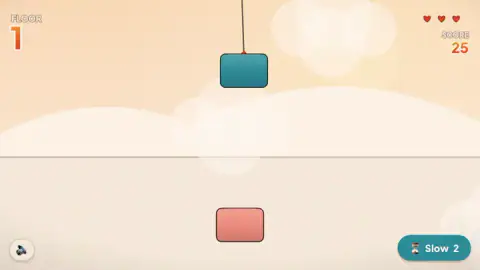
The screen is as plain as the rule. A cream and peach sky with pale round clouds, a thin grey horizon, and a rounded block in pink, teal, red, lavender or yellow hanging from a line so thin you may miss it, swinging left and right. FLOOR sits in the top-left corner, three hearts and SCORE in the top-right, an hourglass button marked Slow in the bottom-right. The first run opens with a ring on the ground and the words tap to drop.
The title screen names the studio as Everwuss Studio, under a strapline that doubles as the manual: stack it high, keep it steady. A line of small print at the bottom says the game is made after tower_game, an open-source project, with music by Matthew Pablo under a CC-BY licence. We played it for ten minutes on a computer: about ten runs, most of them over on the first or second floor, and one that reached floor 5 with 150 points and a New best label. What follows is what those runs showed.
Three hearts change what a miss means
In a stacking game that ends on the first slip, every tap carries the whole run. Here a miss is a setback. The block tips, slides down the side of the tower at an angle, and comes to rest on the ground next to it; a heart in the corner turns pale; the next block is already swinging. The floor count stays exactly where it was, so a miss costs you time and a life, never progress.
That makes the hearts the real clock. In our runs the pattern repeated: all three full on the first floor, two gone by the time the stack was tall enough to be hard, and then the card. The run that reached floor 5 did so on its last heart. The Toppled card appears whether or not anything has fallen; the name describes the run, not the blocks.
Two buttons on that card extend a run instead of restarting it. Watch ad · Revive is the teal one at the top; Extra life · $0.50 is the red one under it. We pressed neither, so we cannot tell you whether a revive gives back one heart or three. Play again, at the bottom, costs nothing and puts a fresh pink block on the line.
Every floor pays 25, a clean one pays 50
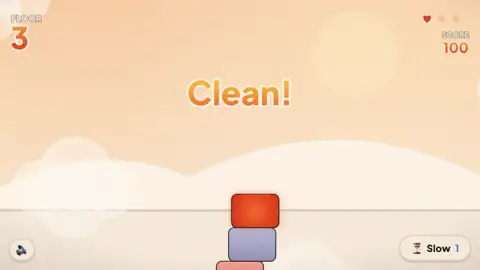
The score has two values and nothing else. An ordinary landing adds 25; a block that lands almost exactly on the one below gets a word across the sky, Clean or Perfect, and adds 50. The third block of our first run earned that word. Our best run reached 150 over five floors, so it held one centred drop among the five.
The floor count is a count of blocks that stayed on, starting at zero before the first one lands. There is no level, no target and no finish line that we saw; the only numbers to beat are your own best, printed on the Toppled card, and the leaderboard behind the button of that name. When we opened it, the list held two names tied for first at 225 points, Minimum Wildcat and Effective Gopher. Our 150 was not on it, which we take to be the Sign in button doing its job.
The blocks are not trimmed, and the tower remembers
The design choice that gives the game its name is physical. In many stacking games an off-centre block is cut to the overlap, so the tower narrows but stays straight. Here the block keeps its full size and lands as it falls. One that arrives a little off sits a little off; one that arrives tilted settles tilted, as the purple block did in one of our runs before it slid away altogether.
The result is a tower that carries its history. A floor that landed left of centre gives the next block a smaller flat surface to find, and a block that half-hangs over an edge leaves a shelf that the next one can catch on. By floor 4 or 5 the stack has drifted sideways and the camera has followed it down out of the frame, so you are aiming at the two topmost blocks and guessing the rest from memory.
The Slow button is there for exactly that moment. It carries an hourglass and a number, three when you first arrive. Press it and the button turns teal while the charge lasts, then goes white again with one fewer on the count. What slows is, by the button's own name, the swing; we did not measure by how much. The count did not refill when we started a new run, so treat the three as a budget for the sitting rather than for each attempt.
Ads, the shop and what we did not reach
The game is free and says where its money comes from. Between runs a dark card came up over the sky reading We skipped the ad this time - enjoy the game, with a purple Continue playing button; that is an ad slot, and on another day it may hold an ad. The two paid routes, a video for a revive and 0.50 dollars for a life, sit on the Toppled card and nowhere else. Nothing interrupted a run while blocks were falling.
Things we saw but did not try: the Sign in button, the small flag button in the top-right corner of the title and Toppled screens, which we take to switch language, and the speaker button in the bottom-left corner. We never watched a revive, so what a revived run looks like we cannot say. Our session recorded no sound, so we say nothing about the music beyond the credit on the title screen.
Who it is for, and more one-tap towers
This is a game for the two minutes between other things. One finger, one decision per block, a run that lasts as long as your aim and no further. A young child can play it from the first tap; the hearts give them room to miss. Someone who has played the trimmed kind of stacking game will find the untrimmed blocks the harder half, because a bad landing is not corrected for you.
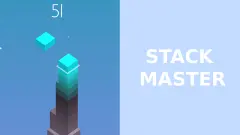
If you want the other rule, Stack Master slices the overhang off every block and ends the run the moment nothing is left to land on, and Mochi Mochi Tower drops sticky rice cakes in a cherry-blossom garden and ends on the first one that slides off. Panellka: Build a Tower is the closest cousin: a crane swings each floor on its cable, floors are never trimmed, and every miss shifts the weight of the tower.
More in our arcade games.
Screenshots
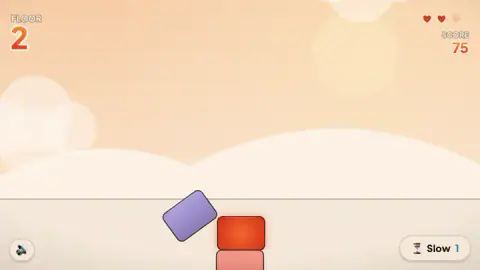
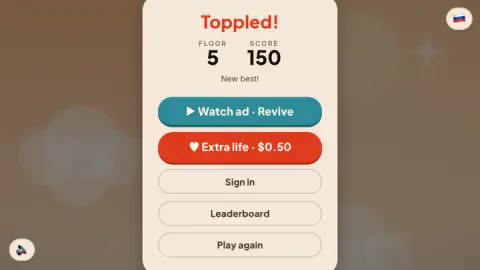
Taken by opening the game ourselves and letting it run — not supplied by the publisher, and not the same picture every other site shows.
How to play Sway - Tower Builder
- Press Tap to start. The red button in the middle of the title screen takes you straight into a run; there is no menu between.
- Wait for the swing to cross the middle, then tap. The block hangs from a line and swings in a steady arc. Your tap lets it go from wherever it is, and it falls straight down. The first one lands on the ground and reads FLOOR 1, SCORE 25.
- Stack the next block on the last one. Each block that stays on top adds a floor and 25 points. Land it almost dead centre and the game flashes Clean or Perfect across the sky and pays 50.
- Watch the hearts, not the tower. A block that slides off lies on the ground beside the stack and one heart fades; the floor count does not move. The third fade ends the run.
- Choose from the Toppled card. Play again is free. Above it sit Watch ad · Revive, Extra life · $0.50, Sign in and Leaderboard.
Tips from our run:
- The line is the tell. The block swings on a thread you can barely see, and its angle shows which way the block is travelling better than the block does. Drop when the thread is vertical and the block is over the stack.
- Spend Slow early or not at all. The button holds three charges for the whole sitting; ours read Slow 1 at the start of every run after the first few minutes. A charge wasted on floor 1 is one you will not have at floor 5.
- A crooked floor is permanent. Blocks keep the offset they land with. Our best tower had a pink block sitting well to the right of the lavender one under it, and every drop after that had less to aim at.
- The stack scrolls away from you. By floor 4 only the top two blocks are visible above the bottom edge, so judge the landing by the top block alone.
Controls
| Tap or click anywhere | Drops the block that swings on the line; the first tap of a run also dismisses the tap to drop prompt |
|---|---|
| Slow button, bottom right | Spends one of three hourglass charges; the button turns teal while it lasts, and the count did not refill between our runs |
| Play again | Starts a new run from the Toppled card |
| Watch ad · Revive and Extra life · $0.50 | The two ways the Toppled card offers to keep a run going; we pressed neither |
| Leaderboard and Close | Opens and closes the score list over the Toppled card |
| Speaker button, bottom left | Sound toggle |
Features
- One input for the whole game: a block swings on a thin line and your tap drops it onto whatever is below
- Every landing is worth 25 points; a landing the game calls Clean or Perfect is worth 50
- Three hearts instead of sudden death: a block that slides off costs a heart and the tower stays; the third miss brings up the Toppled card
- Blocks keep the tilt and offset they land with, so a crooked floor stays crooked for the rest of the run
- Three Slow charges per sitting, shown on an hourglass button that turns teal while a charge is running
- The Toppled card offers a revive for a video, an extra life for 0.50 dollars, a sign-in and a leaderboard whose top scores read 225
- An ad slot sits between runs: a card reading We skipped the ad this time appeared before several of ours
Game details
- Developer
- Everwuss Studio
- Release date
- August 2026
- Added here
- June 2026
- Technology
- HTML5 (2D physics)
- Platforms
- Browser (desktop), Browser (mobile & tablet, touch)
- Saved progress
- Saving, when available, is managed by this game. Mava cannot confirm your level.
FAQ
How do you play Sway - Tower Builder?
A block hangs from a thin line at the top of the screen and swings from side to side. You tap or click anywhere to let it go, and it falls onto the ground or onto the block below. Each block that stays on adds a floor and 25 points. You have three hearts; a block that slides off the tower costs one, and when the third goes the run ends on a card called Toppled.
How does scoring work in Sway - Tower Builder?
A plain landing adds 25 points and one floor. A landing the game calls Clean or Perfect, when the block sits almost exactly on the one below, adds 50 instead. The floor count only rises when a block stays on, so a run that ends at floor 5 with 150 points, as our best did, had one well-centred drop in it.
What happens when you miss in Sway - Tower Builder?
The block slides off the side of the tower and lies on the ground beside it, one of the three hearts in the top-right corner fades, and the floor count stays where it was. The tower itself does not fall. After the third miss a card reading Toppled shows your floor and score, your best, and the options to revive by watching an ad, buy an extra life for 0.50 dollars, sign in, open the leaderboard or play again.
What does the Slow button do in Sway - Tower Builder?
It is the hourglass button in the bottom-right corner with a number next to it, three when you start. Pressing it spends a charge and the button turns teal while the effect lasts, which from its name we take to slow the swinging block. The count did not refill when we started a new run, so the three charges are for the whole sitting rather than for each attempt.
Does Sway - Tower Builder have ads or in-app purchases?
Both are offered, and neither is forced on you during a run. The Toppled card has a Watch ad · Revive button and an Extra life · $0.50 button above the free Play again. Between runs a card appeared reading We skipped the ad this time - enjoy the game, with a Continue playing button, so there is an ad slot there as well. We watched no ad and bought nothing.
Is there a leaderboard in Sway - Tower Builder?
Yes, behind a Leaderboard button on the Toppled card, with a Sign in button above it. When we opened it the list held two names tied for first place at 225 points, Minimum Wildcat and Effective Gopher. Our own best of 150 did not appear, which we put down to never signing in.
Can you play Sway - Tower Builder on a phone?
The whole game is one tap, so it suits a touchscreen, and the portal lists it in portrait for phones. We played it on a computer in a landscape window and everything fitted: the floor count top-left, hearts and score top-right, the Slow button bottom-right. The title screen itself says Tap to start.
Who made Sway - Tower Builder?
The title screen credits Everwuss Studio, with the name printed above the Sway logo and the strapline stack it high, keep it steady. A line at the bottom of the same screen says the game is made after tower_game, an open-source project under the MIT licence, that the music is by Matthew Pablo under a CC-BY licence, and that it runs Bridge. The portal's listing gives no developer name, so the screen is our only source.