







About Mochi Mochi Tower
A tower game needs something that stacks. Blocks stack. Crates stack. Mochi is close to the worst material in a Japanese kitchen for the job: it is rice pounded until the grains vanish into one soft mass, it keeps no edges, and it sticks to whatever it touches. Every January the Tokyo Fire Department has to remind people to cut it into small pieces before swallowing it. Mochi Mochi Tower builds an entire arcade game on that one awkward property, and the joke holds up.
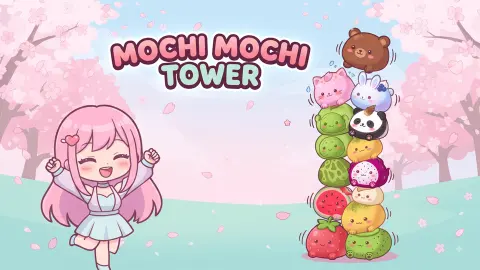
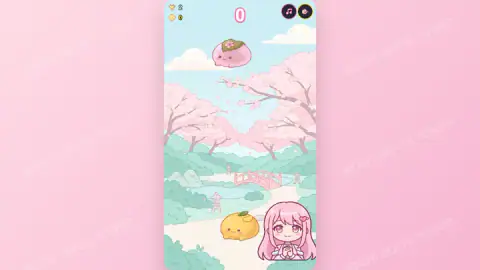
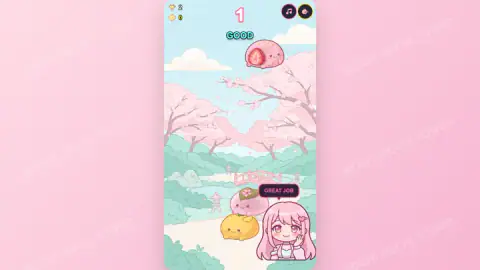
The game itself is one tap wide. A rice cake with a face hangs in the air above a cherry-blossom garden. You tap, it drops straight down, and it either settles on the one below it or it does not. There is no steering, no second input and nothing to adjust mid-fall. The number across the top of the screen counts the ones that settled, a word flashes underneath it, and the girl in the bottom-right corner turns to you with a speech bubble. Ours said GREAT JOB.
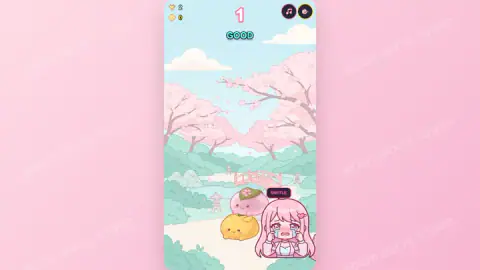
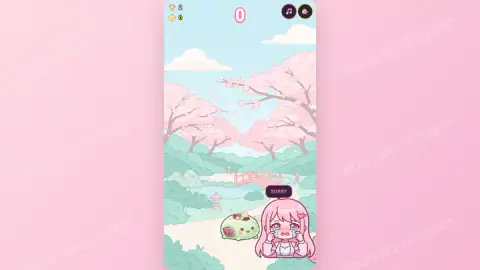
What happens on a miss is the part the screenshots do not prepare you for. The same girl bursts into tears, her bubble changes to SNIFFLE and then SORRY, and a dark card comes up reading "GAME OVER!" with a crying portrait, a trophy, a coin count and two buttons: a play arrow and a little house. The counter resets. Nothing from the run you just lost comes with you except the two small totals in the corner.
Mochi Mochi Tower is by YokaiWorks. It was published in August 2026.
Mochi is a bad building material, and that is the joke
Most sweets are baked or moulded. Mochi is beaten. The traditional method, mochitsuki, starts the night before by soaking glutinous rice, steams it in the morning, tips it into a heavy mortar called an usu, and then two people work in rhythm: one swings a wooden mallet, the kine, and the other darts a hand in between blows to fold and turn the mass. The whole thing is a race against the rice going cold, because once it cools it will not come together.
What that produces is not dough and not cake. It is a single elastic lump with no grain structure left, which is why it holds a shape badly, slumps under its own weight and grips anything it rests on.
That property has a serious side. Japanese New Year is the season for mochi, and it is also when people choke on it. In Tokyo alone, over five years to 2024, the fire department recorded 338 people taken to hospital after choking on mochi, of whom 33 died. Around four in ten of those cases fell in January, and the great majority of the patients were elderly. The standing advice from the fire department is blunt: cut it into small pieces before you eat it, and chew well.
Put that next to the game and the design reads differently. A tower of mochi is a tower of things that deform, grip and slide, and the game's whole difficulty is that you are stacking the one sweet famous for not behaving. Even the title says so. Mochimochi is a Japanese texture word, the chewy, springy, slightly resistant feel you get from pounded rice or from very good bread, and doubling the name is closer to "chewy tower" than to "mochi tower".
What is actually on the screen
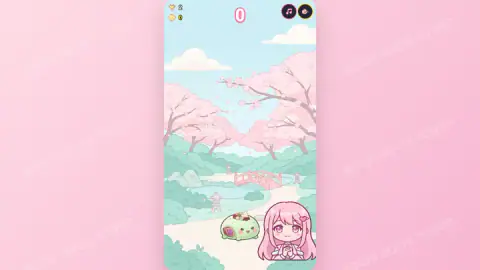
The garden is drawn once and never changes: cherry trees in full blossom with petals crossing the frame, rounded green hills, a stream with a red arched bridge and a stone lantern beside it, and a pale path across the front. The girl stands at the right-hand end of that path, and the stack grows beside her.
The mochi themselves are the variety. In one short session we saw a plain pale-yellow one, a pink one wearing a dark green sakura leaf, one cut open to show a strawberry inside, and a green matcha one speckled with tiny flowers. Which one you start on changes between runs: ours was yellow in one, green in the next.
The counters are worth knowing. The number in the middle of the top edge is your current stack and it resets to zero on a miss. The trophy and the coin in the top-left corner do not reset. Two round buttons sit in the top-right corner, one a music note for the sound and one marked with a pink flower, which we left alone.
It is a phone game, and on a desktop you will notice
This matters before you click Play. The playfield is a tall, narrow column, the shape of a phone held upright. On a desktop monitor it sits in the middle of the window with wide pink margins on both sides, and the game occupies roughly a third of the width available to it.
Nothing is cut off and nothing is broken, but the picture is small, and the mochi in the sky is a modest shape rather than the centrepiece it is on a phone. If you have the choice, play this on a phone or a tablet.
What we saw, and what we did not
We played for about four minutes, across several runs. The tallest stack we built was two mochi high, which means we never saw what the tower looks like once it is genuinely tall, whether the camera pulls back, or whether the pieces start wobbling the way the game's own promise suggests.
Our coin counter read zero in every single moment of the session. So although there is a coin total in the corner and a shopping-bag icon on the title screen, we cannot tell you what a pack of mochi costs, what the mascot outfits look like, or how coins are earned in the first place. We saw neither.
Twice a dark card came up over the garden offering to carry the run on in exchange for watching an advert, with a close button beneath it. We pressed close both times, so we did not see what an advert break looks like here or how far a continue takes you.
Who it is for
This suits anyone who wants a game that explains itself in one picture: a child who cannot read yet can play it, because the instruction is a hand and the words TAP TO DROP. There is no clock, so the piece waits for you.
It is not a game with much to chew on past the first few minutes. One input, one failure condition, one score. If the cherry-blossom garden and the crying mascot are not doing something for you, there is not a second layer underneath.
More one-tap games to try
Watermelon: Falling Animals is the nearest relative we have: drop things from above, let them pile up, and watch physics decide whether the pile holds. Color Shot throw the ball is the same single decision of when to release, with a moving target instead of a stack. Jumping Bottle 3D turns one tap into a landing problem rather than a stacking one. If the art is what drew you in, Paper Doll Diary - Chibi Dolls and Anime Avatar Maker: Anime Doll work in the same soft anime style with nothing to lose. More games built on a single button are in the arcade category.
Screenshots
How to play Mochi Mochi Tower
- Wait for the mochi to appear in the sky above the garden, then tap or click anywhere. That is the only control we could find.
- The piece falls straight down from where it was when you tapped. Aim for the top of the mochi already sitting on the path, not for the middle of the window.
- Every one that stays adds one to the number at the top, and a rating word appears under it.
- One miss ends the run. On the GAME OVER! card, the play arrow starts again from a single mochi and the house button returns you to the title screen.
- The trophy and the coin in the top-left corner survive a failed run. The big number does not.
Tips from our session:
- The only decision is when. We tried the arrow keys and the space bar and got no response we could see or hear. Nothing steers the falling mochi, so the game is entirely about the instant you let go.
- The stack is not centred. It sits low and to the right, on the path next to the girl. On a desktop your eye goes to the middle of the window, which is the wrong place.
- The praise is not the score. In one moment we caught, GOOD was still glowing at the top of the screen while the girl below it was already in tears. The rating word lingers; the number is what counts.
- Expect short runs at first. We never got past two mochi. The margin on a drop looks generous in a still image and is not generous at all in motion.
Controls
| Tap or click anywhere | Drop the mochi waiting in the air onto the stack below |
|---|---|
| Music-note button (top right) | Turn the sound on and off |
| Play arrow on the Game over card | Start another run from a single mochi |
| House button on the Game over card | Go back to the title screen |
Features
- One input and nothing to steer: the whole game is the moment you let go
- A counter at the top that goes up by one per mochi landed and back to zero the moment you miss
- Rating words over the stack, GOOD among them, and a mascot who answers with GREAT JOB, SNIFFLE or SORRY
- At least four kinds of mochi seen in one short session: plain, sakura leaf, strawberry and matcha
- A trophy and a coin counter in the corner that survive a failed run, unlike your score
- A tall, narrow playfield drawn for a phone, with pink filling the rest of a desktop window
Game details
- Developer
- YokaiWorks
- Release date
- August 2026
- Last updated
- August 1, 2026
- Added here
- July 2026
- Technology
- HTML5 (2D)
- Platforms
- Browser (desktop), Browser (mobile & tablet, touch)
- Classification
- Arcade , Casual , Fashion & Beauty
- Saved progress
- Saving, when available, is managed by this game. Mava cannot confirm your level.
FAQ
What is Mochi Mochi Tower?
Mochi Mochi Tower is a free browser stacking game by YokaiWorks, published in August 2026. A Japanese rice cake waits in the air above a cherry-blossom garden and you tap once to drop it onto the stack below. The run ends the first time one fails to land, and the counter goes back to zero.
How do you play Mochi Mochi Tower?
You tap or click anywhere, and the mochi currently in the air falls straight down. There is nothing to steer and no second chance at a drop. Each one that settles adds one to the number across the top of the screen, and a word such as GOOD appears under it.
How do you lose in Mochi Mochi Tower?
One bad drop is the whole of it. The mascot in the bottom-right corner bursts into tears, her speech bubble says SNIFFLE or SORRY, and a card reading "GAME OVER!" appears with a play arrow to try again and a house button to go back to the title screen. Your score resets, but the trophy and coin counters in the top-left corner carry over.
Is Mochi Mochi Tower free to play?
Yes. It runs in a browser with nothing to install and no account. Twice in our session a card appeared offering to carry the run on in exchange for watching an advert, with a close button underneath, and we closed it both times rather than watch.
Can you unlock new mochi and outfits in Mochi Mochi Tower?
The game is built for it: there is a coin counter in the top-left corner and a shopping-bag icon on the title screen. We cannot tell you what is behind them. Our coin counter sat at zero for the whole session, so we never had anything to spend and never opened the shop.
Why is the game called Mochi Mochi Tower?
The doubling is not decoration. Mochimochi is a Japanese word for a texture, the chewy, springy, slightly resistant feel of pounded rice, and it is used for good bread as well as for mochi itself. Saying it twice is closer to saying "chewy tower" than "mochi tower".
Is real mochi as sticky as the game suggests?
It is stickier. Mochi is made by pounding steamed glutinous rice until the grains disappear into one mass, so it clings to everything including itself. Every January the Tokyo Fire Department asks people to cut it into small pieces before eating it, after a long run of New Year choking cases.
Does Mochi Mochi Tower work on a phone?
Yes, and that is the shape it was drawn for. The playfield is a tall, narrow column that fills a phone screen and leaves wide pink margins on a desktop monitor. Everything is done with one tap, so a touchscreen loses nothing.