



About Samurai Survivor
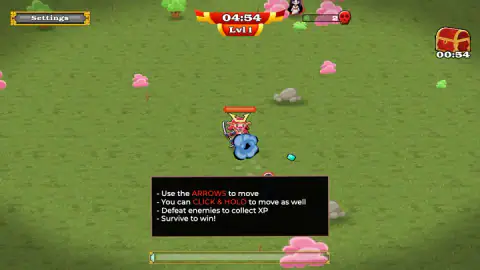
There is no attack button. That is the first thing worth knowing about Samurai Survivor, and the game never quite says it out loud — it drops a black card over the screen listing four lines, three of them about moving, and leaves the katana to look after itself. In our first run the samurai dealt 1,125 damage in nineteen seconds. We pressed nothing. We only walked.
The second thing is the clock, and it is why this plays unlike most things wearing the same coat. It sits on a red banner at the top with Lvl 1 on a gold scroll beneath it, and it runs backwards from 05:00. The last line of that tutorial card gives it away: "Survive to win!" Surviving is not a score here. It is a finish line.
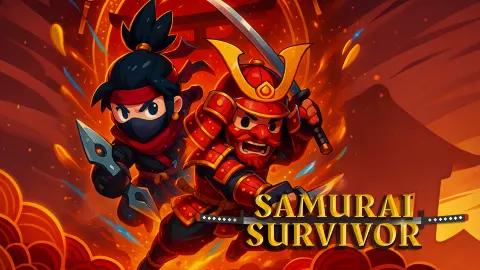
Rising Pixel made it, and it was published in June 2025. The look is cheerful in a way the subject is not: a green meadow, pink blossom bushes, a red-armoured samurai in a gold horned helmet, and a crowd of things out of Japanese ghost stories walking towards him.
The third thing is the confession. We played three runs on a desktop and they lasted nineteen, nineteen and twenty seconds. We never left Lvl 1, never opened a chest, and never saw what this game becomes once it has had time to arm you. Everything below is what we saw, and where that stops, it says so.
Five minutes, counted backwards
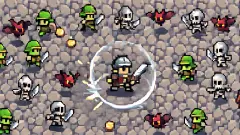
The subgenre has one ancestor, and the label the game's listing hangs on it — survivors-like — names it. Vampire Survivors, by the one-man studio poncle, went into early access in December 2021 and reached version 1.0 on 20 October 2022. Its idea was almost rude in its simplicity: take away the attack button, automate every weapon, and let the player control nothing but where they stand. Everything since, this included, is a variation on that.
But in that game the clock rises, towards thirty minutes, and surviving is a measurement. Here it falls. You are handed five minutes and you spend them.
That changes what a run is for. When the clock rises there is no such thing as finishing: you are always playing for a bigger number. When it falls there is a last second, and your run either reaches it or it does not. Dying at nineteen seconds is not a low score — it is a run you did not finish.
Five minutes is also five chest marks, which gives the thing a tempo rather than a curve, and the ramp that longer games spread over half an hour has to happen here in a few. That is why the opening is busier than the genre usually dares: there is no room for a quiet first wave.
Where our account stops is worth naming. Games built this way nearly always hand you a choice of upgrade on each level-up, and that choice is where the genre's depth lives. We never reached Lvl 2, so whether this one does it, what it offers, and how many skills stack in that table are all beyond us.
The ghosts and the ogres are the real ones
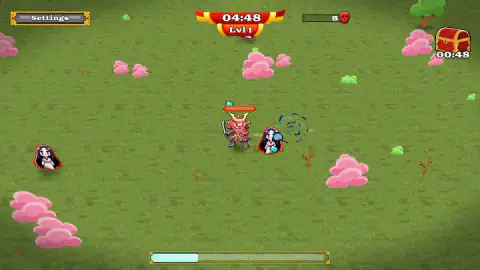
Look closely at the white figure that walks at you in the first few seconds. She is in a white kimono with a red collar and sash, her face is dead white with red streaks running down from black eyes, her hair falls past the hem of the robe — and she has no feet. The robe simply ends above the grass.
That is not a shortcut. It is the Japanese yūrei, drawn to specification. The white robe is a burial garment, the loose black hair is a dead woman's hair unbound, and the missing lower half is the detail that fixes the whole image. Its codification is generally credited to a single hanging scroll: Maruyama Ōkyo's The Ghost of Oyuki, painted in ink on silk around 1750, among the earliest pictures to carry the full late-Edo set — dishevelled hair, white kimono, limp hands, near transparency and nothing below the waist. The caution worth adding is that the image has older roots in kabuki and in woodblock prints, so Ōkyo settled the convention rather than invented it. What is not in doubt is that the ghost in this browser game is wearing an outfit that has been standard for some two hundred and fifty years.
The blue ones are an oni, and they are just as faithful. Blue skin — red and blue are the two usual colours — a single gold horn in wild dark hair, pointed ears, a loincloth, and a spiked club carried on the shoulder. That club is a kanabō, and it is so firmly part of the picture that Japanese has a proverb about it: 鬼に金棒, oni ni kanabō, "an oni with an iron club", said of something already strong that has just been handed one more advantage.
And the two meet the mechanic, which is the only reason any of it belongs here. The yūrei is a haunting: one restless spirit, personal, arriving alone. The oni is a raiding party. The game plays them exactly that way — the ghosts came at us singly and in pairs, the ogres as a block of six. Once you know which is which you can read the field at a glance, and the move when the blue ones appear is to stop walking towards them.
What the Game over sheet actually tells you
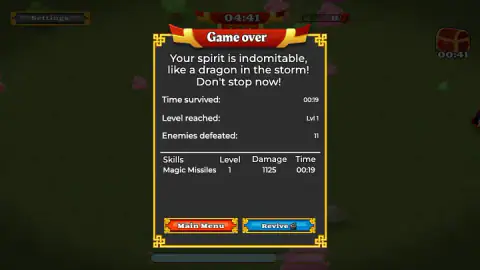
The sheet is better than it needs to be. A red banner reads Game over, a line underneath says "Your spirit is indomitable, like a dragon in the storm! Don't stop now!", and then it gets specific: time survived, level reached, enemies defeated. Below a dividing line sits a table headed Skills, Level, Damage and Time, one row per skill you were carrying.
Ours only ever had the one row: Magic Missiles, level 1, 1,125 damage, 00:19. That single line is the clearest proof of how the game works — we never pressed an attack and never aimed, and that weapon still killed eleven monsters on its own. A table built to hold several skills, each with its own damage total, is also a quiet promise about what a longer run becomes, and a reminder of how little of it we saw.
Two buttons close the panel. Main Menu in red sends you back to the title screen. Revive in blue carries a small video icon; we left it alone, so what happens next is not ours to say.
Three times we read that sheet, and three times it said Lvl 1. Take that as the honest measure here: Samurai Survivor is a short, fast, good-looking horde game whose opening minute is genuinely unkind, and whose middle we have not earned the right to describe.
More from Rising Pixel, and more hordes
Rising Pixel has two other games here, and neither resembles this one: Luna And The Magic Maze is a puzzle, and Slime Clicker is the opposite of anything with a five-minute clock. For the same shape, Deorbit - Space Survivors runs the identical trick with a stranded starship and guns that fire themselves, and Doodle RPG Survivor does it with spells that cast themselves across a notebook page. If the setting rather than the swarm brought you here, Go! Up! Samurai keeps the armour and drops the monsters. The rest are in action games.
Screenshots
How to play Samurai Survivor
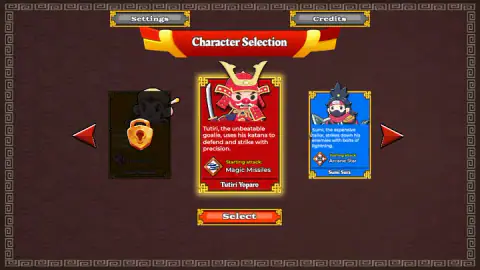
- Press Start on the title screen, then pick a card on Character Selection. The red arrows either side swap which card sits in the middle; the orange Select button takes the one that is there.
- Move. The card says arrow keys, and it also says you can click and hold — the samurai walks towards the pointer for as long as the button is down.
- Walk over the pale blue gems that enemies leave behind. They fill the bar in the gold frame along the bottom edge, which is your experience.
- Watch the orange bar over your own head. That is your health, not a timer, and nothing we saw refilled it.
- Keep the clock running down to 00:00. There is nothing else to do and nothing else to press.
Things we only learned by being there:
- The tutorial card does not pause anything. The clock keeps falling behind it and so do the monsters — ours read 04:54 with a ghost already on screen while we were still on line two. Start moving, then read.
- Moving is aiming. Since the skill fires itself, the only way to decide where the damage lands is to put your body near what you want hit. That is the whole skill ceiling of the opening minute.
- The skull counter goes up, not down. It sits beside a red skull and reads like something draining, but it is your kill count: 2, then 5, then 9 as the clock fell.
- The chest in the corner is a minute hand. Its clock read 00:54 when the main one read 04:54, and 00:41 when the main one read 04:41 — the same seconds, every time we looked. Whatever is in it arrives on the minute.
- The two monsters arrive differently. Ghosts drift in alone or in pairs. The horned ogres do not: twenty seconds in, the field held six of them in one clump, with three ghosts around the edges.
Controls
| Arrow keys | Move the samurai around the field. These are what the game's own tutorial card names first |
|---|---|
| Click and hold, then drag | The other way to move, and the one we used. Your samurai walks towards the pointer for as long as the button is down |
| Touch and drag | The same thing with a thumb. The game is listed for phones and tablets; we played it on a desktop, so that part is its claim rather than ours |
| Nothing at all | There is no attack button and no aim. Your starting skill fires on its own from the moment the run begins |
| Select | Confirms the card in the middle of the Character Selection screen. The red arrows either side swap which card is in the middle |
| Main Menu / Revive | The two buttons on the Game over sheet. Main Menu drops you back to the title screen; Revive carries a small video icon |
Features
- A five-minute countdown instead of a high score: the clock starts at 05:00 and runs backwards, and the tutorial's last line is "Survive to win!"
- No attack button anywhere. Your character's starting skill fires by itself, and moving is the whole of your input
- Three characters, one of them padlocked — Tutiri Yoparo opens with Magic Missiles, Sumi Sura with Arcane Star, and Fatun Nakazata waits behind the lock with Trap Boots
- The counter beside the red skull is your kill count and it climbs: at the end of a run it matched the Enemies defeated line exactly
- A treasure chest sits in the corner on its own clock, which read the same seconds as the main clock every single time we looked
- Enemies drop pale blue gems; walk over them to fill the experience bar along the bottom edge
- The Game over sheet itemises every skill separately by level, damage dealt and time, not just the run total
- The monsters are Japanese folklore drawn straight: footless ghosts in white burial kimono, and horned blue ogres carrying spiked clubs
Game details
- Developer
- Rising Pixel
- Release date
- June 2025
- Last updated
- October 23, 2026
- Added here
- June 2025
- Technology
- HTML5 (Construct)
- Platforms
- Browser (desktop), Browser (mobile & tablet, touch)
- Saved progress
- Saving, when available, is managed by this game. Mava cannot confirm your level.
FAQ
What kind of game is Samurai Survivor?
It is a horde-survival game seen from above: you walk a samurai around an open meadow while monsters close in from every side, and your weapon attacks for you. It is filed under Survival and tags it a survivors-like, which is accurate — the lineage runs back to Vampire Survivors. The difference is the length, because a run here is built around a five-minute clock rather than a half-hour one.
How do you attack in Samurai Survivor?
You do not. There is no attack button, no aim and no cooldown to press; your character's starting skill fires on its own for as long as you are alive. The only thing you control is where your samurai stands, which means positioning is both your defence and your aim. The Game over sheet confirms it: ours dealt 1,125 damage in a run where the only thing we ever did was move.
How long does a run of Samurai Survivor last?
At most five minutes. The clock at the top starts at 05:00 and counts down rather than up, and the tutorial's closing line is "Survive to win!", so reaching zero is the goal rather than a score. Our own runs were nothing like that long — three of them ended at nineteen or twenty seconds.
What does the number next to the red skull mean?
It is how many enemies you have killed, and it counts upwards. This is worth saying because it sits beside a skull and looks like something draining away: ours read 2 after six seconds, 5 after twelve and 9 after twenty. At the end of a run that number is exactly what the Game over sheet prints under Enemies defeated.
Which characters can you play in Samurai Survivor?
Three cards appear on the selection screen, and one of them is padlocked. Tutiri Yoparo starts with a skill called Magic Missiles, Sumi Sura with one called Arcane Star, and the locked card, Fatun Nakazata, lists Trap Boots. Nothing on screen says what unlocks that third card, and we did not find out.
Who made Samurai Survivor and when did it come out?
A studio listed as Rising Pixel. It was published in June 2025 and was last updated in August 2026. We found no studio website to point at, so the game's listing is the only link that exists.
Is Samurai Survivor free, and does it work on a phone?
It is free and it runs in a browser on this page with nothing to install. The tutorial card mentions arrow keys and click-and-hold, and the game is listed for desktop, mobile and tablet alike. We played it with a mouse on a desktop, so how it handles under a thumb is the listing's claim rather than something we can vouch for.
Is Samurai Survivor hard?
The opening is harsher than the genre usually allows. Ghosts drift in within the first few seconds and the horned ogres arrive as a block of six, and at twenty seconds we were still at Lvl 1 with a weapon that had not been upgraded once. Nothing about it is unfair, but it does not give you the long quiet start that this kind of game normally does.