












About Luna And The Magic Maze
Most mazes are somewhere you can take your time. This one counts down. A banner across the top of the screen carries the level number and a clock, and the clock loses a second every second — the stage we spent longest on handed us about forty-five of them and then, without ceremony, replaced the forest with the words Game over.
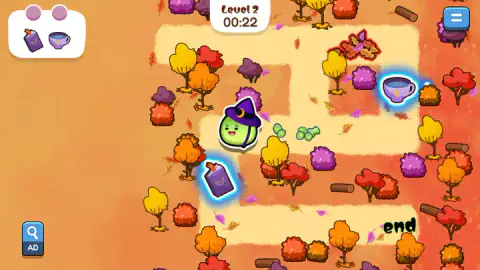
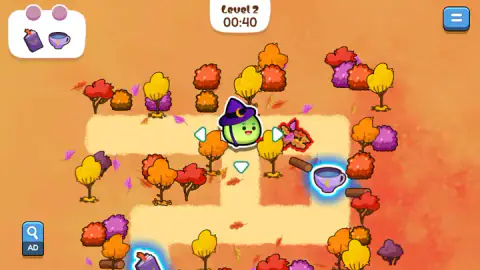
Underneath that pressure is a genuinely pretty thing. The maze is an autumn wood seen from above: corridors of pale sand cut between trees in orange, red, yellow and purple, with logs and drifts of red leaves lying on the path and single leaves falling across the screen. You move along the corridors with the arrow keys. What makes the forest readable is a detail that is easy to miss on your first run — small pale triangles appear around your character showing which ways she can leave the square she is standing on. One triangle is a corridor. Three is a junction.
Two things have to happen before the clock empties. A card in the top-left corner shows what the level wants: on the stage we played most, a purple spell book and a purple teacup, each under an empty round socket, and each marked with a gold crescent moon. Both are out there in the forest, glowing blue so you can find them between the trunks. And the way out is literally written down — end, in black handwriting on the sand, in a far corner of the map.
Luna herself is not what the name suggests. She is a green blob with pink cheeks and an open smile, wearing a purple pointed hat with a crescent moon on it, and the game is unbothered about what she really is: lose, and the panel tells you that slimes always bounce back. Rising Pixel built her. This one was published in March 2025 and holds a rating of 4.4 from roughly 1,690 players.
We played it on a desktop on 23 October: around four minutes, enough to clear the first level and to lose the second one four times without ever finishing it.
A maze has junctions. A labyrinth does not — and the clock takes away the method that always works
Those little triangles are doing something more interesting than pointing. They are telling you, square by square, that this thing is a maze and not a labyrinth, and in the small world of people who study these shapes that is not a quibble.
The specialist convention — usually traced to W. H. Matthews, who laid it out in a book in 1922 — splits the two words by structure. A labyrinth is unicursal: one single winding path, no branches, no dead ends. You cannot get lost in one, only bored; walk long enough and you arrive. A maze is multicursal: it branches, it dead-ends, it asks you to choose. By that rule the famous Labyrinth of the Minotaur, which is always drawn as one coiling line, would have made a hopeless prison. It is worth saying that the split is a convention rather than a law; Jeff Saward, who edits the labyrinth journal Caerdroia, points out that any decent dictionary treats the two words as synonyms. But as a way of describing shapes it is useful, and a triangle pointing three ways is the clearest proof of multicursal you could ask for.
Here is why that matters at forty-five seconds. Real mazes have a solution that cannot fail, and most people have heard of it: put one hand on the wall and keep walking. In a maze that is simply connected — one where every wall is joined to its neighbours or to the outer boundary — the hand-on-wall rule genuinely cannot get you lost. The reason is pleasingly simple once you see it: if all the walls are connected, you can imagine squashing them into a single loop, and following a loop is just walking round a circle until you come back out.
It only breaks on islands, walls floating free of the boundary, where you can circle the same block forever. For those there is Charles Trémaux's method, published in Édouard Lucas's Récréations Mathématiques in 1882: mark each passage as you use it, never take a doubly marked one, and you will find the exit of any maze — though not the short way round.
And that is exactly the problem. Both methods guarantee an exit by walking most of the maze. The Hampton Court Maze, planted for William III between 1689 and 1695 and the oldest surviving hedge maze in Britain, takes about twenty minutes to reach the middle of. Luna gives you less than a minute, and asks you to make two detours on the way. Every reliable maze-solving method in existence is too slow for her. What is left is the one thing no algorithm offers: look at the whole screen first, find the two glowing objects, find the word end, and decide the order before you touch a key.
One footnote that makes the clock feel less unfair. The Hampton Court maze is also, indirectly, why psychology laboratories are full of mazes. Edmund Sanford, at Clark University, suggested copying its pattern to build a navigation test for rats, and his student Willard Small published the first study using one in the American Journal of Psychology in January 1900. The rats were timed too.
What the game claims, and what we actually saw
The provider's description promises magical artifacts and secrets uncovered. What we found were two clearly marked objects per level, posted on a card so you know what you are hunting before you start — which is better design than "secrets" implies, because it means you are never searching blindly, only routing badly.
Its listing also calls the game relaxing, and on the evidence of our session that is the one word that does not fit. There is a countdown, there is a failure screen, and the failure screen arrives in silence. Everything else about it is gentle: no enemies chased us, nothing attacked, and the only thing that ever killed us was the clock.
We should be straight about the limits of what we can tell you. We cleared level 1 and never cleared level 2, so we do not know how many levels exist, whether the clock gets meaner, or whether the exit refuses to open until both sockets are filled — that last one is what the card implies, not something we confirmed. We never opened the menu button in the top-right corner, and when the loss panel offered extra time behind a video button we took the plain Retry instead, every single time.
More mazes, and more from Rising Pixel
Slime Clicker is the other half of this studio's running joke and a far calmer way to spend ten minutes, while Samurai Survivor is Rising Pixel in a completely different mood. If it is the maze you came for, Marble Maze inverts Luna's movement — the marble does not step, it slides until a wall stops it — and 3D Pyramid Maze puts the corridors inside stone and makes working inward the same thing as climbing. The rest are in puzzle games.
Screenshots


How to play Luna And The Magic Maze
- Click through the opening screens until the forest appears with a banner reading Level 1 across the top.
- Move with the arrow keys. Luna walks the sand corridors; the trees and bushes are the walls.
- Read the pale triangles around her before you commit. They mark every exit from the square she is on.
- Pick up the glowing objects listed on the card in the top-left corner — each one has an empty socket waiting above it.
- Reach the handwritten end on the ground before the clock hits zero. Clear the level and a panel offers you Next level or Main Menu.
Things we only found out by doing them:
- Look before you move. The clock does not start when you do, so the seconds you spend working out the route are the same seconds you will need for walking it. Our losses were not reaction failures; they were route failures.
- The detour is the puzzle. The objects do not sit on the straight line to the exit. The level is not "get to the end", it is "get to the end the long way round, in time".
- Trust the triangles over your eyes. The corridors are wide bands of sand with trees standing on them, so a gap between two trunks can look like a turning and not be one. The triangles never lied to us.
- Losing is cheap. Retry puts you back at the top of the same level with a full clock. You are not sent to the beginning of the game.
- The keyboard is the way in. The arrow keys moved Luna for us throughout. The game's instructions also offer WASD; we did not need it, so that part is its word rather than ours.
Controls
| Arrow keys | Move Luna along the sand corridors. These are what we played with from start to finish |
|---|---|
| W, A, S, D | Named by the game's own instructions as the alternative. We moved her with the arrows, so this one is its word rather than ours |
| Click the middle of the screen | Gets you through the opening screens and past the panels that sit between levels |
| The blue button in the top-right corner | The only other control on the playing screen. We never opened it |
Features
- The clock runs backwards. The level we spent longest on started at about forty-five seconds and ended the moment it hit zero
- Pale triangles appear around Luna marking every exit from the square she is standing on — one triangle is a corridor, three is a junction
- Each level posts its shopping list in the top-left corner: a card holding the objects you need, with an empty socket above each one. The objects themselves wait out in the forest wearing a bright blue halo
- The way out is written on the ground. A handwritten "end" on the sand is where the level finishes
- Losing costs you the level, not the run: the loss panel puts you back at the start of the same stage with a fresh clock
- The maze is built out of autumn: orange, red, yellow and purple trees for walls, with fallen logs and piles of red leaves lying across the pale sand
- Listed for desktop, mobile and tablet, in landscape and in portrait
Game details
- Developer
- Rising Pixel
- Release date
- March 2025
- Last updated
- October 23, 2026
- Added here
- May 2025
- Technology
- HTML5 (Construct)
- Platforms
- Browser (desktop), Browser (mobile & tablet, touch)
- Saved progress
- Saving, when available, is managed by this game. Mava cannot confirm your level.
FAQ
How do you play Luna And The Magic Maze?
You steer a green slime in a witch's hat along sand corridors cut through an autumn forest, using the arrow keys. Each level shows the objects you need on a card in the top-left corner, and they are scattered around the map glowing blue. The exit is the word end, written on the ground. All of it has to happen before the countdown at the top of the screen reaches zero.
Is there a time limit in Luna And The Magic Maze?
Yes, and it is the whole difficulty of the game. The banner at the top carries the level number and a clock that counts down, not up. The second level gave us somewhere around forty-five seconds, and when the clock emptied the screen said Game over without warning.
What are you collecting in Luna And The Magic Maze?
On the level we played longest, a purple spell book and a purple teacup, each marked with the same gold crescent moon that Luna wears on her hat. They are listed on a card in the top-left corner with an empty round socket above each one, and out in the forest they wear a bright blue halo so you can spot them between the trees. We never filled both sockets, so whether the exit opens without them is something we cannot tell you.
What do the pale triangles around Luna mean?
They are the exits from the square she is standing on. One triangle means the corridor only goes one way from there; three means a junction and a decision. They are the most useful thing on the screen, because the corridors are wide bands of sand with trees scattered along them, and a gap in the trees is not always a path.
What happens when the timer runs out in Luna And The Magic Maze?
A panel appears that reads Game over and tells you, in the game's own words, that slimes always bounce back. It offers two buttons: a green one with a video icon for extra time, and a blue Retry. We took Retry every time, and it put us back at the start of the same level with the clock full again, so losing costs you the stage rather than your progress.
Who made Luna And The Magic Maze?
The other two are Samurai Survivor and Slime Clicker — which explains the joke, because the loss screen in this game calls Luna a slime. This one was published in March 2025 and was last updated in August 2026.
How many levels does Luna And The Magic Maze have?
We cannot tell you, and we would rather say so than guess. We cleared the first level, reached the second, and lost it four times without finishing it, so we never saw a third. The game's own description promises fresh challenges on every stage, and that remains its claim and not ours.
Can you play Luna And The Magic Maze on a phone?
It is listed for desktop, mobile and tablet, in both landscape and portrait, and the provider's description says it works on either. We played it on a desktop with the keyboard, which is the only control the game's instructions name, so how it handles a touchscreen is a question we have not answered ourselves.