

About Magic Potion School For Witch
The listing for this one calls it a match-3. It is not. Nothing in Magic Potion School For Witch asks you to line up or connect three of anything. The shapes drifting over the cauldron carry numbers, and a number is a hit counter: throw at a 3 and it becomes a 2, throw twice more and it bursts, a small +1 floats up where it was, and the trophy tally in the corner goes up.
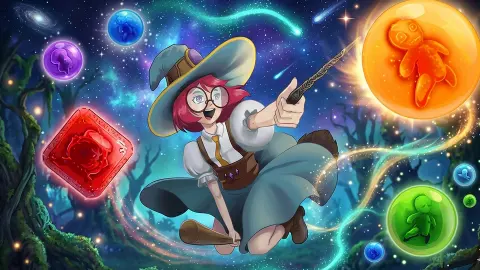
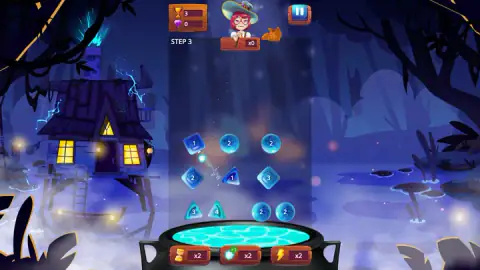
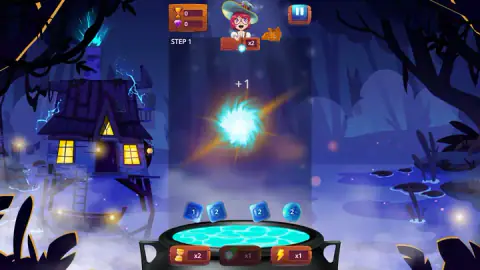
Everything happens in a tall strip down the middle of a much wider picture. At the top of that strip, a red-haired witch leans forward with a wand and a ginger cat asleep beside her. Under her hangs a small wooden plaque with a glowing ball on it and a number that counts down to x0. It is not a button: it is your stock of throws. At the bottom sits a black cauldron full of glowing green brew. In between float about ten blue shapes, circles, rounded squares, diamonds and triangles, each with its number written on it.
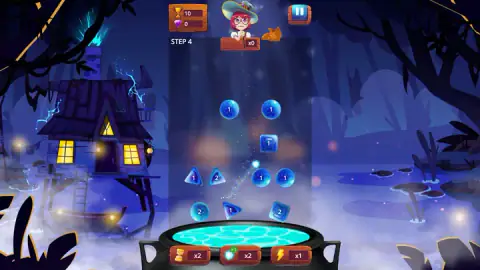
You can see where a throw comes from, because it leaves a trail. In two of our pictures a line of sparks arcs down from that plaque and ends in a bright burst among the shapes. The witch lobs the ball and it falls. In both of those pictures the plaque already reads zero while the ball is still in the air, so a throw is spent the moment you let go of it, not when it lands.
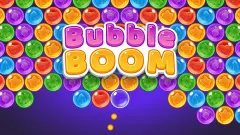
Magic Potion School For Witch is by SecGame. That shelf fits what we played a good deal better than a match-3 does, and this game.
The listing gives March 2026 for the release and August 2026 for the last update, with no day printed against either.
The numbers are hit counters, and that is really the whole game
Once you see the shapes as targets with health bars written on them, everything else on screen explains itself. The trophy tally in the top-left corner is what bursting pays: ours climbed from three to fourteen across a single run. The purple gem beside it, by contrast, sat on zero in every picture we took, and nothing we burst produced one.
The shapes are not all the same, though we could not work out what the differences buy you. Circles, rounded squares, diamonds and triangles share the board, carrying the same range of numbers. In one of our boards a small hourglass drifted among them; in another, a dull grey orb sat at the bottom of the strip. Neither lasted long enough in front of us for an honest description, so we are not going to invent one.
The three cards on the cauldron are the one part of the game with an obvious cost attached. An hourglass, a blue spark with a little green plus one on it, and a lightning bolt, each carrying a count of one or two. Those counts fell as our runs went on, which tells you they are spent rather than permanent. What they do when you spend them deliberately, we cannot say, because we never managed to.
From STEP 1 to STEP 6, and then a scroll
The step counter is the clock of this game, and it is a strange one. In our cleanest run it went from STEP 1 to STEP 6 in forty-eight seconds, climbing every handful of seconds whether we were hitting anything or not. Our first run took far longer, but that was the pause panel's doing rather than the game's.
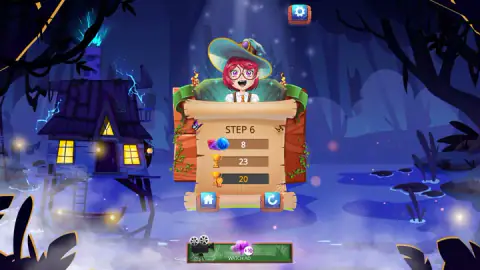
Both runs ended the same way. The board vanishes, the witch comes forward holding an unrolled parchment scroll, and the scroll reads STEP 6 with three rows under it.
The rows are a cluster of gems against eight, a gold trophy against twenty-three, and a second trophy wearing a ribbon against twenty, printed in gold on a dark bar. We cannot tell you which of those is the run and which is the record. They disagree with each other, and the icons are the only labels there are.
What the scroll does make clear is that STEP 6 is a stopping point, not a doorway. There are exactly two buttons on it, a house and a circular arrow, and neither of them is a "next". Press the arrow and you go back out to a grid of nine slots that the game puts between runs. Ours was too blurred to read, so we are not quoting prices off it.
Why a game about potions counts in steps
A cauldron, a scroll, a counter that says STEP 6. The game is dressed in the furniture of a recipe, and that furniture turns out to be older than cooking.
"Recipe" is a Latin verb standing in the imperative: recipe, meaning take. For centuries it was the first word written at the head of a prescription, the physician's instruction to the apothecary who would make the thing up. Take so much of this, then so much of that, in this order. The Online Etymology Dictionary dates that medical sense in English to the 1580s and the kitchen sense to 1716, and notes that the pharmacist's ℞ is the same word, shortened to a mark. A recipe was a prescription long before it was a cake.
What made it a recipe was never the list of ingredients. It was the order of the operations: you cannot grind after you boil. That is the single thing this game keeps. It never tells you which potion you are brewing, the shapes have no flavours and the cauldron takes whatever falls into it, but the counter insists on step one, then step two, then step three, and a written scroll at the end. Which is also the second reason the match-3 label misses: there is nothing here to match, and nothing to collect either. There is only an order to get through before the throws run out.
What it costs, and what we could not buy
One ad in four minutes, and it never interrupted anything. The single offer we saw was on the closing scroll: a green banner with a film camera on it, a cluster of purple gems and a plus ten, under the words WATCH AD. Since the gem counter never moved off zero while we played, that banner may well be the only way gems arrive. We did not press it, so that is a suspicion and not a finding.
The game made almost no noise for us either. One sound in the whole session, at the moment it opened, and nothing afterwards: no sound for a burst, no sound for the end of a run. If you want to know whether a throw connected, you have to watch for the burst.
More boards to clear
Block Bloom and This is Blast both ask you to clear a filling board rather than aim at one, which is the nearest thing we have to this without the throwing. Coin Color Sort is the opposite temperament: no clock, no stock to run out of, just an order to work out. Lanternward keeps the lamplit night mood and swaps the cauldron for a path to light. The rest of them are in the puzzle category.
Screenshots
How to play Magic Potion School For Witch
- Click in the play area to cast. A ball leaves the plaque under the witch and arcs down into the floating shapes.
- Each hit takes one off the number on whatever it strikes. At zero the shape bursts and a plus one floats up.
- Watch the plaque. It counts your throws down to zero, and it hits zero while the ball is still falling.
- Three cards sit on the rim of the cauldron: an hourglass, a blue spark marked plus one, and a lightning bolt. Each has its own small stock, and the stocks drop as a run goes on.
- The step counter in the top-left corner climbs on its own. Both of our runs finished at STEP 6, on a scroll with the totals on it.
Tips from our session:
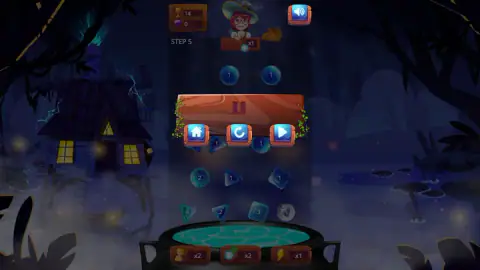
- The pause button is in the worst possible place. It sits in the top-right corner, right where a stray click lands, and the panel it opens is a wooden plank across the whole board. Getting out of it costs you the corner button, which does nothing, and the small play triangle in the middle of the plank, which works. We lost about fifty seconds of one run to that.
- Escape will not help you there. We tried it twice with the plank up and nothing moved.
- Aim at the low numbers when your stock is short. A 1 is one throw and a burst; a 5 is five throws and nothing to show for four of them. With the plaque reading x1 there is only one of those you can finish.
- The numbers grow before the board does. By STEP 4 there were 5s up there that we had not seen earlier, and the board still held about ten shapes either way.
- Expect a short wait between runs. The game drops a plain LOADING card over the same blurred night scene. It cleared within a few seconds both times.
Controls
| Click in the play area | Cast. A trail of sparks arcs down from the plaque under the witch and ends in a burst among the shapes |
|---|---|
| Dragging with the mouse | We tried it several times and could not tell it apart from a click, so we are not claiming it does anything different |
| The plaque under the witch | Not a button. It reads x0, x1 or x2 and that is how many throws you have in hand |
| The three cards on the cauldron rim | An hourglass, a blue spark marked +1 and a lightning bolt, each with a small stock of its own |
| Pause, top right | Covers the board with a wooden plank. Resume with the play button in the middle of the plank, not the corner |
| Escape | We pressed it twice while the pause panel was up and the panel stayed where it was |
| Touchscreen | The platform lists the game for mobile. We played the whole session with a mouse on a desktop, so no gesture here is confirmed |
Features
- A hit-counter puzzle dressed as potion brewing, where a shape marked 3 takes three throws and then bursts with a +1
- Four shapes on the board at once in our runs, circles, rounded squares, diamonds and triangles, carrying numbers from 1 to 5
- A throw counter under the witch that empties as you cast, and reads zero while the ball is still in the air
- Three limited-use cards on the rim of the cauldron, an hourglass, a spark marked +1 and a lightning bolt
- A step counter that climbed from STEP 1 to STEP 6 in under a minute in our cleanest run, and ended there both times
- A trophy tally that rose from three to fourteen across one run, and a purple gem counter that never left zero
- One ad in the whole session, a Watch Ad banner offering ten gems on the scroll that closes a run, with nothing interrupting play
Game details
- Developer
- SecGame
- Release date
- March 2026
- Last updated
- August 1, 2026
- Added here
- December 2025
- Technology
- HTML5 (2D)
- Platforms
- Browser (desktop), Browser (mobile & tablet, touch)
- Classification
- Puzzle
- Saved progress
- Saving, when available, is managed by this game. Mava cannot confirm your level.
FAQ
Is Magic Potion School For Witch a match-3 game?
No, despite what the listing says. Nothing we played asked us to line up or connect three of anything. The shapes floating over the cauldron carry numbers, and each throw takes one off the number of whatever it hits. When a number reaches zero the shape bursts. It is an aiming game with a counter on every target, not a matching game.
How do you play Magic Potion School For Witch?
You click in the tall strip of play area between the witch at the top and the cauldron at the bottom, and a ball arcs down from her into the floating shapes. Every hit knocks one off a shape's number. The small plaque under the witch tells you how many throws you have left, and it empties as you cast.
What do the numbers on the shapes mean?
They are hit counters. A shape marked 1 bursts on the next hit, a shape marked 3 needs three. We saw numbers from 1 to 5, with the higher ones turning up as the step counter climbed. Bursting a shape sends a small plus one floating up and pushes the trophy tally in the top-left corner higher.
What does STEP 1, STEP 2, STEP 3 mean in this game?
It is the counter in the top-left corner, under the trophy and gem tallies. It started at STEP 0 with an empty board and climbed every handful of seconds in both of our runs. Both runs stopped at STEP 6, on a scroll showing the totals, so STEP 6 is as far as we can describe.
How do you unpause Magic Potion School For Witch?
With the play button in the middle of the wooden plank, not with the pause button in the corner. This cost us most of a run. We kept pressing the corner, the plank kept covering the board, and about fifty seconds went by before we got back to playing. Escape did not close it either.
Does Magic Potion School For Witch have ads?
Nothing interrupted our play. The only offer we saw was a green banner on the scroll at the end of a run, with a film camera, a cluster of purple gems and plus ten under the words Watch Ad. We did not press it, so we cannot say how long the ad runs or what the gems are for.
Who made Magic Potion School For Witch and when did it come out?
It is credited to SecGame, a studio that has also made a bubble shooter, which fits what we played rather better than a match-3 would. The listing gives March 2026 for the release and August 2026 for the last update, with no day in either case.
Can you play Magic Potion School For Witch on a phone?
The platform lists it as a mobile title, and the layout would suit a phone, since the whole game happens in a tall strip down the middle of a much wider picture. We cannot confirm it from our own experience. We played the entire session with a mouse in a desktop browser.