





About Neon Maze
A tap that does nothing in Neon Maze still costs you. On one of the late boards we tapped three times in a row, no arrow moved a pixel, and the number in the little black box at the top dropped by three anyway. Nothing warns you. You find out by running out.
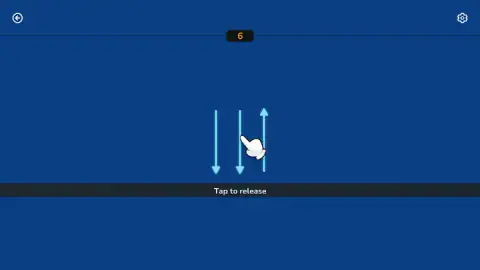
That box is the whole game, and it is not a level number. It is how many taps you get on the board in front of you, and it is only a shade larger than the number of arrows you have to clear. The tutorial board hands you six taps for three arrows, which feels generous until the boards grow.
Much later, on a crowded green board, we counted thirteen arrows against a counter that opened at sixteen. The cushion is three spare taps, the same as on the tutorial board, and that is not much for a knot you have not read yet.
The rule itself fits in a line. An arrow leaves the board in the direction its head points, and only if nothing lies across that line on the way out. Clear them all and the board is done. Everything after that is working out the order.
Neon Maze is by Green Train. It was published in April 2026. We went back to it this week for a far longer sitting than our first, from the tutorial board through to the big green tangles.
Every tap is spent, even the ones that miss
Here is what convinced us. On a fresh green board the counter read sixteen. We tapped, and tapped again, and tapped a third time, aiming at arrows that turned out to be blocked. The board did not change between those taps, not one arrow, not one dot. The counter read twelve.
That is the design, and a sharper one than it looks. Plenty of puzzles of this shape let you poke at the board until something gives, which quietly turns a thinking game into a clicking game. Neon Maze charges you for poking. Being wrong costs what being right costs, so the only way ahead is to be sure before you move.
It also settles a question the game never answers. The number is not the level you are on, and it is not how many arrows are left: the tutorial board shows three arrows and a six. It counts down, it never climbs while you are on a board, and it starts high again when a new one opens.
When it does empty, nothing dramatic happens. We spent a green board down to its last tap without clearing it, and the board came back with its full allowance. No defeat screen, no lost life, no wait. The only thing you lose is the thinking you had already done.
Turn on the grid, because it is the only help you get
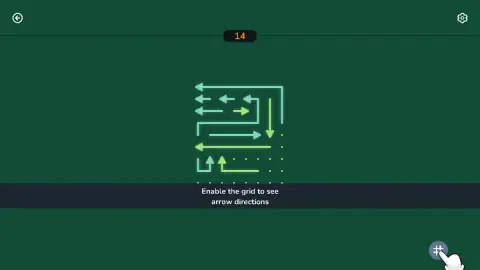
A few boards in, the game stops and points at a round button in the bottom corner, with a caption reading "Enable the grid to see arrow directions". Take it seriously: it is the only assistance in the game.
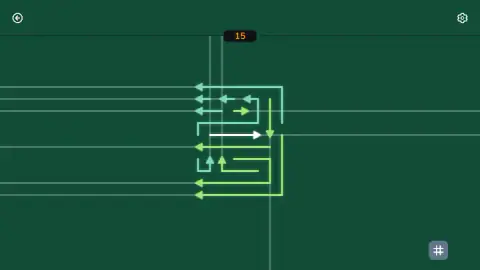
Press it and every arrow grows a faint grey lane running from its head to the edge of the screen. The question you have been squinting at suddenly has a visible answer. A clear lane means that arrow can leave now; a lane crossing another arrow's body means it cannot, and names the arrow that has to go first. It is a toggle, so you can switch it off once the board thins out.
The game's own description mentions hints. In two sittings it is the only thing resembling one that we saw. There is no button that solves a move for you, no undo, no second chance after a bad tap.
The colour tells you how deep you are
The opening boards are flat blue with pale blue arrows, and the first holds your hand: three straight arrows, a finger pointing at the middle one, and a caption reading "Tap to release". Nothing is in anyone's way, so any order clears it.
Later the background turns dark maroon and the arrows come in peach. This is where the idea arrives. A typical maroon board is three arrows in a tight block, two pointing left and one long bent arrow whose head points up but whose body runs left and then straight down the side of the block. That stretch of tail crosses the path of both of the others, so the bent arrow has to go first, even though it looks like the one buried in the middle.
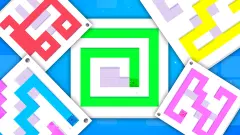
Deeper still the boards turn deep green and stop being a block of three. One of ours was thirteen arrows laid over each other like a badly stacked shelf, bent tails threading between heads. That is the board where the grid stops being optional.
One other thing: the game pauses between boards for an advertising break, a full screen with a button to carry on. The one we met was polite, telling us it was skipping the ad that time, but the slot is there.
Cell, IQ 0 and the padlock marked Level 12
The back arrow at the top left does not open a plain menu. It opens a progress screen, the strangest thing in the game.
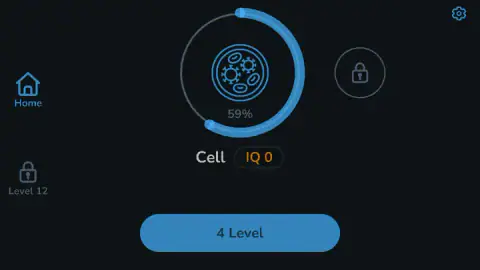
In the middle is a ring drawn around a picture of a single living cell, the kind you see down a microscope. Under it, the word "Cell" and an orange badge reading IQ 0. To the right of the ring, a locked circle; on the left, a Home button and a padlock labelled Level 12; at the bottom, a blue button naming the level you are about to play.
Read together it is a ladder of evolution. You begin as a single cell with an IQ of nothing, and the ring is how far you have climbed out of that stage. Ours moved from about a third to nearly sixty per cent while the button on it counted one level upwards, so a rank is only a handful of boards long, and the locked circle beside it is whatever you become next.
The badge, though, never moved. Through every board we cleared, across both sittings, the IQ score sat at zero. Either it only pays out when a whole rank is finished, or it rewards something we were not doing, which on the evidence of our wasted taps is quite possible.
An old idea in neon: pick-up sticks
The thinking behind Neon Maze is older than screens. In pick-up sticks, also called Mikado, you drop a handful of thin sticks on a table and lift them away one at a time without disturbing the rest. The skill is not in the hand, but in seeing which stick lies on top of which, and choosing the one that is genuinely loose.
Neon Maze is that game laid flat. Instead of sticks resting across each other you have arrows across each other's exits, and instead of a wobble that ends your turn you have a counter that charges you for guessing. In both, the player who stares longest before touching anything wins. That is also why it suits any age and very short sittings: the rule takes one board to learn, and the difficulty comes only from how tightly the arrows are tangled.
More arrow puzzles
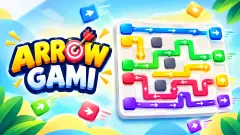
Green Train also made Arrow Cube 3D, which takes the same clear-every-arrow idea onto the six faces of a cube, and the tower climber Knife Tower. If the bent tails are what caught you, ArrowGami: Arrow Puzzle is a close cousin we have played, with hearts in place of a tap counter. For the same business of needing a clear path before anything moves, try Onet Puzzle - Tile Match Game. More are in our puzzle games.
Screenshots
Taken by opening the game ourselves and letting it run — not supplied by the publisher, and not the same picture every other site shows.
How to play Neon Maze
- Read the board before you touch it. Each board is a cluster of glowing lines, every one ending in an arrowhead. Some are straight. Some bend at right angles, and those are the ones that matter.
- Follow a head to the edge. Trace where the arrowhead points, all the way off the board. If nothing crosses that line, the arrow is free to go.
- Tap it. It slides away in that direction, leaving small dots on the squares it used to cover, so you can see the space you opened.
- Turn the grid on. A round button with a grid symbol sits in the bottom right corner. It draws every arrow's lane across the screen, turning guesswork into reading.
- Watch the box at the top. It drops by one for every tap, right or wrong. Empty the board before you empty the box.
Tips from our run:
- Check the tails, not only the heads. A bent arrow blocks others with the far end of its body, a long way from its point. That is where most of these puzzles hide.
- Never tap to see what happens. It is the one habit that separates a cleared board from a restarted one, because a failed tap is charged at full price.
- Count arrows against taps first. The gap between the two numbers is exactly how many mistakes the board will forgive.
- There is no clock. A board waited on our screen for over a minute without changing, counter included. Stare as long as you like.
Controls
| Click or tap an arrow | Sends it sliding off the board the way its head points, if the path is clear, and spends one tap either way |
|---|---|
| Grid button (bottom right) | Draws every arrow's lane across the screen, so you can see what crosses what |
| Back arrow (top left) | Leaves the board for the progress screen with Home, the Cell ring and the level button |
| Gear (top right) | We pressed it more than once and nothing we could see changed |
| Keyboard | Nothing; arrow keys, Enter and Space moved nothing and cost nothing |
Features
- Every board is a knot of glowing arrows, some straight and some bent at right angles
- An arrow leaves the way its head points, and only if nothing lies across that line
- A box at the top counts your taps down, and a tap that moves nothing is spent all the same
- The tutorial board gives six taps for three arrows; a late green board gives sixteen for thirteen
- A grid button draws each arrow's lane to the edge of the screen, and it is the only help on offer
- No clock at all; a board sat untouched on our screen for over a minute without changing
- Behind the back arrow, a progress ring labelled Cell, an IQ badge and a padlock on Level 12
Game details
- Developer
- Green Train
- Release date
- April 2026
- Last updated
- August 10, 2026
- Added here
- March 2026
- Technology
- HTML5 (2D)
- Platforms
- Browser (desktop, mouse), Browser (mobile & tablet, touch)
- Classification
- Puzzle
- Saved progress
- Saving, when available, is managed by this game. Mava cannot confirm your level.
FAQ
How do you play Neon Maze?
Each board is a cluster of glowing arrows. Tap one and it slides off the board in the direction its head points, as long as nothing lies across that line on the way out. Clear every arrow and the board is done. The whole puzzle is choosing the order.
What does the number at the top of Neon Maze mean?
It is how many taps you have left on that board, not the level number. It counts down, it resets higher when a new board opens, and it never goes up while you are playing. The tutorial board starts at six, and the big late boards start at sixteen.
Why can't I remove an arrow in Neon Maze?
Something is in its path. Look along the way the head points, all the way to the edge of the board, and remember that a bent arrow blocks with its tail as well as its head. Clear whatever crosses that line first and the blocked arrow is free.
Do wasted taps count in Neon Maze?
Yes, and this is the trap. We tapped three times on one green board without a single arrow moving, and the counter still fell by three. A tap that achieves nothing is as expensive as one that clears an arrow, so reading the board costs you nothing and guessing costs you everything.
What happens when you run out of moves in Neon Maze?
The board starts again with its full allowance. We emptied the counter on a big green board without clearing it, and after a moment the same kind of board was back in front of us with sixteen taps to spend. Nothing is lost except the time.
Does Neon Maze have hints?
There is a round grid button in the bottom corner, and the game points at it with a caption reading "Enable the grid to see arrow directions". Pressing it draws every arrow's lane across the screen so you can see which paths cross. It is a toggle, and it is the only help we found.
Can you play Neon Maze with the keyboard?
No. The arrow keys, Enter and Space did nothing at all in our runs. The game is played by clicking or tapping the arrows themselves, and the good news is that stray key presses did not cost a move either.
Who made Neon Maze?
Neon Maze is made by Green Train. It was published in April 2026.