





About Eat Donuts
Most match-three games hand you sixty or seventy tiles and let the cascades do half the work. Eat Donuts gives you nine cells. Nothing cascades, and there is nowhere to hide a bad move, so every donut you drop is a decision you live with.
The pieces are donut rings in three sizes, and they nest: a small donut sits inside a medium ring, which sits inside a large one, so a single cell holds three at once. You drag them in from a tray at the bottom. Line up three of the same colour in a row, a column or a diagonal and they vanish, flying up to a penguin who eats them. Fill one cell with a single colour and that clears too.
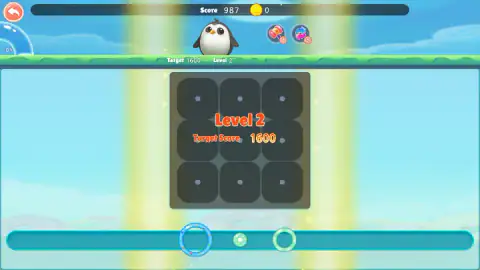
What makes it a game rather than a toy is a card. Every level opens with a grey panel dropped over the board carrying the level number and two words, Target Score, with a figure underneath. Reach it and the level ends. Level 1 wants 800 points. Level 2 wants 1,600.
We played it for ten minutes in a desktop browser, through all of level 1 and a long way into level 2. It is made by a developer listed as SecGame, and the game was published in March 2026.
Nine cells, eight lines: the noughts-and-crosses board underneath
The grid is the one you drew as a child for noughts and crosses, which Americans call tic-tac-toe, and one fact carries straight over: a 3x3 board has exactly eight winning lines. Three rows, three columns, two diagonals.
They are not shared out evenly. The centre cell belongs to four, each corner to three, each edge cell to two. That is why noughts-and-crosses players take the centre first, and why the same cell matters most here.
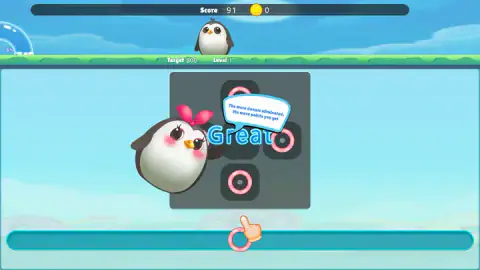
The diagonals are the last thing the tutorial teaches, on the board where the penguin says that donuts of the same colour can also be eliminated diagonally. The real difference from noughts and crosses is the third dimension: each cell holds three rings, so you are playing three games on the same nine squares at once.
Why stacking rings changes the game
The second tutorial board is a single cell. It holds a large pink ring with a small pink donut inside, and hands you a medium pink ring. Drop it in and the cell is full, all one colour, and it clears.
That is a second way to score that needs no line at all. It also means a cell can be full long before it looks full: one holding a large and a small ring has room only for a medium. So keep colours together where you can. A cell with a pink small donut and a blue large ring never clears on its own, and blocks both colours from finishing a line through it.
The card at the start, and the gauge that tracks it
The card is the only place the game states its terms, and it is worth reading rather than clicking past. Level 1 drops its card over a board of three cells; level 2 drops its card over the full nine.
The target doubling sounds brutal, and it is not, because the score never resets. We finished level 1 on 987, level 2 opened with 987 still on the counter, and what it wanted was the 613 we were short.
In the top-left corner a small donut-shaped gauge fills with a rainbow and shows a percentage. It does not track your total. It tracks the stretch the current level is asking for: at 313 points against a target of 800 it read 39 per cent, exactly the fraction of the way there.
That is where the carry-over shows up. Level 2 opened at 23 per cent before we had played a piece, because the points banked above the previous target already counted. The gauge is not a clock, and nothing in ten minutes of play counted down.
"Good", "Great" and the rainbow that crosses the board
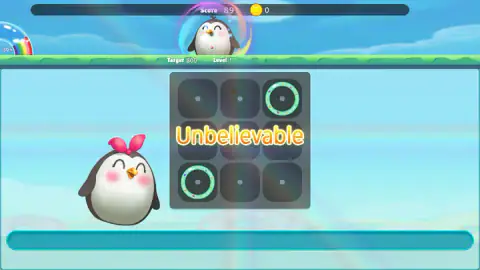
The game grades every clear out loud. Three donuts in a line gets a green Good and a pale rainbow band across the screen. A bigger clear gets a blue Great. The best one we managed put up an orange Unbelievable in letters wider than the board, with rainbow beams firing across the grid.
There is a fourth banner between those last two, but we only ever saw it with the guide penguin standing in front of it, so we will not tell you what it says.
The banners are the clearest signal the game gives about what it wants, which is not tidy three-in-a-rows but moves that take several lines down at once. Two penguins run it, by the way: the one at the top who eats, and the pink-bowed one who brings the speech bubbles.
The second level is where the board starts winning
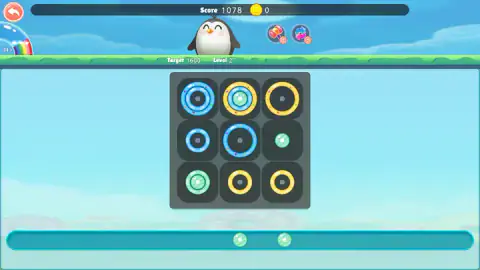
Level 2 arrives with things level 1 never had: a back arrow, a hammer and a rotator with three uses each, three pieces waiting in the tray instead of one, and nobody pointing at where they go. The palette changes too — level 1 is pink, blue and green; level 2 drops pink and brings in yellow.
The difference in pace is the most useful thing we learned. Level 1 took about a minute and a half, because the tutorial hands you the exact piece the board needs. Level 2 took the rest of our ten minutes and gave up 91 points.
By the end every one of the nine cells held at least one ring. The tray was offering small green pieces, and the cells with room for them already held blue or yellow, so dropping one in would have sealed that cell for good. Nothing announced a loss: no game-over screen, no card. The board had simply run out of good answers, which in a game this small is the same thing.
"Eat donuts": which one is this?
A good share of people searching for "eat donuts" want the party game, where you eat a donut hanging on a string without using your hands. This is not that. Here it is a colour-matching puzzle, and the only one eating is the penguin.
What we saw, and what we did not
Ten minutes, a desktop browser, a mouse, sixty moves: the four tutorial boards, all of level 1, both level cards, the praise banners, and level 2 up to the point where the board filled. Two things sit between you and the first donut — a cover screen with a Let's Play button, and an ad break that can land between moves; one of ours came with a note saying the ad had been skipped. Our first attempt stuck on the opening tutorial board, which kept asking for the same drag, and a reload fixed it.
We never used the hammer or the rotator, so we cannot say what they do; both still showed three uses when we stopped. We never earned a coin: the counter beside the score read zero in every frame. We never saw a level-complete screen, because there is not one — the next level's card is the transition. We never got past level 2, so we cannot say how many levels there are. The game's description mentions swapping and rotating placed rings, and a time limit; we found neither.
More small-grid puzzles
If the noughts-and-crosses angle hooked you, Tic Tac Toe Match Three is that board turned into a puzzle. Wood Block Journey also clears rows, columns and 3x3 boxes, on a bigger grid. For sorting colours by hand there is Stack Sort, and for a classic swap-and-match board, Vegetables Match 3. More in our puzzle games.
Screenshots
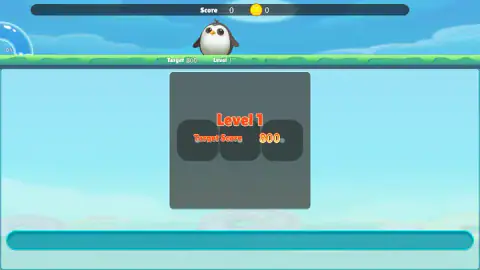
Taken by opening the game ourselves and letting it run — not supplied by the publisher, and not the same picture every other site shows.
How to play Eat Donuts
- Drag a donut from the tray into a cell of the 3x3 board, with the mouse or a finger. Clicking does nothing.
- Line up three donuts of the same colour in a row, a column or a diagonal. They disappear and your score goes up.
- Use the sizes. A small, a medium and a large ring share a cell, and a cell that ends up all one colour clears on its own.
- Read the card at the start and remember the number. When the score reaches it, the next level opens with its own card.
- Keep the hammer and the rotator, the buttons at the top right from level 2 on, for when the board locks up.
Tips from our session:
- Drag, do not click. A long stretch of our run went by with nothing happening because we were tapping instead of dragging.
- Two lines beat one. The first clear of the game, a row of three small donuts, was worth 30 points. A few moves later one donut dropped into the middle of a plus shape finished a row and a column together and carried the score to 313. The penguin spells it out: the more you clear at once, the more you get.
- The centre cell is the most valuable. It sits on four lines. Keep it for the move that finishes two of them.
- Overshooting is not wasted. Pass a target by a wide margin and the extra travels with you into the next level.
- Leave one cell that can still take a small ring. A cell holding a large and a medium is full unless the tray hands you a small. That is how a board stops accepting pieces.
Controls
| Click and drag (mouse) or drag with a finger | Move a donut from the tray at the bottom into a cell of the 3x3 board |
|---|---|
| Hammer button (top right, from level 2) | Power-up; it carries a badge showing three uses |
| Rotator button (top right, from level 2) | Power-up; it carries a badge showing three uses |
| Arrow (top left, from level 2) | Back out of the level |
Features
- A board of only nine cells, where every row, column and both diagonals count as a line
- Donut rings in three sizes that nest inside each other, so one cell can hold three pieces at once
- Clears for three of a colour in a line, and for one cell filled with a single colour
- A card at the start of every level that names the score you have to reach - 800 for level 1, 1,600 for level 2
- A score that carries over, so anything you bank above one target is already progress on the next
- A rainbow gauge in the top-left corner that shows how far through the current level you are
- Praise banners that grow with the size of the clear, from a green "Good" to an orange "Unbelievable" with rainbow beams across the grid
- A different palette each level - pink, blue and green in level 1; blue, green and yellow in level 2
- A four-board tutorial that grows the grid one rule at a time, from three cells to all nine
Game details
- Developer
- SecGame
- Release date
- March 2026
- Added here
- January 2026
- Technology
- HTML5 (2D)
- Platforms
- Browser (desktop, mouse), Browser (mobile & tablet, touch)
- Classification
- Puzzle
- Saved progress
- Saving, when available, is managed by this game. Mava cannot confirm your level.
FAQ
What is Eat Donuts?
Eat Donuts is a free browser puzzle game by SecGame. You drag donut rings from a tray into a 3x3 board and clear them by lining up three of the same colour in a row, a column or a diagonal. Rings come in three sizes that fit inside each other, and a penguin at the top of the screen eats what you clear.
How do you play Eat Donuts?
Drag a donut from the tray at the bottom into any cell of the board; clicking does nothing. Line up three donuts of one colour, straight or diagonally, and they disappear for points. A small, a medium and a large ring can share one cell, and a cell filled with one colour clears too. Reach the target score to move on to the next level.
How do you win a level in Eat Donuts?
Each level opens with a card over the board naming its target score. Level 1 asks for 800 points and level 2 for 1,600. Your score carries over, so the climb is the same each time even though the number on the card goes up, and finishing a level well above its target leaves you partway through the next one before you place a piece.
How do you get more points in Eat Donuts?
Clear more donuts in a single move. In our run the first clear, a line of three small donuts, was worth 30 points. A few moves later one donut dropped into the middle of a plus shape finished a row and a column at once and took the score to 313. Setting up a cell that completes two lines is the whole game.
What is the rainbow circle in the corner of Eat Donuts?
It is a gauge that shows how far through the current level you are, filling with a rainbow as the score climbs and resetting with each new level. It is not a timer, and nothing on screen counts down. We never saw it reach 100 per cent, so we cannot say whether anything happens when it does.
What do the hammer and the rotator do in Eat Donuts?
They are the two power-ups, and they appear at the top right from level 2, each with a badge showing three uses. The listing's instructions only say that you tap them to activate special abilities for bigger combos. We did not use either in a ten-minute run, so we cannot say exactly what each one does.
Who made Eat Donuts?
The game's listings credit Eat Donuts to a developer called SecGame. The game was published in March 2026, with an update in August 2026. We did not find a studio website.
Is Eat Donuts the party game with donuts on a string?
No. The party game, where players try to eat a donut hanging from a string with their hands behind their back, has nothing to do with this one. Eat Donuts on Mava Games is a colour-matching puzzle played on a 3x3 board.