






About Magic Circus - Match 3
A match-three game usually explains itself with the board. Magic Circus - Match 3 explains itself a moment earlier, with a card: level 1 wants 10,000 points and gives you 12 turns to collect them. Everything else on the first screen, the circus tent, the eye staring from the top of the frame, the four power-ups, is decoration around that sum.
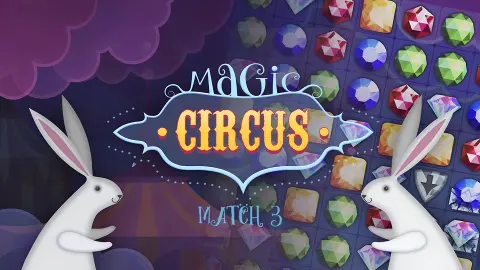
The board is seven crystals wide and eight tall, and it holds five kinds: red, green, blue, yellow and a white diamond with a pink edge. You swap two neighbours. If the swap leaves three of a kind in a line, the line vanishes, whatever was above falls into the gap and new crystals arrive at the top. That costs one turn and adds to the score.
The game is credited to a developer listed as AnimaGames. It was published in September 2025.
Now the honest part. We played for about four minutes on a desktop computer, with the mouse, and it was a short and clumsy session. Most of it went on the opening cards and on drags that lined nothing up. We completed exactly one line and did not finish level 1. So this page describes the first board closely and stops there: nothing below is about later levels unless it says where the claim comes from.
One line paid 900 points, and the sum that follows
Our one successful swap was as plain as they come. A red crystal changed places with the green one beneath it, which put three greens side by side in the middle of the board. They disappeared, three columns each dropped by one, and three new crystals came in at the top. Nothing else fell into place.
The score tiles went from 0 to 900, and the turns from 12 to 11.
Do the multiplication and level 1 looks tighter than a first level usually is. Twelve lines like ours would be worth 10,800 points against a target of 10,000. That leaves room for less than one wasted turn, if a plain three always pays what ours did. We only have one move to go on, so treat it as a reading and not as a rule.
What it does suggest is where the level is won. A player who makes twelve minimum lines scrapes through. Anything that pays more than a basic three, a longer line or a second line falling into place after the first, is what buys a margin. We did not get to see either, and we cannot tell you their value.
What sits around the board
The top bar holds four round icons, two on each side of a large eye in a gold frame. From left to right: a hammer, a ball in several colours, a pale blue orb and a gem with rainbow facets. Each has a small 1 next to it. These are the power-ups the game's instructions call bonuses. We did not use any, so their effects are not on this page.
The eye is the oddest thing on the screen. It sits where many games would put the level goal, and in four minutes it did nothing we could see.
The bottom bar has two yellow buttons. The one on the left is an arrow pointing back. The one on the right shows a small case with a dollar sign; we did not open it. Between them are the numbers at the bottom, 12 and 10000 when the level begins, with the score tiles perched on top.
One practical note for a computer screen. The board is a tall, narrow column in the middle of a wide window, with the tent filling the sides. The crystals are large enough to pick out, but the playing area is about a third of the width.
A rule from 1994 with a scoreboard from 2012
The rule you play by here is older than most of the people who will play it. According to Wikipedia, the first of what came to be called match-three games was Shariki, a 1994 program for MS-DOS whose Russian name means "the marbles". You swapped two adjacent balls to put three or more of one colour in a line, the line was removed, and new balls dropped from the top. Every swap had to make a match.
That description fits the first board of Magic Circus almost word for word, with crystals in place of marbles. Wikipedia traces a direct line from Shariki to Bejeweled in 2001, the game that made gems the default costume of the genre.
The other half of level 1 is newer. In Shariki you simply played for a higher score. The idea of handing the player a fixed number of moves and a target to hit with them is the format Wikipedia credits to Candy Crush Saga, in 2012. Magic Circus has no connection with any of these games. It inherits from both ideas: the 1994 swap, and the 2012 contract of points against turns. That is why its opening card matters more than its tent.
What the description promises that we did not reach
The game's description speaks of many levels in several sets, of obstacles to smash, and of gold and bonuses for finishing levels. It also says there are no time limits and no lives. We can confirm the last part only for the first board: there was no clock on it and no lives counter, just the turns.
Everything else in that list lies beyond what we played. We saw no obstacle on level 1, no gold, and no level map.
Who it is for
It suits someone who wants match-three in its plainest form: big crystals, one rule, and a number to beat. The first level has no story to click through beyond three short cards.
It is not for players who want the genre's recent extras from the first minute. And if you prefer to play without counting, the turn limit will bother you, because on our numbers level 1 does not leave many turns to spare.
More games to try next
Royal Jewels Match is the nearest relative here: swapped jewels and a move counter, but with targets to collect instead of a score. Diamant: Match 3 Sky Story adds a floating island to build between levels. Jewel Monsters turns the same swap into a fight, where only one colour does damage. Vegetables Match 3 replaces the turn limit with a clock. The rest are under puzzle games.
Screenshots
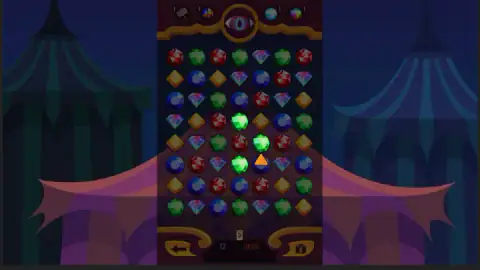
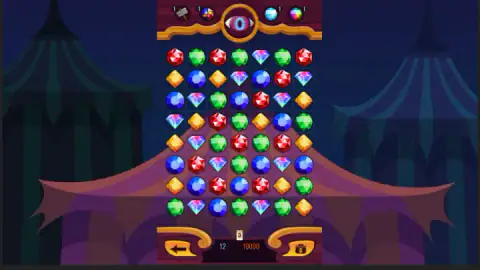
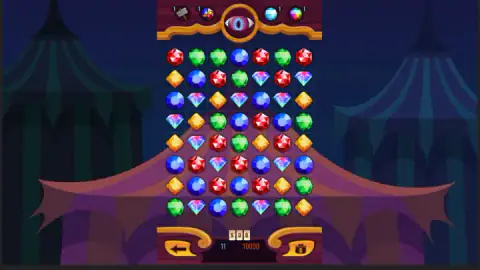
Taken by opening the game ourselves and letting it run — not supplied by the publisher, and not the same picture every other site shows.
How to play Magic Circus - Match 3
- Read the level card. It states the points you need and the turns you get, then you press OK.
- Find two of a kind with a third one step away. The third crystal is the one you will move.
- Drag it onto its neighbour so the three line up, across or down.
- Watch the bottom of the screen. The blue number is your turns, the orange number is the target, and the small tiles above them are your score.
- Reach the target before the turns reach zero.
What our session taught us:
- The tutorial shows you a line, not the only line. On the first board the screen goes dark except for three green crystals, with an orange arrow under the one to move. Our scoring move was a different green line, built across the board through one of those same crystals. It counted just the same.
- Dragging at random gets you nowhere. We sent a long run of drags that made no line. The board stayed exactly as it was and the turn counter stayed on 12. Whether the game ever takes a turn for a wasted swap is something we cannot confirm; in our session it did not.
- Look for the line before you touch. With so few turns, each one has to score. Scan a row for two matching crystals with a gap between them, then check what sits just above or below the gap.
- The power-ups are few. Each of the four icons carries a 1. We left them alone, and on a first level with a plain points target that seems the sensible thing to do with them.
Controls
| Drag a crystal onto a neighbour | Swaps the two; if three of a kind end up in a line, the line is removed and one turn is spent |
|---|---|
| Four round icons (top of the board) | Power-ups: a hammer, a multicoloured ball, a pale blue orb and a rainbow gem, each marked with a 1 |
| Arrow button (bottom left) | Leaves the board |
| Dollar button (bottom right) | A button with a small case and a dollar sign; we did not open it |
Features
- A board seven crystals wide and eight tall, with five kinds of crystal
- A first level with a plain contract: 10,000 points in 12 turns
- A line of three green crystals paid 900 points in our session
- Four power-ups above the board, each showing a 1 at the start of level 1
- A tutorial that dims the board and lights up a line you can make
- A running score on flip-style tiles, above the turns and the target
- Made by AnimaGames
Game details
- Developer
- AnimaGames
- Release date
- September 2025
- Last updated
- August 10, 2026
- Added here
- July 2025
- Technology
- HTML5
- Platforms
- Browser (desktop, mouse), Browser (mobile & tablet, touch)
- Classification
- Puzzle
- Saved progress
- Saving, when available, is managed by this game. Mava cannot confirm your level.
FAQ
How do you play Magic Circus - Match 3?
You swap two crystals that sit next to each other so that three of the same kind end up in a line. The line disappears, the crystals above drop into the gap and new ones come in from the top. Each swap that makes a line uses one turn and adds points to your score.
What is the goal of level 1 in Magic Circus - Match 3?
A card before the first board asks for 10,000 points and gives you 12 turns. Both numbers stay at the bottom of the screen while you play: the turns count down and the target does not change. In our session the turns went from 12 to 11 after our first line.
How many points is a match worth in Magic Circus - Match 3?
The one line we completed, three green crystals side by side, paid 900 points. At that rate twelve plain lines add up to 10,800, only just above the level 1 target of 10,000. We made a single scoring move, so we cannot say what longer lines or chain reactions are worth.
What are the four icons at the top of the board?
They are power-ups: a hammer, a multicoloured ball, a pale blue orb and a rainbow gem. Each one shows a small 1 beside it on level 1, which we read as one use of each. We did not spend any of them, so we cannot describe their effects.
Does Magic Circus - Match 3 have a time limit or lives?
We saw no clock and no lives on the first level, and the game's description says there are none. What limits you is the number of turns: level 1 gives you 12. We did not reach the end of the level, so we cannot say what happens when they run out.
Who made Magic Circus - Match 3?
It is credited to a developer listed as AnimaGames. It was published on 18 September 2025. It is listed for PC, Android and iOS; we played it on a desktop computer with the mouse.
Is Magic Circus - Match 3 related to Bejeweled or Candy Crush?
No. It belongs to the same genre, match-three, which goes back to a 1994 computer game called Shariki and became widely known through Bejeweled in 2001. Magic Circus uses the genre's standard rule, swap two neighbours to line up three, and adds a points target and a turn limit.