

About Sticker Art Book Puzzle
Paint by number has always had one weak point: the paint. You get the numbered outlines, you get the little pots, and then you spend an afternoon going over the edges. Sticker Art Book Puzzle by Drivix Games takes that part of the job away. The colour turns up already finished, printed on a sticker, and the only thing left for you to work out is where it goes.
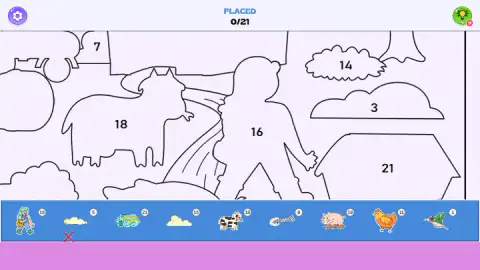
The screen is split in two. Above sits a black line drawing on pale lilac paper, in our game a farm: a cow, hens, a barn, a tractor, trees and clouds, every one of them an empty silhouette with a number printed in the middle of it. Below runs a blue strip of stickers, each with its own small number in the corner. Drag the sticker onto the outline that carries the same number and it stays there, in colour.
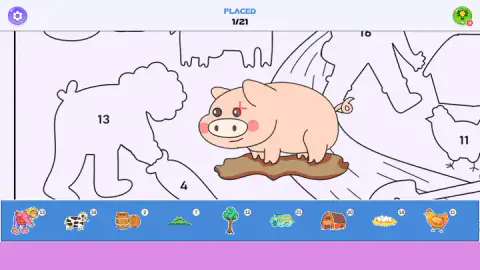
Then there is the counter, centred at the top of the screen. It reads PLACED, with a fraction under it that started at 0/21. We dragged a pink pig out of the strip and onto its silhouette, a pig lying in a puddle of mud halfway up the drawing, and the fraction turned to 1/21. That one movement is the whole game: the number in the hole tells you which sticker belongs in it, and the counter is the receipt.
The total belongs to the picture rather than to the game. Ours asked for twenty-one stickers; another asked for twenty.
This one was published in September 2025.
The two buttons in the corners
Top left, a purple gear. We never opened it, so we cannot tell you what is behind it; on the evidence of the rest of the screen, settings.
Top right, a round green button with a small red badge on it, the kind of mark a game usually puts on something that plays a video. That is the help, and it asks for an advert in return. We found that out the plain way in an earlier sitting: we pressed it, the screen dimmed, and the game said there was no advert available right now and offered a button to carry on playing.
You rarely need it. The number is printed on both halves of every match, so the answer is always on screen somewhere. What the button really buys is the search, not the solution.
It is not a colouring book, and that is the point
Most colouring games online hand you a brush and a palette and let you fill shapes in whatever colour you fancy. This one gives you no choice of colour at all.
Our pig came pink. The puddle came brown. Every sticker is a finished piece of artwork, with shading and detail that the outline never hinted at, and the hole only decides where it belongs. There is no way to make the picture look wrong, which is what makes the game calm. There is also no way to make it look like yours.
So the pleasure on offer is a different one. If you want to pick the colours, an ordinary colouring game suits you better. If what you like is the moment a grey drawing fills in piece by piece, this is that moment, repeated as many times as the counter says.
Where the idea comes from: paint by number
Painting by numbers as a home hobby is younger than most people assume. The kits came out of the Palmer Paint Company in Detroit, whose owner, Max Klein, asked a commercial artist on his staff, Dan Robbins, to turn the idea into a product. In 1951 they reached the shops under the name Craft Master.
The method was simple. Break a picture into small areas, give each one a number, give each number a pot of paint, and anybody could finish a landscape without ever having been taught to paint. Craft Master went on to sell more than 12 million kits, and the company's archive now sits in the Smithsonian's National Museum of American History.
Sticker Art Book Puzzle splits the work the same way, with one change that matters. In the old kits the number told you which colour to use, and the difficulty was keeping a brush inside a line. Here the number tells you which finished piece to put down, and the difficulty is finding it among the others. That is why this plays like a search puzzle rather than an art lesson, and why a child too young for a paintbrush can still finish a picture with it.
Who it suits, and how far we got
The game asks two things of you: recognising numbers, and dragging with a little care. A child who knows their numbers up to about twenty can play it alone, as long as somebody shows them that the drawing slides. Nothing on screen hurries you or tells you off. For an older player it is something to do with one hand while listening to something else.
We should be straight about our own game. In roughly ten minutes we placed one sticker, the pig, and we did not finish a picture. Twice the drawing stopped answering our drags and we reloaded; the game came back on its title card, and the counter was at zero again. So we have not seen what happens when the counter fills, how many pictures there are, or what the gear opens. The instructions say later pictures grow larger and busier, and that is the instructions talking, not us. We also played with a mouse. The game is listed for phones and tablets, and we have not tried it by touch.
More from Drivix Games
Drivix Games also made The Fill, a one-line puzzle where you colour every square with a single stroke, and Liquid Sort Puzzle, where you pour coloured water between glasses until each one holds a single colour. Tile Match is theirs as well, a stack of picture tiles that asks you for three of a kind instead of the usual two. If you were looking for Sticker Book Puzzle: Color By Number, that is a different game by a different author with a nearly identical name. More quiet games for younger players are in our kids games.
Screenshots
Taken by opening the game ourselves and letting it run — not supplied by the publisher, and not the same picture every other site shows.
How to play Sticker Art Book Puzzle
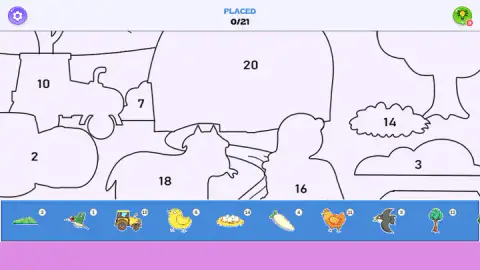
- Read the number inside an empty shape. Every silhouette has a figure printed in the middle of it, a barn-shaped hole marked 20 among them. On our picture the numbers ran from 1 to 21.
- Find the same number in the strip. Each sticker carries a small badge in its upper corner. Look at the badge, not at the drawing on the sticker.
- Drag the sticker up and let go inside the outline. If the numbers match, it lands in full colour and the counter gains one. Our pig arrived with pink ears, a curled tail and the brown puddle under it, none of which was in the outline.
- Slide the drawing to reach the rest. The picture is wider than the screen. Start a drag on a white part of the drawing itself and it moves sideways, bringing the shapes that were off the edge into view.
- Keep placing until the counter fills. Each sticker you use leaves the strip and the others shuffle along, so the nine on screen keep changing as you go.
Tips from our game
- Scan the badges, not the pictures. Nine stickers fit on the strip at once, and they are in no useful order: ours opened with a 13 sitting next to an 18.
- Let the silhouette confirm it. Every hole is cut to the shape of the sticker that fills it. The one our pig went into was already pig-shaped, tail curl and all, so the number and the outline agree twice.
- Do not drag from the strip to move the picture. A drag that begins in the blue band picks up a sticker. To move the drawing, begin on the drawing.
- A wrong drop costs nothing. When we let go over the wrong hole, the sticker was back in the strip afterwards and the counter had not moved. No timer, no lives, nothing to lose by guessing.
- Expect to hunt. The matching is easy and the finding is not. In ten minutes we placed one sticker, because most of the numbers we were looking at had their partners somewhere off the screen or further along the strip.
Controls
| Drag a sticker from the blue strip | Drops it on the drawing; it stays only on the outline carrying the same number |
|---|---|
| Drag on the drawing itself | Slides the picture sideways to reach the shapes hidden off screen |
| Green button (top right) | Asks for help, which the game pays for with a video advert |
| Gear button (top left) | Opens the settings |
Features
- A line drawing on pale lilac paper with a number printed inside every empty shape
- A counter at the top, PLACED and a fraction under it, that gains one with every sticker in the right place
- Each picture has its own total; the one we played asked for twenty-one stickers
- Nine stickers fit on the strip at a time, out of order, so you match by the small number badge
- A sticker dropped on the wrong outline goes back to the strip; no lives, no clock, no fail screen
- The drawing is wider than the screen and slides sideways when you drag across it
- A green help button in the top corner that the game pays for with a video advert
Game details
- Developer
- Drivix Games
- Release date
- September 2025
- Last updated
- August 10, 2026
- Added here
- July 2025
- Technology
- HTML5 (2D)
- Platforms
- Browser (desktop, mouse), Browser (mobile & tablet, touch)
- Saved progress
- Saving, when available, is managed by this game. Mava cannot confirm your level.
FAQ
How do you play Sticker Art Book Puzzle?
You drag stickers from the blue strip at the bottom of the screen onto the line drawing above it. Every empty shape has a number printed inside it and every sticker carries the same kind of number, and a sticker only stays where the two match. The PLACED counter at the top of the screen keeps the score: it gains one for each sticker in the right place.
What does the PLACED counter mean?
It is the picture's progress, not the game's. It reads PLACED with a fraction under it, the second figure being how many stickers that drawing needs. Ours needed twenty-one and started at 0/21; the first sticker we landed turned it to 1/21. Another picture asked for twenty, so the total changes with the drawing.
Who made Sticker Art Book Puzzle?
It is by Drivix Games, the studio the game is credited to for it.
Is Sticker Art Book Puzzle a colouring game?
Not in the usual sense. There is no brush and no palette: the colour arrives with the sticker. Each correct sticker turns a white outline into a finished piece of the picture, so it plays like paint by number with the painting already done for you.
What happens if I put a sticker in the wrong place?
Nothing bad. In our games the sticker was back in the strip afterwards and the counter had not moved. We saw no lives, no timer and no fail screen, so you can try as often as you like.
Why can I not see all the shapes at once?
The drawing is wider than the screen. Start a drag on a white part of the picture, rather than on the strip, and it slides sideways to show the parts that were off the edge. Ours had a tractor and a barn waiting out there.
Is Sticker Art Book Puzzle good for young children?
Mostly, yes. Matching a number on a sticker to the same number on a shape is something a child who knows numbers up to about twenty can do, and nothing on screen punishes a wrong try. The hard part is that shapes sit off the edge of the screen, and a parent may need to show that the picture slides.
Is it the same game as Sticker Book Puzzle: Color By Number?
No. That is a different game by a different author that happens to share almost the same name and description. We have played Sticker Art Book Puzzle, the one by Drivix Games, and not the other one.