





About Coffe Merge House
Ten minutes with this game got us a single merge and a single completed order. That is not a difficulty rating. The game is not hard. It is that nothing on the screen tells you where the game is.
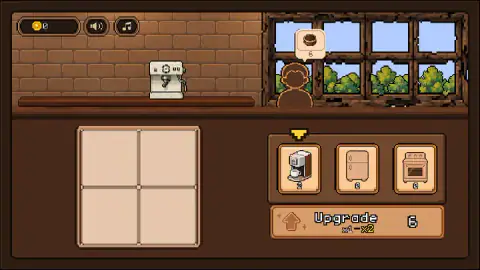
The cafe is already built when you arrive. A brick wall, a long wooden shelf with a white espresso machine standing on it, and on the right a window of small panes with trees and blue sky behind. Somebody is waiting at that window, and over their head is a thought bubble with a picture in it. No text, no menu of dishes, no clock running down. Just a drawing of a thing, and a number underneath.
All of that is scenery. The actual game is a grid of four squares in the bottom-left corner, next to three cards showing an espresso machine, a fridge and an oven. Nothing labels the grid, nothing explains it, and the pull of a cafe scene is to reach for the espresso machine on the shelf — which is a picture. We dragged bags of coffee at that machine, at the counter, at the window and at the customer for most of our session, and none of it moved a pixel. The one drag that did something was the short one: from a square of the grid to the square beside it.
The game is credited to DanmingGames. It was published in August 2026. The name really is spelled with one e; that is the developer's spelling, not our typo.
So here is the honest size of what we can tell you. We made one product and served one order. We never bought the upgrade, never got the fridge or the oven out of their silhouettes, and never saw a second recipe. What follows is what the screen did, and where our knowledge stops.
Four squares, and why that is the whole game
Every merge game runs on two resources at once. There is the stuff on the board, which is what you want, and there is the space the board has, which is what the stuff costs. Most of the genre keeps that second cost politely out of sight by handing you a generous grid. This one does not.
Work it through with the only product we actually made. A sack of beans is the cheapest thing in the game, and one sack occupies a quarter of everything you own. The pair you need for a single merge takes up half the cafe's working surface, and they are still just beans. The tub of ground coffee that comes out of them is worth more and takes up less room than what went into it.
That is the exchange the whole game is built on. Generating costs you no money at all; it costs you room. Merging is the only move that gives room back. So the skill is not patience and it is not speed. It is not tapping a generator one more time than you have space for, because the moment the last square fills, the only thing a board full of beans can do is merge its way out.
Where merge games learned this
The shape is older than the phone games that made it famous. Triple Town, in 2011, put patches of grass together to make a bush, bushes together to make a tree, and ran the whole thing on a small grid that filled up behind you.
2048, three years later, stripped the pictures off and used numbers instead, and became the browser game everybody's colleague was playing at lunch. Both are built on the same anxiety: the board is finite and the board is filling.
The cafe version — a generator, a board, and a customer with an order — arrived later, and is the shape this game uses. What it changes is where the pressure comes from. In 2048 the board adds a tile on its own after every move, so the squeeze is done to you and your job is to stay ahead of it. Here nothing appears unless you put it there. The counter under the card goes down only when you drag.
That is a real difference in feel, and it is why this is a puzzle rather than a panic. There is no timer in the corner, and we found no way to lose. If you jam yourself up with four sacks of beans and no room to work, nobody did that to you.
What we still could not see
Radical honesty is cheaper than a guess, so here is the list, and it is long.
We do not know what Upgrade doubles, because our six coins arrived as the session was ending. We do not know what the fridge and the oven make, or what unlocks them, since they stayed as silhouettes with a zero underneath — though the arrow pointing at the fridge at the end says that is the next step.
We do not know how the finished tub actually leaves the board: the developer's instructions say you drag it onto the customer, and we could not get that drag to land, so we cannot tell you which of our attempts worked. We do not know whether the order paid our six coins or something else did; the tub leaving, the counter filling and the new order all happened between two frames, and the six under the tub matching the six in the counter is a reading, not a proof. And we do not know how far the merge chain goes above ground coffee, whether there are levels, or what the cafe looks like with more than one appliance on the shelf.
What we can say is the thing that cost us the most time, and it is free: the game is in the corner, in four squares, and it will not tell you so.
More cafes, more boards
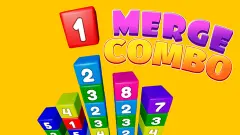
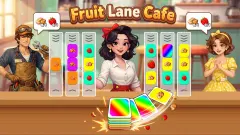
Fruit Lane Cafe is the nearest neighbour: matching food to fill a cafe's orders, except on a timer and with lanes rather than a board. Merge Combo is the pure version of the mechanic, with no cafe wrapped around it — stacks of numbered cubes and a chain that pays more the longer you keep it going. My Bakery starts, like this one, on an almost empty floor and makes you build the shop before you serve anybody. And Cooking City is what the same picture-orders idea looks like when a queue of customers is counting down at you instead of waiting. The rest are in cooking games.
Screenshots
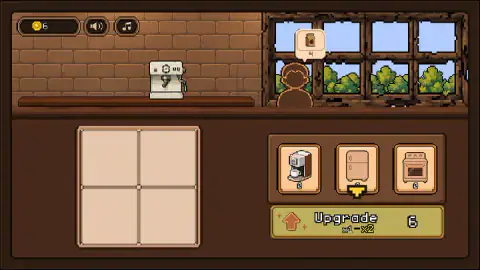
How to play Coffe Merge House
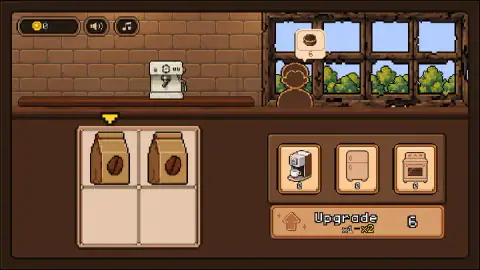
- Drag the espresso machine card onto an empty square in the grid. A paper sack of coffee beans lands there. Dragging is the entire interface; clicking the card did nothing for us, and neither did the space bar.
- Watch the number under that card. Ours read two when we started, one after the first sack and zero after the second. It is a stock of uses, not a price, and it runs out after exactly one merge.
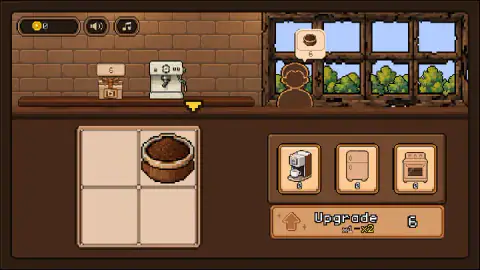
- Drag one sack onto the other, inside the grid. Both vanish and a single wooden tub heaped with ground coffee takes their place, in one square. Keep the drag short and keep it on the board.
- Look back at the bubble. The customer at the window was asking for that tub, drawn exactly the same way, with a 6 printed under it. The developer's instructions say that number is what the customer pays, and ours did.
- Watch the order clear. The tub left the board, the picture in the bubble changed to a plain sack of beans worth four, and the coin counter — on zero until that moment — read six.
What the session taught us that the game does not say:
- Follow the yellow arrow, because it is the whole tutorial. It moves between steps: first the espresso machine card, then down onto the sack sitting on the board, then up to an empty gap on the shelf, and finally the fridge card, which is the purchase it wants you to make next. There is not one word of instruction anywhere.
- Short drags, not long ones. Every long drag we tried across the room failed. If a drag is not landing, you are almost certainly aiming outside the grid.
- Do not reload when you get stuck. We did, around the halfway mark, and the cafe came back at the beginning: board empty, stock on the card full again, nothing we had done kept.
- A wrapped parcel turns up on the shelf now and then, with a small play symbol on it and a 6 on a plaque above — the shape of an offer to watch something in exchange for coins. It appeared and vanished several times while our counter still read zero, so it gives nothing on its own. We never pressed it.
- The Upgrade bar tells you when it is live. It sits brown while you are short, and turns olive green the moment you have its six coins.
Controls
| Drag an appliance card from the right-hand panel onto an empty square | Puts one product on the board. The number printed under that card drops by one |
|---|---|
| Drag one product onto a matching product, inside the board | The two become a single larger product and one square comes free. This is the only drag that worked for us |
| Dragging, generally (mouse or finger) | The whole interface. Plain clicks moved nothing on the board for us, and neither did the space bar |
| Long drags out of the board — at the shelf, the counter, the window, the customer | Nothing happened, over and over. The developer's instructions say an order is served by dragging the product onto the customer; we could not make that drag land |
| Upgrade, the wide button under the cards | Priced at 6 coins, with x1 - x2 printed under the word. The bar is brown while you cannot afford it and turns olive green when you can |
| Speaker and music buttons, top left | Sound and music, switched separately, next to the coin counter |
Features
- A workspace of exactly four squares, tucked into the bottom-left corner, with no label and no tutorial text to tell you that it is where the game happens
- Three appliance cards — espresso machine, fridge, oven — of which only the espresso machine starts drawn in colour; the other two are flat silhouettes with a zero under them
- Two sacks of beans merge into one wooden tub of ground coffee, and the tub takes a single square
- Orders are pictures, not words: the customer's thought bubble holds a drawing of the exact item, with a number under it
- An Upgrade button that costs 6 coins, reads x1 - x2, and changes colour the moment you can pay for it
- A yellow arrow that teaches by moving: card, then board, then a gap on the shelf, then the next locked appliance
- Published on 12 August 2026 by DanmingGames
Game details
- Developer
- DanmingGames
- Release date
- August 2026
- Added here
- July 2026
- Technology
- HTML5 (2D pixel art)
- Platforms
- Browser (desktop), Browser (mobile & tablet, touch)
- Download size
- 1.4 MB
- Ad requests
- 5 (some)
- Has a save
- Yes
- Saved progress
- Saving, when available, is managed by this game. Mava cannot confirm your level.
Measured by opening the game ourselves on 2026-09-11, not taken from the feed. Twelve seconds on a phone-sized screen, with ad requests counted and blocked rather than loaded.
FAQ
Is it Coffe Merge House or Coffee Merge House?
The game's own title has one e: Coffe Merge House. A lot of people type Coffee Merge House when they go looking for it, which is the same game and the spelling most of us would reach for. We keep the developer's version on this page because that is what the game is actually called.
How do you play Coffe Merge House?
Everything happens in the small grid of four squares in the bottom-left corner, and those four squares are your whole workspace. Drag an appliance card from the panel on the right onto an empty square and a product appears there. Drag one product onto a matching one, inside the grid, and the pair becomes a single better product — merging is also the only move that gives you a square back. The customer's thought bubble shows a picture of what they want, so you are matching a drawing, not reading a menu.
Why does nothing happen when I drag things around?
Because almost nothing outside the four squares is a target. We spent most of a ten-minute session dragging sacks of coffee at the espresso machine on the shelf, at the window and at the customer, and none of it moved anything. The drag that works is the short one, from one square of the grid to the square next to it.
What does the number under each appliance card mean?
It is a stock, not a price. Ours read two under the espresso machine at the start; the first sack of beans took it to one and the second took it to zero, and nothing came out of the coin counter either time, because the counter was empty. The fridge and the oven showed a zero from the beginning and stayed as flat silhouettes.
What does the number under the customer's order mean?
The developer's instructions say it is what that customer will pay. That fits what we saw: the first order was a tub of ground coffee with a six under it, and when the order cleared the coin counter went from zero to six. The next order was a plain sack of beans, a simpler item, and it was worth four.
What does the Upgrade button do?
It costs 6 coins and reads x1 - x2 under the word, which reads like a doubling of something — how much a card gives you, most likely. We cannot tell you for certain, because we finished our session with exactly the coins it asks for and never pressed it. The bar does light up from brown to olive green once you can afford it, so the game at least tells you when it is available.
Who made Coffe Merge House and when?
It is credited to DanmingGames and was published on 12 August 2026. The game's listing is the only source we have for the studio, so we cannot tell you where DanmingGames is based or what else they have made.
Can you play it on a phone or a tablet?
Yes — it is listed as playable on mobile, and the controls are drags, which a finger does as well as a mouse. Our own session was on a desktop, so we cannot tell you whether the four squares and the three cards sit comfortably on a small screen.