











About Event Horizon: Black Hole Idle
Most idle games ask you to watch a number climb. Event Horizon: Black Hole Idle hands you the steering wheel as well, and then quietly punishes you for letting go of it.
You are the black hole. It sits in the middle of the screen with a glowing orange disk and a thin blue ring around it, and the space around it is full of drifting rocks. Steer with the mouse, the arrow keys or WASD, and the camera follows: the hole stays put on screen while the field slides past. Everything that crosses the ring falls in, and that is your energy.
The counter at the top shows energy, and a small green tag under it shows how much comes in each second. Energy buys upgrades: a wider ring, more speed, a brighter disk. The publisher promises much more further up, from jets to a Big Bang reset, but the loop you spend your first minutes in is that simple.
The game is credited to Dmitrii Medvedev and was published in November 2026. We played one ten-minute session on a computer and stayed on the second scale throughout. Below is what we learnt, and at the end, what we did not get to see.
The orange button is the cheapest thing in the game
This is where we lost the most time, so learn from it. When our session opened, the counter already read 143K, and the orange button offered Speed for 324 energy. We left it alone for about seven minutes while the bank grew past 280K.
Then we started tapping. Speed went to level 2, and the button switched to Luminosity for 648. After that it offered Radius for 432. Each purchase barely dented the counter, because each cost well under one percent of what we had.
The effect was plain to see. Within a couple of minutes income went from 62 a second to 97, more than half again, and the blue ring around the hole grew visibly wider. The next luminosity level then asked for 3.11K, about five times the one before, which tells you how the prices climb. At this stage, though, waiting to save up for something is pointless. Spend whenever the button lights up.
An idle game that wants you to keep moving
"Idle" suggests you can walk away. Here income comes from matter actually falling in, and the hole runs out of it.
Early in our session the green tag read 81 a second, with a small Streak badge underneath at ×1.1. We then spent several minutes poking at menus while the hole sat more or less still. The rate sank a step at a time, and about six minutes later it was down to 62, with no streak badge in sight.
Nothing was wrong with the game. The rocks within reach had simply been eaten. Holding D for a single second slid the whole field sideways, so moving costs you nothing. When the tag starts to drop, steer towards the next cluster of rocks and keep the streak alive.
Moons are worth more than minutes of waiting
About a minute in, a grey moon drifted just below and to the left of the hole. The counter read 149K. We opened the Evolution panel, and half a minute later the counter read 267K. When we closed the panel, the moon was nowhere on screen and a trail of debris was curling into the disk.
We did not see the moon break up, so we cannot tell you exactly how it happened. But the sums are clear. At the 80 a second we were earning, an extra 117K takes close to 25 minutes. If the moon was the cause, as everything on screen suggests, it paid that in about half a minute.
So the big bodies are where the progress is. For the last few minutes of our session a small badge with a ringed planet and an arrow sat to the right of the hole, pointing at something off screen. We never followed it. You should.
What an event horizon really is, and why the disk pays
The name is real physics. The event horizon is the edge of a black hole: the boundary past which nothing, not even light, can get back out. NASA describes it as the point of no return.
The black hole itself gives off no light. What shines is the accretion disk, the ring of gas and dust spiralling in, heated as it falls until it glows. NASA calls the disk the main source of a black hole's light. That is the idea behind the Disk luminosity upgrade: a brighter disk means more energy, and the biggest single jump in our income came right after we bought a level of it.
The moons follow real physics too. A body that strays too close to a black hole is stretched by the difference in pull between its near and far sides until it comes apart into a stream of gas that wraps around the hole. Astronomers call it a tidal disruption event. In the game, Tidal forces is one of the locked branches of the tree, and the publisher says moons are torn apart the same way when you get close.
The Evolution tree: long branches, many locks
The Evolution panel puts the black hole in the middle with branches running out from it. Three were open for us. Pull radius goes to level 60 and Speed to level 30; Disk luminosity shows only its current level.
At least nine more nodes were locked, among them Gravity well, Pull force, Tidal forces, Autopilot, Orbiting moons, Magnetic field and Hole spin. Autopilot is the one an idle player will want, since it suggests the hole may one day steer itself. We did not open any of them.
In the top left corner a number shows your scale, with a ring around it, partly filled. Ours read 2 for the whole session, and a label at the start said a feature "opens at the next scale". Expect the game to stay simple until you climb.
What we did not see
We played about ten minutes on a computer. We did not reach the third scale, open a locked node, fire a jet, try the spiral button in the bottom left or trigger the Big Bang reset the publisher describes. We did not watch a moon break apart on screen, only what it left behind. We did not test whether energy keeps growing while you are away, play with a touch screen, or hear any sound. The ×2 video offer came up twice and we turned it down both times.
Who is it for? Players who like their idle game with a little driving in it, and anyone curious about black holes. There is nothing to lose, so younger players can start at once; the trick worth learning is to keep moving and spend early.
More black hole and idle games
Black Hole: Eat the Universe is a tap-based take on the same idea, with a reset that sends you back to Stage 1. In Feeding A Black Hole the hole stays put and you break the asteroids around it, and Planet Destroy Idle has you chipping the crust off a turning planet. More in our clicker and idle games.
Screenshots
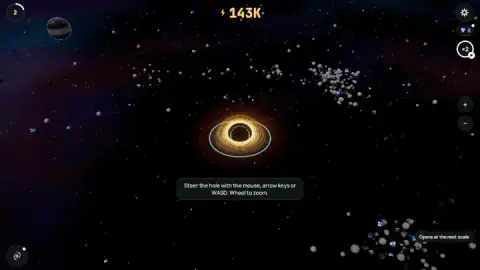
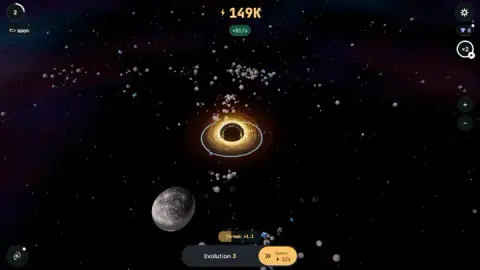
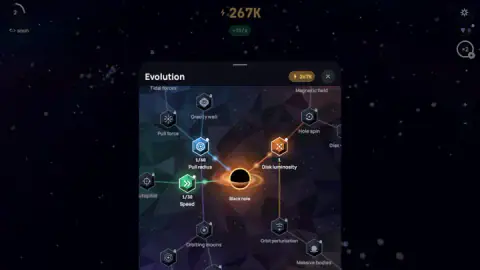

Taken by opening the game ourselves and letting it run — not supplied by the publisher, and not the same picture every other site shows.
How to play Event Horizon: Black Hole Idle
- Wait for the game to start. It opens on a Warming Up screen. On our first visit it never got past it; a later visit loaded fine.
- Steer into the rocks. Mouse, arrows or WASD. Anything inside the blue ring is pulled in.
- Watch the green tag. That is your income per second. If it falls, you have run out of food nearby.
- Tap the orange button. It sits next to Evolution and shows one upgrade with its price. Tap it and it offers the next one.
- Open Evolution to see the whole tree, how far each branch goes and what is still locked.
Tips from our session
- Buy early and often. The first upgrades cost a few hundred energy, small change next to a bank in the hundreds of thousands.
- Do not park. A still black hole earns less and less.
- Moons are the jackpot. When one drifts near, go for it.
- The ×2 offer is a video. You can say Not now and lose nothing but the bonus.
Controls
| Mouse, arrow keys or WASD | Steer the black hole; the camera keeps it in the centre and the field slides past |
|---|---|
| Mouse wheel or the + and − buttons | Zoom in and out |
| Orange button at the bottom | Buys the upgrade it shows, at the price written on it |
| Evolution button | Opens the full upgrade tree |
| ×2 button (top right) | Offers double income for 30 minutes in exchange for watching a video; Not now closes it |
Features
- You are the black hole: steer it through drifting rocks and everything inside the blue ring falls in
- Income per second shows under the energy counter and drops if you stop feeding
- Moons drift past, and swallowing one is worth far more than minutes of steady income
- An orange button at the bottom buys the next upgrade in one tap: speed, pull radius or disk luminosity
- An Evolution tree with Pull radius to level 60, Speed to level 30 and at least nine locked branches
- A scale counter in the corner; some features stay closed until the next scale
- An optional double-income video offer that you can turn down and keep playing
Game details
- Developer
- Dmitrii Medvedev
- Release date
- November 2026
- Last updated
- November 4, 2026
- Added here
- November 2026
- Technology
- HTML5 (WebGL, 3D)
- Platforms
- Browser (desktop, mouse & keyboard), Browser (mobile & tablet, touch)
- Classification
- 3D , Arcade , Clicker , Simulation
- Saved progress
- Saving, when available, is managed by this game. Mava cannot confirm your level.
FAQ
How do you play Event Horizon: Black Hole Idle?
You steer a black hole with the mouse, the arrow keys or WASD, and anything that enters the blue ring around it falls in and turns into energy. Energy keeps coming in every second, and you spend it on upgrades with the orange button at the bottom or in the Evolution tree. Bigger pull, more speed and a brighter disk all raise your income.
What should I upgrade first in Event Horizon: Black Hole Idle?
Whatever the orange button is offering, as soon as it lights up. In our session the first upgrades cost a few hundred energy while we had well over 200,000 banked. Three taps (speed, disk luminosity and pull radius) lifted our income from 62 to 97 a second and visibly widened the pull ring.
Why is my income going down in Event Horizon: Black Hole Idle?
Because you stopped feeding the hole. Income comes from matter falling in, and once the rocks near you are gone the rate sinks. Ours slid from 81 to 62 a second over about six minutes of sitting still. Steer into a fresh cluster of rocks and it climbs again.
Are moons worth chasing in Event Horizon: Black Hole Idle?
Yes. A moon drifted past our hole early on, and within about half a minute the energy counter had jumped by roughly 117,000 and the moon was gone. At the 80 a second we were earning, that is close to 25 minutes of steady income. The game marks bodies off screen with a small badge; head for them.
What does the ×2 button do in Event Horizon: Black Hole Idle?
It opens an offer of double mass and energy for 30 minutes, paid for by watching a video. You can press Not now and carry on; nothing in the game stops without it. We turned it down both times it came up.
How many levels do the upgrades have in Event Horizon: Black Hole Idle?
The Evolution tree shows Pull radius out of 60 and Speed out of 30. Disk luminosity shows only its level, and its price climbs fast: our second level cost 648 energy and the third about 3,100. At least nine more branches, such as Tidal forces and Orbiting moons, are locked at the start.
Is Event Horizon: Black Hole Idle stuck on Warming Up?
It happened to us on our first visit: the game sat on its Warming Up screen and never started. On a later visit it loaded and played normally. If it hangs, reload the page and give it a moment before clicking.
Who made Event Horizon: Black Hole Idle?
The game is credited to the developer Dmitrii Medvedev and was published on 3 November 2026, with an update the next day. It runs in the browser in English and Russian, and it is listed for PC, Android and iOS.