



About Dig To The Core
Most digging games give you a shovel and a meter that goes up every time you click. Dig To The Core gives you three sticks of dynamite and a rule you only discover after the first bang: from then on, a charge will only stick where there is bare rock. Most of the game is learning where that is.
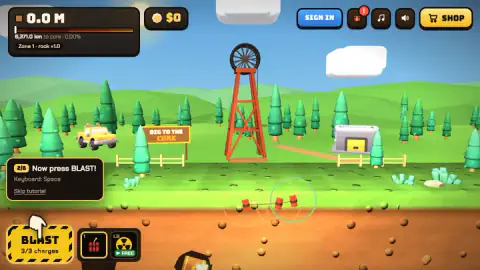
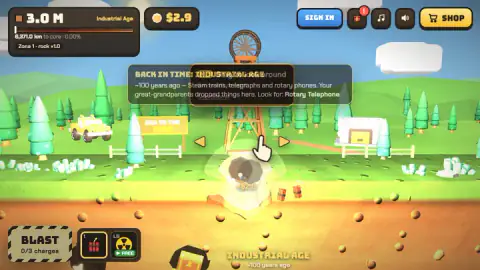
You start on a grassy field with a red drilling tower, three dotted circles on the ground and a progress bar promising 6,371 km to the centre of the Earth. Place the charges, press BLAST, and the ground opens. Our first blast dug 3 metres and paid a few dollars. It also dropped us straight into the Industrial Age, because in this game depth is time: the further down you go, the older the rubble.
It is credited to TechBrandGames and was published on 1 November 2026. We played the tutorial, our first blast and a long stretch of trying to place the next charges, on a computer. That second part taught us more than the first.
Why the game says CAN'T PLACE HERE
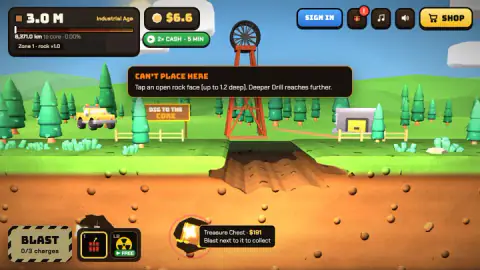
In the tutorial, the circles are drawn for you. After it, you choose, and the game is strict. We tapped into the open crater several times, aiming for what looked like its floor. Every time the same black panel came back: CAN'T PLACE HERE, tap an open rock face, up to 1.2 deep, "Deeper Drill reaches further."
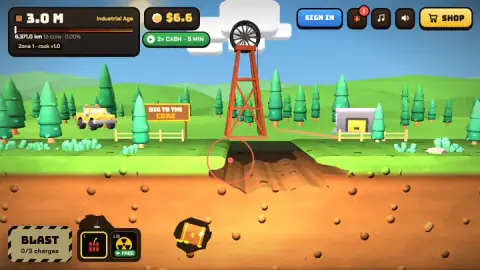
That one line explains the whole placement system. A charge has to sit on rock you can see, and it can only go a short way into it. The dark part of the hole is shadow and air, not rock, so it does not count. What worked for us was the lip of the crater, right where the grass meets the cut: that is where the one charge we placed after the tutorial sat.
It also tells you what one of the shop items is for. The game's listing mentions a deeper drill without saying what it does. The panel does: it lets your charges reach further into the rock. So if you keep seeing that message near something you want, the Deeper Drill is the upgrade that fixes it.
Treasure is worth more than rock
After our first blast, the money counter read $6.60. Just below the hole, half-buried in the orange clay, sat a golden chest. A label beside it reads Treasure Chest, $191, blast next to it to collect.
That is about thirty times the value of the crater that uncovered it. And because of the placement rule, you cannot simply drop a charge on top of the chest from the surface: the charge has to touch open rock within reach of it. The useful plan is to steer your next blasts so the walls of the hole move toward the treasure, then place a charge on the wall beside it.
Crater size is not fixed either. In an earlier, cut-short attempt, a first blast with charges in different spots went only 2.5 metres deep but paid slightly more. Where you put the three charges changes both how deep you go and what you earn.
Depth is time: what the era cards tell you
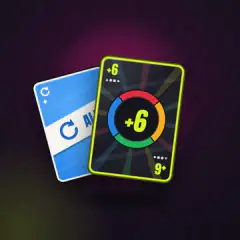
The first blast brought up a card headed BACK IN TIME: INDUSTRIAL AGE. It says this layer is about a hundred years old, the time of steam trains, telegraphs and rotary phones, and ends with a line worth reading: "Look for: Rotary Telephone." The era name stays in the top left, next to your depth.
So the cards are not only flavour. Each one tells you which treasure belongs to the layer you just opened. The game's listing says the eras run back through Roman coins, Stone Age tools, dinosaur fossils and trilobites to the oldest rock on Earth. We only reached the first of them.
The depth panel in the top left also shows a small label, "Zone 1, rock x1.0". The listing says the rock gets harder in every zone and craters shrink. That multiplier is where you will see it coming.
6,371 km: how far the real core is
The number on the bar is real. 6,371 km is the average distance from the surface to the centre of the Earth, the planet's mean radius. That explains why the percentage still read 0.00% after our first crater: the bar only ticks up after roughly 640 metres, so it barely moves at the start.
Real drilling gives a sense of scale. The deepest hole ever dug, the Kola Superdeep Borehole in north-west Russia, took Soviet engineers about two decades and stopped at roughly 12.3 km. On this game's bar that would be under 0.2%.
The game's listing says you pass the Kola depth on your way down, as well as two real boundaries geologists use: the Moho, where the crust ends, and the Gutenberg boundary, where the liquid outer core begins, about 2,900 km down.
So when you play, measure early progress in metres and eras, not in percent. The percentage only starts to mean something once you are many kilometres down.
Video extras, and what happens without an ad
Two buttons offer something for a video. A green 2x CASH, 5 MIN pill appeared under the money counter after our first blast; it was not there before. Next to the BLAST button, the nuke slot is marked FREE with a play icon. When we tried a video reward, the screen dimmed and a message said there were no ads available right now and offered "Continue playing". Nothing else changed. Both extras are optional, and the game works fine without them.
What we played, and what we did not
We played the tutorial up to step three, one blast and a long series of placement attempts, with one charge placed after the tutorial. We did not open the shop, buy an upgrade, fire a nuke, collect a treasure, hire miners or reach a second era. The game's listing also mentions eight explosives, six nuclear bombs, daily rewards and hazards such as methane pockets; we saw none of them. We played on a computer, not on a phone.
More digging games
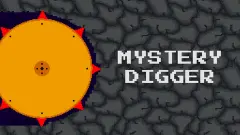
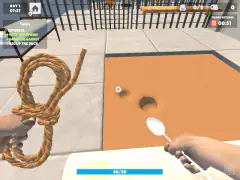
If you like blasting your way down, Miner Dig It All is the closest relative: you lay a line of dynamite, fire it and grind the broken rock with a drill. Mole Dig Clicker has the same goal, the centre of the world, with tapping instead of explosives. Mystery Digger mixes drilling upgrades with buried finds, and Jurassic Digging Tycoon is all about the fossils.
More in our clicker games.
Screenshots
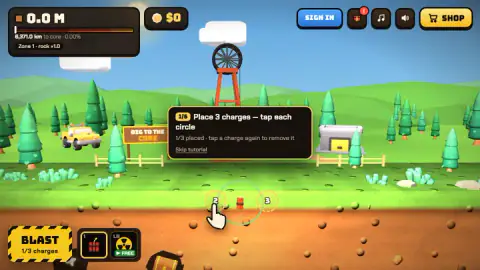
Taken by opening the game ourselves and letting it run — not supplied by the publisher, and not the same picture every other site shows.
How to play Dig To The Core
- Tap or click the three circles to place your charges. The counter under BLAST goes from 0/3 to 3/3.
- Press BLAST, or the Space bar. All placed charges go off and the crater pays cash.
- Drag left or right to look around the site, and keep an eye out for buried treasure near your hole.
- Place the next three charges on the floor, walls or edge of your crater, and blast again.
- Open the SHOP to spend what you earn on bigger charges, more charges, a deeper drill or more miners.
Tips from our run:
- Tap each spot once. A second tap on a charge removes it; during the tutorial our counter fell from 2/3 back to 1/3 that way.
- Never aim into the dark middle of the hole. That is empty air, and the game refuses the charge.
- Read the era card after a blast. It names the item to look for in that layer.
- If a treasure shows up below you, dig toward it before anything else. One chest outweighs many plain craters.
- Do not count on the free nuke. It needs a video, and when we asked for one there was no ad to show.
Controls
| Click or tap the rock | Place a charge; the circle shows the crater it will make |
|---|---|
| Click or tap a placed charge | Remove it again before the blast |
| Space or the BLAST button | Set off every placed charge |
| Drag, or swipe left and right | Look around the dig site |
| SHOP button | Spend cash on upgrades |
Features
- Three charges per blast at the start; BLAST shows how many are placed, from 0/3 to 3/3
- Charges only stick to exposed rock, no deeper than 1.2 into it; the Deeper Drill upgrade extends that reach
- Each depth band is a period of history: 3 metres down is already the Industrial Age, with a card saying which treasure to look for
- Buried treasure is worth far more than plain rock: a chest just below our first crater was marked $191, against $6.60 earned by the blast
- A progress bar counts down the 6,371 km to the centre of the Earth, as a percentage
- Optional video rewards: a 2x cash boost for five minutes and a free nuke slot, both only when an ad is available
- It is listed for computers, phones and tablets, in portrait and landscape
Game details
- Developer
- Partner studio
- Release date
- November 2026
- Last updated
- November 3, 2026
- Added here
- November 2026
- Technology
- HTML5 (3D)
- Platforms
- Browser (desktop), Browser (mobile & tablet, touch)
- Saved progress
- Saving, when available, is managed by this game. Mava cannot confirm your level.
FAQ
How do you play Dig To The Core?
Click or tap the rock to place your charges; each one shows a circle with the size of its crater. When all three are down, press BLAST or the Space bar and they go off together. The crater pays cash, the cash buys upgrades in the shop, and every blast takes you a little deeper toward the centre of the Earth.
Why does Dig To The Core say Can't place here?
Because charges only go on open rock, no more than 1.2 deep into it. Tapping the empty air inside your hole, or solid ground far from it, gives the CAN'T PLACE HERE message. Put the charge on the floor or walls of the crater, or on its edge; the Deeper Drill upgrade lets charges reach further into the rock.
How do you get treasure in Dig To The Core?
A treasure has to be blasted from close by: the game's tooltip says to blast next to it to collect. Because charges only reach a short way into the rock, you have to dig your hole toward the treasure first. The first chest we saw was worth $191, roughly thirty times what our first blast earned.
How far is it to the core in Dig To The Core?
The game counts 6,371 km, which is the real average distance from the surface to the centre of the Earth. The bar shows it as a percentage, so early blasts of a few metres still read 0.00%. The deepest hole people have actually drilled, the Kola Superdeep Borehole, reached just over 12 km.
What does 2x CASH do in Dig To The Core?
It is a video reward that doubles your earnings for five minutes. It appears under the money counter after your first blast. Like the free nuke slot next to the BLAST button, it only works when an ad is available; when we tried a video reward the game told us there were no ads right now, and we kept playing normally.
Who made Dig To The Core?
The game's listing credits TechBrandGames, and we found no studio page to confirm it. The game was published on 1 November 2026 and runs in the browser with nothing to install. We played it on a computer.