






About Spill & Knock Down
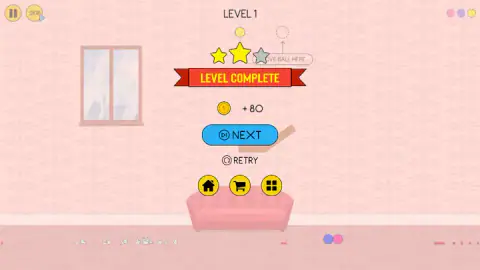
Level one does not begin with a target. It begins with an empty dotted circle up near the ceiling, an arrow pointing at it, and the words MOVE BALL HERE.
Do as you are told. The pink ball lands on the high end of a plank, rolls down the slope and arrives at a glass of red wine standing on a block at the bottom. The glass goes over, and it does not go quietly: for the rest of that level the carpet keeps a scatter of white shards and one small red stain. The game has explained itself in a single move, and never explains itself again.
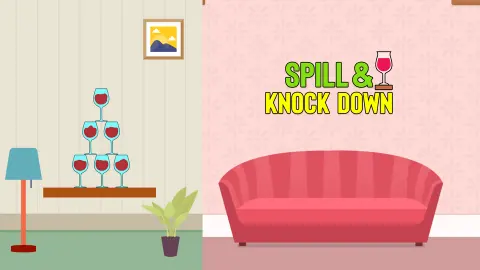
What it has explained is smaller than it looks. Most browser physics games want scale — towers to collapse, walls to blow apart. Spill & Knock Down gives you a living room drawn in thin lines on pale pink wallpaper, with a sofa, a curtained window, a clock and a cactus in a purple pot, and asks you to tip over one glass of wine. That is the whole ambition, and it turns out to be plenty.
It is credited to Drivix Games. This one was published in September 2025 and was last updated in August 2026.
A small jury, and worth saying so.
A word on how far we got, because it decides what this page can tell you. We have been back twice. The better visit took the first two rooms clean, with the result card on screen to show for each, and ran aground on the fourth — the room that stopped us the first time too. So we can tell you what the game asks, what it pays and what being wrong looks like, but not what the later rooms build.
The dots in the corner are the balls, colour for colour
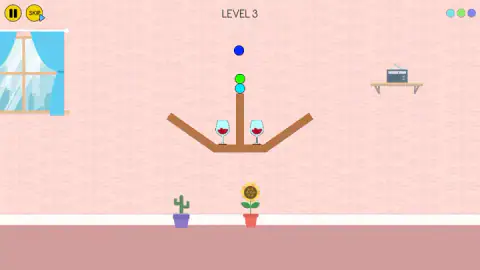
Look at the top-right of any level screen and there are three small coloured circles. They are not decoration and they are not a score. They are your ammunition, and the game shows you all of it before you spend any.
Level three is the clean proof. The corner reads cyan, green, blue, and the room holds exactly those three: the cyan and the green waiting one above the other over the middle of the frame, the blue already on its way down.
Level one proves it from the other end. By the time the result card appears, a pink ball and a lilac one are lying on the carpet at opposite sides of the room and a yellow one is still near the ceiling — which is what the corner had read all along. Spent balls stay where they stopped, so the room keeps the count for you.
Two stars pay eighty coins, three pay a hundred
Finish a room and a card drops over it: three star outlines along the top, a red ribbon reading LEVEL COMPLETE, a coin figure under it, a blue NEXT and a smaller RETRY.
We cleared the first room with two of the three stars lit and were paid eighty coins.
The second came up with all three gold, and the figure read a hundred.
The stars are not a flourish on the way out, then: they are the pay scale, and the gap between a clean clearance and a scruffy one is twenty coins.
What the third star measures is still beyond us. The first room went over with a single ball and paid two stars; the second went over and paid three. Thrift is not the rule, and nothing on screen offers another.
The menu that leads into these rooms sells them in packs of ten: SELECT LEVEL in a red ribbon, LEVEL 01-10 beneath it, then a grid of numbered cards with the first marked PLAY and the rest padlocked, each carrying three grey stars waiting to be filled in.
Two counters keep score, one for the pack and one for the whole game: the pack is worth thirty stars, the game a hundred and eighty, and both read nought when we arrived.
At three stars a level, and ten levels a pack, that is sixty rooms — arithmetic, not a promise.
Where the coins go is the blank we could not fill. There is a shopping-trolley button on the result card, between the home button and the level grid, and we never opened it.
When you keep failing, the game offers you the door
Miss often enough in the same room and a panel takes the screen: a red SKIP LEVEL ribbon, a grey icon of an arrow walking out through a doorway, and the question TOO HARD FOR YOU ? Below it sit two choices — a blue button marked SKIP LEVEL with a little film clapper on it, and the words NO THANKS in plain text.
The clapper is the honest part. The way out of a room you cannot solve is paid for by watching a video, and the game says so with a picture rather than hiding it. We took the NO THANKS every time, which on the fourth level was often, so we cannot tell you how long the video runs or what the room counts as afterwards.
Why a wine glass is such a good thing to knock over
Everything else in these rooms is built to stay put. The sofa, the bookcase, the sideboard: wide at the bottom, heavy low down. The wine glass is the one object in a living room designed the other way round — a foot you could cover with a coin, a thin stem, and all of its weight carried up in the bowl.
Anything standing stays standing for exactly as long as its centre of gravity, the single point you could balance the whole object on, stays above its base. Tip it far enough that the point crosses the edge of the foot, and gravity stops holding the glass up and starts pulling it over. Nothing has to push it after that. It is already going.
The wine makes it worse, which is the part most people have backwards. In a stemmed glass the liquid sits in the bowl, the top half, so filling it lifts the centre of gravity instead of lowering it. A full glass goes over at a smaller angle than an empty one, and the game draws every glass with wine in it.
Which is why the ramp on the first level works. You are not trying to break anything: you are arranging for something top-heavy to lean further than it can afford to, and letting gravity finish the job. The shards on the carpet are how you know it counted.
More games by Drivix Games
Tower Colour Crash is the same studio with the opposite instinct: instead of one glass to tip, a whole tower to bring down by colour. Unstack Tower works a stack from the other end, pulling pieces out and asking what the rest will do about it. TENKYU BALL keeps the ball and takes away the furniture, tilting the floor under you instead. Liquid Sort Puzzle shares the fondness for coloured liquid in glass, except there the job is to keep it in. More rooms full of breakables are in puzzle games.
Screenshots
How to play Spill & Knock Down
- Pick a ball up and put it where you want it to fall. Dragging it through the air and letting go works; so does a plain click on the ball itself. We used both, on different levels.
- Read the furniture before you drop anything. The planks, shelves and ledges are the level. A ball that lands on a slope will take the slope, and that is usually the point.
- Aim at the route, not at the glass. Level one is the lesson: the dotted circle is nowhere near the wine. It is above the top of a ramp that runs down to it.
- Spend the dots left to right. The coloured dots in the top-right corner are the balls this room will give you, in that order.
- Let it come to rest. There is nothing to press once the ball is falling. Either the glass leans past the point of no return or it does not.
What two visits taught us:
- The glass never has to be struck hard. On the first level the ball arrives rolling, almost politely, and that is enough. You are engineering a lean, not a collision.
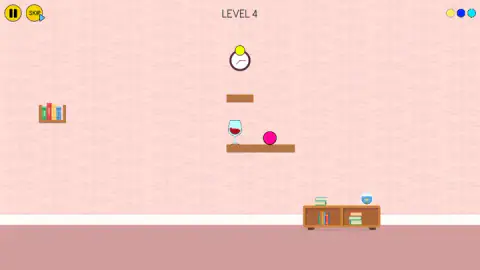
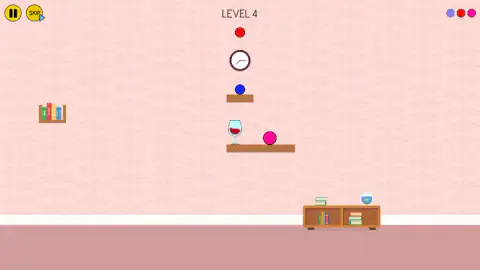
- Not everything round is yours. On the fourth level a pink ball sits on the plank right beside the glass, close enough to look like the answer. We dragged at it four times and it never moved.
- Nothing is on a clock. No timer, no move counter. Look at a room for as long as you like.
- Being wrong costs nothing but the attempt. A red LEVEL FAIL, a RETRY underneath it, and you are back with your balls.
- The yellow SKIP button sits next to pause from level one, before you have been given anything hard to do.
- It is listed as a portrait phone game and does not behave like one. Our window was wider than it was tall, and the room got wider with it: the furniture spread out, the buttons stayed in their corners, nothing was cut off.
Controls
| Drag with the mouse | Pick a ball up and put it where you want it to fall. This is how the first level teaches you, with a dotted circle marking the spot |
|---|---|
| Left click on a ball | Also releases it. Both the drag and the plain click worked for us, on different levels |
| Pause (top left) | The round yellow button on every level screen. We never opened the panel behind it |
| SKIP (top left) | Sits next to pause from the first level onwards. We did not take it, so we cannot tell you what it costs |
| NEXT and RETRY | The two buttons on the card at the end of a level. NEXT is the big blue one, RETRY the small one under it |
| Keyboard | Nothing we could get out of it. The arrow keys and the space bar drew no response we could hear |
Features
- Every level is a room, not an abstract shape: a sofa, a curtained window, a radio on a shelf, a wall clock, a bookcase, a sideboard with a blue bowl, a cactus in a purple pot — and one full glass of red wine standing where it should not be
- Three balls to a room, and you can see them before you spend them: the coloured dots in the top-right corner are the balls that level will hand you, colour for colour
- The glass never has to be struck hard, only made to lean far enough. When it goes it breaks, and the shards and the spilt wine stay on the floor for the rest of the level
- Clearing a level pays stars and coins together, and the stars set the rate: two of three paid eighty coins, all three paid a hundred
- The level menu sells rooms in packs of ten, the first one open and the rest padlocked, under a star counter that starts at nought out of a hundred and eighty
- Failure is a red LEVEL FAIL banner and a RETRY button, with nothing taken off you for it
- Fail often enough and the game offers to skip the level for you in exchange for a video. There is a NO THANKS under the offer, and we took it every time it appeared
- Made by Drivix Games
Game details
- Developer
- Drivix Games
- Release date
- September 2025
- Last updated
- August 10, 2026
- Added here
- July 2025
- Technology
- HTML5 (2D physics)
- Platforms
- Browser (desktop, mouse), Browser (mobile & tablet, touch)
- Saved progress
- Saving, when available, is managed by this game. Mava cannot confirm your level.
FAQ
How do you play Spill & Knock Down?
You drop balls on a glass of wine until it goes over. Each level is a room with one or two full glasses standing in it and a few planks, shelves and bits of furniture in between. You put a ball in the air where you think it will do the most good, let go, and watch where it rolls. The first level marks the spot for you with a dotted circle; after that you are on your own.
What are the controls in Spill & Knock Down?
A mouse, and nothing else that we could find. Dragging a ball to where you want it released worked, and so did a plain click on the ball itself. The arrow keys and the space bar drew no response we could hear. There is a pause button and a SKIP button in the top-left corner of every level screen, and the card at the end of a level offers NEXT and RETRY.
How many levels does Spill & Knock Down have?
More than we reached, and the menu gives a strong hint. Levels are sold in packs of ten — the first pack open, the rest padlocked — and a star counter in the corner reads nought out of a hundred and eighty. At three stars a level and ten levels a pack, that would be sixty rooms in all. It is arithmetic rather than a promise: we only ever had the first pack.
How do you get three stars in Spill & Knock Down?
This one beat us. We cleared the first room with a single ball and were given two stars of three; we cleared the second and were given all three. Using fewer balls plainly is not the rule, and nothing on screen explains what is being measured. If there is a neat answer, the rooms we reached were not enough to find it.
What do the coins in Spill & Knock Down do?
We still do not know. Finishing a level pays coins along with the stars — eighty for two stars, a hundred for three — and the total sits there growing. There is a shopping-trolley button on the card at the end of each level, next to the home button and the level grid, which we never opened, so we cannot tell you what is behind it or what the coins buy.
Can you skip a level in Spill & Knock Down?
The game offers to. Get stuck and a panel takes over the screen asking TOO HARD FOR YOU ?, with a blue SKIP LEVEL button carrying a film clapper on it and a plain NO THANKS underneath. The clapper means the skip is paid for with a video. We took the NO THANKS every time it came up, so we cannot tell you how long the video runs or what the level counts as afterwards.
Who made Spill & Knock Down?
Drivix Games, according to the game's listing, where the studio's page header counts a hundred and seventy-five titles — mostly sorting, matching and tidying puzzles rather than physics. This game was published in September 2025 and was last updated in August 2026. We found no studio website to check the name against a second source, so it rests on the portal alone.
Does Spill & Knock Down work on a phone?
It is listed for Android and iOS as well as PC and described as a portrait game. A game whose whole input is picking a ball up and putting it down should move to a touchscreen more comfortably than most. We only played it on a desktop with a mouse, in a window wider than it was tall, so we have not checked a phone ourselves.