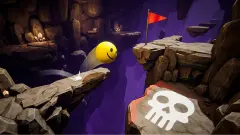



About Hit & Knock Down
At a real fairground, the stall with the cans is built so that you lose. This one is built so that you nearly win, which turns out to be its own kind of torment.
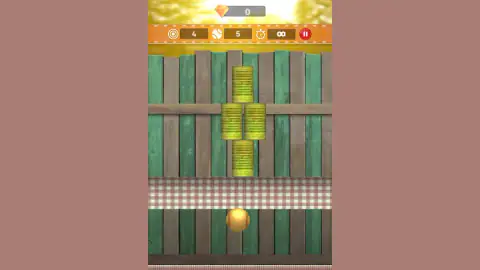
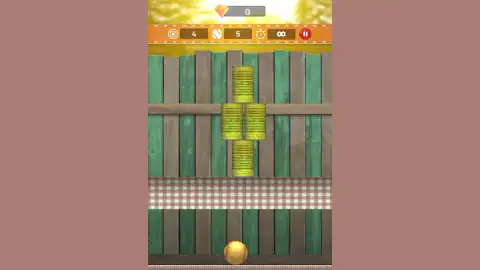
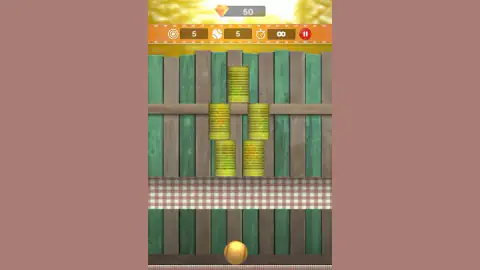
Everything about the scene is familiar on sight: a fence of upright boards, green and weathered grey-brown, crossed by two horizontal rails. Tin cans balanced around the top rail. A strip of red and white gingham across the middle, like the cloth on a stall counter. And one golden ball waiting on the ground at the bottom of the screen, which is the only thing you are allowed to touch.
You drag back from the ball and let go. The ball flies the way you dragged, and what happens next is not scripted: a can that is hit tips over, and a can that tips over shoves whatever is next to it. That is the whole game, and it is enough, because the number of balls you are given is always smaller than you would like.
Hit & Knock Down is credited to Drivix Games, and gives October 2025 for the release with August 2026 for the most recent update. Only the months are printed anywhere, never a day.
The same listing, which is a kinder verdict than our first run at the opening level deserved.
Real stalls are rigged; this fence is not
The reason that game exists at every fair in the world is that it is very hard to win, and not by accident. The Wikipedia entry on carnival games is blunt about the classic milk-bottle stall: on a rigged version, one of the bottles is heavier than the others. The bottle you are aiming at is not the bottle you think it is.
Even an honest stack is built against you, and the physics of why has been measured. In a Science Buddies activity published by Scientific American in March 2014, the thing that decided whether a pyramid went over was not how hard the ball arrived but where. Hitting the top bottle mostly knocked off the top bottle. Hitting low, between the two at the bottom, took the whole stack with it. The lesson is that a pyramid stands on its base, and that its centre of mass, the average place where its weight sits, is the real target.
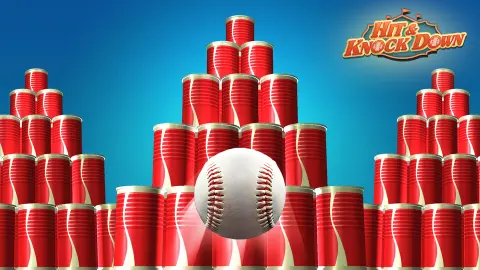
Hit & Knock Down takes the look of that stall and quietly removes the trap. The cans here are not a pyramid resting on a shelf. They are hung around a wooden rail: one above it, one or two sitting on it, one or two below. Nothing is stacked on anything, so there is no weighted bottom row absorbing your throw and no base to undercut. Hit any can hard enough and it goes, and it takes its neighbours with it.
Which means the fairground tactic is the wrong one here. At the stall, you aim low and let the structure do the work. Here, the structure is doing its own work already, and your problem is the opposite one.
The last can is the one that costs you the level
The first level sets four cans in a cross around the rail and gives you five balls. That ratio looks generous, and for a few seconds it is.
On our second attempt at it, one throw into the middle of the cross took three of the four cans at once. We still had four balls in hand and a single can left on the rail. That is as comfortable as this game ever gets.
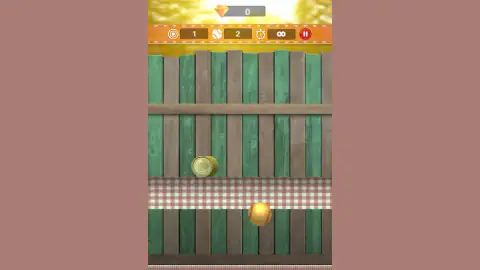
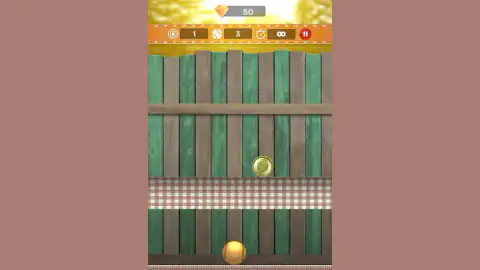
Then the comfort ends, because a lone can has nothing to lean on and nothing to pass a hit to. It also tends to end up turned on its end, showing you only its round lid: a target a fraction of the size of the tin standing upright. We finished that level, but our first run at it died exactly there, with one can up and no balls left.
The second level makes the point again with a wider arrangement: five cans, one above the rail, two spread along it and two below. Two throws cleared four of them. The fifth was still standing three throws later, flat against the boards above the gingham, with the ball lined up underneath it and nothing to show for the attempts.
So the arithmetic of a level is not the five balls against the five cans. It is the one or two balls that clear the group, against the three that the survivor will ask for. If you can place a throw so that the can most likely to be left standing goes early, in the middle of the collapse, the rest of the level is a formality.
What the bar at the top is telling you
Four readings run across the screen, and all of them matter.
Above the orange strip, on a band of gold sunlight, is a diamond counter: the currency. Ours read zero for the whole of the first level, and 50 for the whole of the second, because clearing a level pays out and we had cleared exactly one.
Inside the strip, the target symbol counts the cans still standing. It is worth noticing that this number and the "points" the mission card demands are the same thing: the card asked for four points and the fence held four cans. A point is a can.
Next to it, a tennis ball counts your remaining throws. Then a stopwatch, which in both of our levels showed an infinity sign rather than a time. That is a real design choice and it changes how the game feels: you can stand and look at the fence for as long as you like. Nothing here punishes thinking, only throwing.
What we did not see
We played two levels of the 25 on the map, cleared the first on a second attempt and left the second unfinished. So we cannot tell you what the three stars under each level are awarded for, whether balls left over count towards them, what the diamonds buy, or whether the targets later on stop being cans. We also never found a power gauge, which is why this page describes the drag as a direction and not as a measure of force.
More throwing and target games
If what you want is the throw itself, Color Shot throw the ball is the closest neighbour here: aim, release, and let the target deal with the consequences. Dunkin Beanz keeps the arc and puts a hoop at the end of it, and Swipe Swoosh turns the same flick of the finger into a basketball game. For the other half of the fairground, the half where placement is everything and force counts for nothing, Darts Pro is the one to try. More games that come down to aim and timing are in the sports category.
Screenshots
How to play Hit & Knock Down
- Pick a level from the map. It is a grid of 25 numbered squares with three grey stars under each, and only the first one is open when you arrive.
- Read the card that comes up. It names the target in points, the balls you get and the time, then says to touch the screen to play.
- Drag back from the ball at the bottom of the screen and let go. The direction of the drag is what sends it.
- Watch the first number in the orange bar. It is the cans still standing, and the level ends when it reaches zero.
- Watch the second one too. It is your throws, and when it runs out with a can still up, the level fails and starts again.
Tips from our session:
- Throw into the join, not at a can. The cans are grouped around the rail with gaps between them. A ball into the middle of the group does more than a ball into the face of one tin.
- Spend your early balls on the cluster, your late balls on the stragglers. The group is cheap to clear; a lone can is expensive. Our first attempt died with one can standing and nothing to throw.
- Escape pauses the level. Nothing on screen tells you so. The pause card has a large CONTINUE button and two smaller ones, and it stopped everything cleanly for us.
- Do not wait for an aiming line. There is none, and there is no power bar either. Your first ball of a level is your sighting shot, so take it before you start worrying about the target.
Controls
| Drag back from the ball and let go | Throws the ball at the cans. The direction of the drag is what decides where it goes. We could not tell whether a longer drag throws harder, because we never saw a power gauge |
|---|---|
| Touch or click the screen | Starts the level once the mission card is up. The card itself says "Touch the screen to play" |
| Escape | Pauses the level. This is how our pause card appeared, and it is not written anywhere on screen |
| The red button at the right of the orange bar | The same pause. The card that comes up has one large CONTINUE button and two smaller ones under it |
Features
- A board of 25 numbered levels with three stars to collect under each, and only the first one open when you arrive
- A card before every level that states the target in points, the balls you are given and the time, which was an infinity sign in both levels we played
- The counter at the top counts down the cans still standing, so the points a level asks for and the cans on the fence are the same number
- Five balls a level in both of ours: run out with one can still up and the level fails and goes back to the start
- Cans that take each other down, so a throw into the middle of a cluster can clear three at once
- Diamonds as the currency, shown above the bar; ours sat on zero until the first level cleared and paid 50
- No clock in either level we played, which makes this a game about throws rather than about speed
Game details
- Developer
- Drivix Games
- Release date
- October 2025
- Last updated
- August 1, 2026
- Added here
- August 2025
- Technology
- HTML5 (2D physics)
- Platforms
- Browser (desktop), Browser (mobile & tablet, touch)
- Saved progress
- Saving, when available, is managed by this game. Mava cannot confirm your level.
FAQ
What is Hit & Knock Down?
Hit & Knock Down is a free browser game that recreates the tin-can stall from a fairground. A wooden fence stands in front of you with cans balanced on a crossbar, a ball waits on the ground below, and you drag back from the ball and let go to throw it. Each level gives you a fixed number of balls and asks you to bring down every can. It is credited to Drivix Games.
How do you throw the ball in Hit & Knock Down?
Press on the ball, drag, and let go. The direction of your drag is what sends the ball, and the gesture is identical with a mouse or with a finger, which is why the game works the same on a phone. There is no aiming line and no visible power bar, so you learn the throw by watching where the first ball lands rather than by reading anything on screen.
What do the numbers at the top of the screen mean?
The orange bar carries three readings. The first, next to a target symbol, is how many cans are still standing; it starts at the number of points the level asks for and counts down to zero. The second, next to a ball, is how many throws you have left. The third is a stopwatch, and in both of our levels it showed an infinity sign instead of a time. Above the bar, a diamond icon shows the currency you have banked.
How many levels does Hit & Knock Down have?
The level map is a grid of 25 numbered squares, each with three grey stars under it, and only the first was open when we arrived. We cleared the first level and started the second, so we cannot tell you whether the stars are awarded for balls left over, for speed, or for something else, and we never saw what lies past the grid.
Why is the last can always the hardest in Hit & Knock Down?
Because a cluster of cans knocks itself over and a single can has nothing to pass the hit on to. One of our throws took three of the four cans in front of us in a single go. The one that was left took the rest of the level and cost us a first attempt, and in the second level the final can was still standing after three more throws. Plan your throws around the one that will end up alone, not around the pile.
Is Hit & Knock Down like the real fairground can game?
It borrows the look and changes the odds. Real stalls are set up to resist you: the carnival game entry on Wikipedia notes that on a rigged version one of the milk bottles is heavier than the others, and a Science Buddies activity published by Scientific American in March 2014 found that hitting low, between the bottom bottles, works far better than hitting the top one. Here the cans are hung around a fence rail rather than stacked into a pyramid, nothing is weighted against you, and a clean hit really does bring the group down.
Who made Hit & Knock Down and when did it come out?
The game's listing credits it to Drivix Games. Only the months are printed, never a day, which is why this page gives no exact date.
Can you play Hit & Knock Down on a phone?
Yes. The whole game is one drag-and-release gesture, the mission card tells you in writing to touch the screen to play, and the screen is laid out tall rather than wide, which is the shape of a phone held upright. We played our session in a desktop browser with a pointer, using exactly the same gesture.