




About Pocket Tile
Most merge puzzles decide for you where the new tile goes. Pocket Tile hands that choice back. Join three matching tiles and all three start to glow; whichever one you tap is where the bigger tile appears. On a board of only 25 squares, that one tap is the whole game.
The rest is simple to read. A tile waits in a slot marked PLACE NOW, the next one shows in a small NEXT box beside it, and you put each one on an empty square. Three of the same number, side by side, become the next number up: three 1s make a 2, three 2s make a 3. But the numbers come in two colours, mint and violet, and a match needs both. That second rule is the one that caught us out.
The game is by Stackaya, the developer listed for it. It was published on 2 September 2026. Its menu calls it, fairly, a tiny number puzzle.
Three modes, one board
The main menu stacks three cards over a faded board. Daily Puzzle carries the day's date and promises a new shared puzzle every day, which means you and everyone else face the same layout. Adventure is labelled 50 levels and described as a journey from gentle openings to harder boards. Rank Game starts from a blank board and sends your score to a leaderboard.
Adventure is the one we played. Its map is a winding path of numbered cards, each with a small tile showing its goal; level 1 wanted a single 2. Levels 2 to 5 sat behind padlocks, and the counter at the top read 0 of 50 cleared. A Shards counter at 0 and a button reading "Reset progress, free today" also sit on that screen. We did not earn a shard, so we cannot tell you what they buy.
Level 1 does not start empty. It already had a mint 1, a violet 2 and a few violet 1s on the board, and two cards explain the rules before you move. The second one is the clearest summary of the game: place tiles to connect three of the same colour and number, tap a glowing tile to merge, and keep the goal tiles on the board together.
What we saw, and what we did not
We played for about ten minutes on a computer, and much of that went on tutorial cards and menus. We made one merge in Adventure level 1, three violet 1s into a violet 2, and then held a Clone tile in the PLACE NOW slot without placing it before the session ended. We never made the mint 2 the level asked for.
So there is a lot we cannot confirm. We did not open the Daily Puzzle or the Rank Game, did not see level 2, and never met the Change Color tile the game's own rules mention. A box marked MOVES sits left of PLACE NOW with a 0 badge; it never changed in our run, and we do not know what fills it. The game did not react to the arrow keys or the space bar: everything is done with taps or clicks.
The tap that moves the tile: Pocket Tile and Triple Town
The rule "three of a kind become one better thing" has a well-known ancestor. Triple Town, by the studio Spry Fox, came out in 2010 on the Amazon Kindle e-reader before moving to Facebook, phones and Steam. You place one item at a time on a 6×6 grid; three patches of grass become a bush, three bushes a tree, three trees a hut, and so on up the chain.
In Triple Town the new item always appears where you put the last piece. That makes the placement itself the decision: you drop the third piece exactly where you want the result. Pocket Tile splits the move in two. You place the tile anywhere it completes the three, and then you choose, from the glowing group, where the merged tile ends up.
That small change matters on a smaller board. Pocket Tile has 25 squares to Triple Town's 36, so space runs out sooner, and being able to pull the result toward its next partners is how you keep room open. It also explains the colour rule. With only one kind of number, a 5x5 board would fill with easy matches; with two colours, every square has to be planned for one of them.
Who it is for
Pocket Tile suits players who like a short, quiet puzzle they can think through one tile at a time. There is no timer on screen and no opponent, and the numbers stay small, so younger players can follow it once they know that colour counts. It is not a sliding puzzle like 2048: nothing moves on the board except what you place and merge.
If you want more of the same idea, Merge Number Up also merges three equal neighbours, but you change a tile's number with each tap instead of placing new ones. Merge 2048 drops numbered tiles into a jar and merges pairs, against a red line. Dice Merge joins matching dice against a short timer. Stackaya also made Wildkin Isles, a very different game about gathering and rescuing on voxel islands. There are more number and logic games in puzzle games.
Screenshots
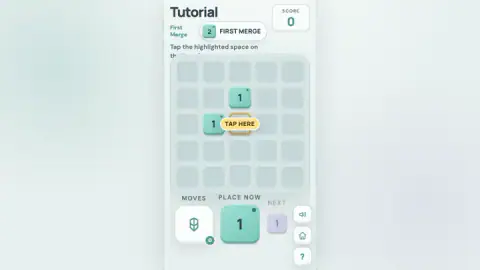
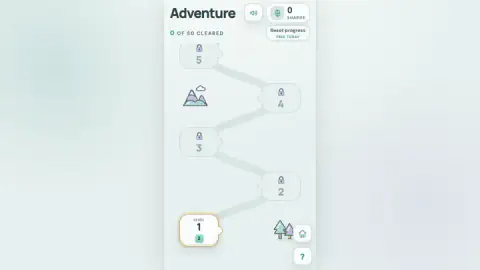
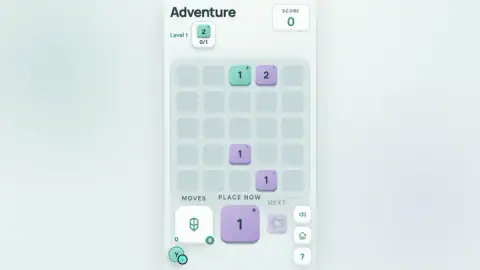
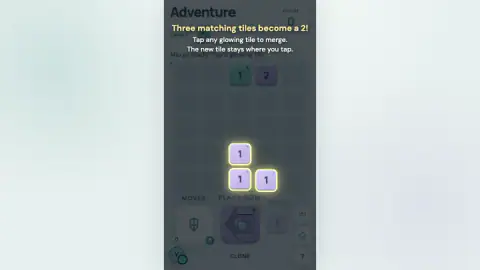
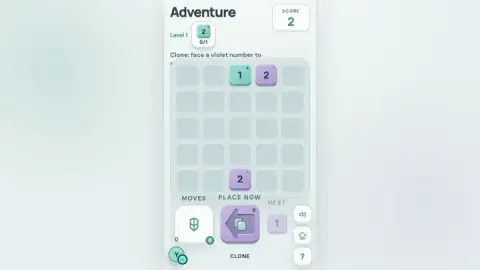
Taken by opening the game ourselves and letting it run — not supplied by the publisher, and not the same picture every other site shows.
How to play Pocket Tile
- Pick a mode on the main menu: Daily Puzzle, Adventure or Rank Game. The first time, a short tutorial board called First Merge walks you through one placement.
- Look at the tile under PLACE NOW and the one under NEXT. Put the current tile on an empty square of the board; the tutorial marks the first one with a TAP HERE label.
- When three tiles with the same number and colour touch in a row, a column or an L shape, they glow and a banner says a merge is ready. Diagonals do not count.
- Tap the glowing tile where you want the result. The three become one higher tile on that square, and the score goes up.
- In Adventure, check the goal above the board. A level is done when the goal tiles are on the board together.
Tips from our session
- Read the colour before the number. Our first Adventure goal was a mint 2. We merged three violet 1s, got a violet 2, scored 2 points, and the counter under the goal stayed at 0/1.
- The tap decides the next merge. The new tile lands where you tap, so put it next to tiles it can match later, not in a corner where it blocks a square.
- Use the NEXT box. You always see one tile ahead. If the next tile is a violet 1, leave room beside the violet 1s already on the board.
- Corners are cheap, the centre is precious. A tile in the middle has four neighbours to match with; one in a corner has two.
- Special tiles are not numbers. A Clone tile arrived in our queue during level 1, with a hint that begins "Clone: face a violet number to…". Read the hint above the board before you place one.
Controls
| Mouse or finger (drag or tap) | Put the tile waiting under PLACE NOW into an empty square of the board |
|---|---|
| Tap a glowing tile | Merges three matching tiles; the new, higher tile appears on the square you tapped |
| Speaker, house and question mark buttons | Sound on or off, back to the main menu, and the rules |
Features
- A 5x5 board, one tile to place at a time, and a NEXT preview of the tile after it
- Three tiles of the same number and the same colour, side by side, merge into the next number
- You choose where the merged tile lands: it stays on whichever glowing tile you tap
- Two colours, mint and violet; a mint 1 and a violet 1 do not count as a match
- Three ways to play from the main menu: a Daily Puzzle with the date on it, a 50-level Adventure and a Rank Game that starts from a blank board
- Adventure levels ask for goal tiles, shown above the board with a counter such as 0/1
- Special tiles join the queue early: a Clone tile appeared in our first Adventure level
Game details
- Developer
- Stackaya
- Release date
- September 2026
- Last updated
- September 11, 2026
- Added here
- August 2026
- Technology
- HTML5
- Platforms
- Browser (desktop, mouse), Browser (mobile & tablet, touch)
- Classification
- Puzzle
- Saved progress
- Saving, when available, is managed by this game. Mava cannot confirm your level.
FAQ
How do you play Pocket Tile?
Put the tile shown under PLACE NOW on an empty square of the 5x5 board. When three tiles with the same number and the same colour touch side by side, they glow. Tap one of them and the three merge into the next number, which stays on the square you tapped.
Does colour matter in Pocket Tile?
Yes. Tiles come in mint and violet, and a merge needs both the number and the colour to match. In our run three violet 1s merged into a violet 2, but the level goal was a mint 2, so the goal counter did not move.
How do you finish a level in Pocket Tile Adventure?
Each Adventure level shows its goal tiles above the board with a counter, such as 0/1 for one mint 2. The game's own card says to keep all the goal tiles on the board together to finish the level. The Adventure map has 50 levels, opened one at a time.
What is the Daily Puzzle in Pocket Tile?
It is one of three modes on the main menu, labelled with the day's date and described as a new shared puzzle every day, so everyone gets the same board. We saw it on the menu but did not play it.
What is the Clone tile in Pocket Tile?
A special tile that arrives in the PLACE NOW slot instead of a number, drawn as an arrow with a small tile inside. The game's hint starts with Clone: face a violet number, which suggests it copies the number it points at. We had it in hand but did not place it.
Who made Pocket Tile?
Pocket Tile is by Stackaya, the developer listed for it. It was published on 2 September 2026.
Can you play Pocket Tile on a phone?
Yes. It is listed for phones and tablets as well as computers, and it plays in a tall column built for a phone held upright. On a computer the column sits in the middle of the window and the mouse does the tapping.