





About Color Match Rush
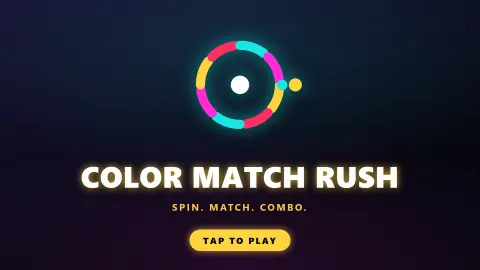
Most colour-matching games in a browser put the colour on you: a ball, a runner, a chameleon that has to be the right shade when it lands on the next floor. Color Match Rush turns that round. The colour is on the dot that falls from the top of the screen, and what you steer is the ring it falls into. One click or tap turns the ring one segment, and your only job is to have the matching quarter under the white arrow when the dot gets there. The menu says it in five words: match the dot to the gate.
The ring has four colours, yellow, purple, red and cyan, always in the same order round the circle, so a turn never shuffles them; it only changes which one sits at the top. The dot slides down a thin thread from the top edge, and when it lands on its own colour a small +1 pops at the gate with a burst of sparks in that colour, and the big number in the middle of the ring goes up by one. That number is your score, and it is also, as we found out, the number of dots you got right.
There are three ways to play, picked from a card after you press Play. Classic ends the run at the first wrong colour. Time Attack gives you a minute and docks two seconds for every miss. Survival hands you three lives and no clock.
We spent our ten minutes in Time Attack, thirteen runs of it, and our best was 11 matches. We saw the second level twice and the third never. Nobody is credited on screen; the game's listing gives the maker as Inentix and dates the game to May 2026. What follows is what the game itself showed us.
Three modes, and the one we played
The mode card is the most informative screen in the game, because each mode carries its rule in one line. Classic: endless, one wrong ends the run. Time Attack: 60 seconds, wrong colour costs 2s, push your score. Survival: 3 lives, endless, the high-score climb. The card also keeps a Best figure per mode, so your record in one does not leak into another.
Time Attack is the forgiving one, and it is where we stayed. A miss costs you time rather than the run, which is why our scores, from 2 to 11, all ended the same way: a Run Complete card when the clock hit zero. The timer in the corner counts down from 60s, turns red as it runs out, and then the card slides in over the ring.
Classic is the mode the title promises, a single mistake and a card, and Survival sits between the two with its three lives. We opened neither, and their Best figures on our card still read 0.
Ten points make a level, and the fifth colour we never saw
Under the words Time Attack and Level 1 in the corner is a thin bar that fills as you score, about a third full after three matches and nearly full after eight. When a run reached ten matches, the card read Level Reached 2. Ten points is a level.
Under the bar sits a label, L3 · +1 COLOR. The listing for the game says each level adds a colour to the ring; the game's own label is more precise and puts the first extra colour at the third level, which is twenty points in a single run. We never got there. At four colours the ring is quarters, and a fifth would make every slice narrower and every turn a little less forgiving, but that is arithmetic, not something we saw.
Our 11 in a minute works out to a dot every five or six seconds. The game was not holding us back; we were. The one habit worth building is to read the dot's colour the moment it appears at the top edge and have the ring in place while the dot is still halfway down; nothing we saw punished an early turn.
Coins, ads and the Continue playing card
Every point is a coin. The Run Complete card shows them as Coins Earned with a small coin mark, and the counter in the top-left corner kept growing through the session, from 55 when we arrived to 149 when we stopped, and kept its total through every trip back to the menu. The menu has a Shop, a Missions button and a Daily Challenge, none of which we opened, so we cannot tell you what a coin buys.
The game asks for an ad between runs. After you press Retry, and sometimes over the Run Complete card itself, the screen dims and a purple panel appears in the middle. In our session every one of those panels resolved into a message reading We skipped the ad this time, enjoy the game, with a purple Continue playing button beneath it, roughly every second run. That was our luck on the day; the game is clearly built to show the ad when it has one.
The mode card adds a second, voluntary ask: a gold strip reading Watch Ad, ×2 coins next run. We did not take it.
What we did not reach
- Classic and Survival. Both unopened; their Best figures read 0 on our card.
- Level 3 and the fifth colour. Our longest run stopped at 11 points.
- A combo above ×1. The line at the bottom read Combo ×1 every time we looked, with a small streak count beside it.
- Shop, Missions and Daily Challenge. All three buttons sit on the title screen; we pressed none.
- Sound. There are two toggles in the top-right corner, one for music and one for effects. We can say nothing about what they switch.
- A phone. The listing says a tap rotates the ring on mobile. We played with a mouse.
Who it is for, and more one-tap games
This is a game for anyone who likes a single input and a clock. There is nothing to learn beyond the order of four colours, and a run in Time Attack is over in a minute, which makes it the kind of thing you play three times while something loads. The dark background and the glow on the ring are easy on the eyes, and nothing in it is violent.
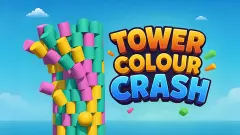
If it is the colour-switch idea you like, Color Dash - Chameleon Runner puts the colour on the runner instead of the dot and asks you to change it to match the floor. Tower Colour Crash also has you turning something coloured, a tower of drums, to line up with a ball. Tap tap Swing is another one-button game that tells you honestly how far you got, and SpeedMatch Competition is about clicking at the right instant as tiles slide past a line.
More in our arcade games.
Screenshots
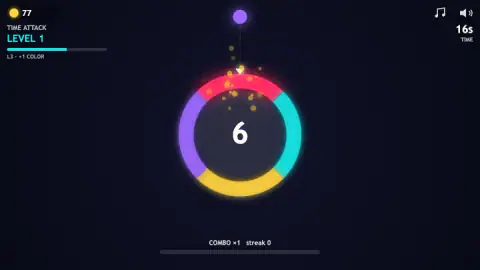
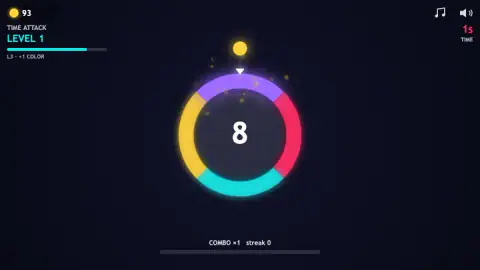
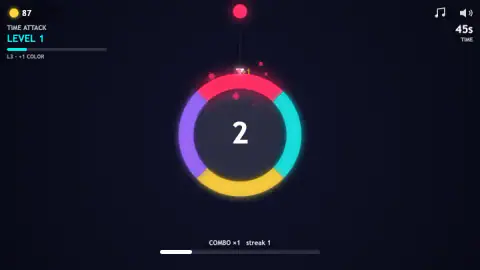
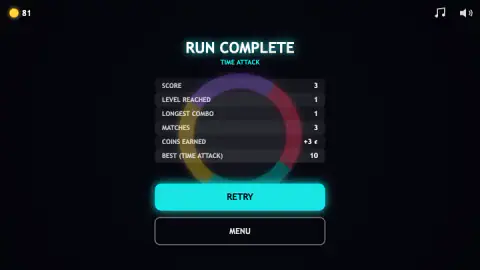
Taken by opening the game ourselves and letting it run — not supplied by the publisher, and not the same picture every other site shows.
How to play Color Match Rush
- Press Play and pick a mode. The card lists Classic, Time Attack and Survival, each with its rule in small print and your best score on the right. A gold strip above them offers double coins for the next run in exchange for an ad.
- Watch the dot, not the ring. It appears at the top of the screen in one of the four colours and slides straight down a thin line towards the white arrow on the ring's rim.
- Click or tap to turn the ring. Each press moves the colours round by one segment. The order never changes, so you soon know which colour is waiting next to which.
- Have the colour under the arrow before the dot arrives. A hit shows +1, a spray of sparks in the dot's colour, and the centre number climbs. In Time Attack a miss costs two seconds of your minute, by the game's own card.
- Read the Run Complete card. It lists score, level reached, longest combo, matches, coins earned and your best in that mode, with a cyan Retry above an outlined Menu.
Tips from our run:
- The centre number is your score, not a countdown. We spent our first runs waiting for a 3 to reach zero. It counts up.
- Score equals matches. In every card we read, the two lines agreed, even in a run whose longest combo was 4. Whatever the combo line at the bottom of the screen does, it did not multiply our points.
- The timer goes red at the end. With a second left the number in the top-right corner turns red; that is your last dot.
- A grey pill reading Click to keep playing means the game has stopped listening. It appeared several times in our session, and one click on the ring brought the dot back.
Controls
| Click or tap | Turns the ring one segment; the colours keep their order, only the one under the gate changes |
|---|---|
| Play, then a mode card | Classic, Time Attack or Survival, each with its rule in small print and your best score on the right |
| Retry and Menu | On the Run Complete card; Retry starts the same mode again, Menu goes back to the title |
| Music and sound icons | Two toggles in the top-right corner; we did not test them |
| Enter | Nothing we could see |
Features
- A ring of four colours, yellow, purple, red and cyan, always in the same order; one press turns it one segment
- Three modes with their rules on the card: Classic ends at one wrong colour, Time Attack gives 60 seconds and takes 2 back per miss, Survival gives 3 lives
- The big number in the middle of the ring is your score, and in every run we played it equalled the number of dots matched
- Ten points reach level 2; the label under the level promises a fifth colour at level 3, which we never reached
- One coin per point, kept across runs and trips to the menu; a Watch Ad strip offers double coins for the next run
- Between runs the screen dims for an ad; in our session every one ended in a card reading We skipped the ad this time with a Continue playing button
- The Run Complete card lists score, level reached, longest combo, matches, coins earned and your best in that mode
Game details
- Developer
- Inentix
- Release date
- May 2026
- Added here
- April 2026
- Technology
- HTML5 (2D)
- Platforms
- Browser (desktop), Browser (mobile & tablet, touch)
- Classification
- Arcade
- Saved progress
- Saving, when available, is managed by this game. Mava cannot confirm your level.
FAQ
How do you play Color Match Rush?
A ring of four colours sits in the middle of the screen with a white arrow at its top, the gate. A coloured dot appears at the top edge and slides straight down towards the gate. You click or tap to turn the ring so the segment under the arrow is the same colour as the dot. A match shows a small +1 and adds one to the big number in the centre, which is your score. The menu sums it up as match the dot to the gate.
What are the modes in Color Match Rush?
Three, chosen from a card after you press Play. Classic is endless and one wrong colour ends the run. Time Attack gives you 60 seconds, takes 2 seconds off for each wrong colour and asks you to push your score. Survival is endless with 3 lives. The card keeps a Best figure for each mode; ours read 10 and then 11 for Time Attack and 0 for the other two, since we only played Time Attack.
How does the score work in Color Match Rush?
Each dot that passes through its own colour is worth one point, and the Run Complete card shows score and matches as two separate lines. In every run we played the two lines agreed, including a run whose longest combo was 4, so at our level the combo did not multiply anything. Coins earned on the same card equalled the score as well, one coin per point.
How many levels does Color Match Rush have?
Levels come from your score inside a run, not from a map. A bar under the level name fills as you score, and when we reached 10 and 11 points the Run Complete card read Level Reached 2. A label under the bar reads L3 · +1 COLOR, which we take to mean a fifth colour joins the ring at level 3. We never got that far, so we cannot describe the ring with five colours.
Does Color Match Rush have ads?
Yes, between runs. After pressing Retry, and sometimes over the Run Complete card itself, the screen dims and a panel appears. In our ten minutes every one of them turned into a message reading We skipped the ad this time, enjoy the game, with a purple Continue playing button, roughly every second run. A gold strip on the mode card also offers double coins for the next run if you watch an ad.
Can you play Color Match Rush on a phone?
The listing says a tap rotates the ring on mobile, which is the only input the game uses, and the layout is a single ring in the middle of a dark screen with small text in the corners. We played on a computer with a mouse, so we have not tested a touchscreen ourselves.
Who made Color Match Rush?
The game itself does not say: no studio name appears on the title screen, on the mode card or on the Run Complete card. The game is credited to Inentix and dates it to May 2026.