


About Recycle Game
There is nothing on the screen to tell you how you are doing. A flat green field, half a dozen pieces of household rubbish drifting across it, two wheelie bins at the bottom, and in the corner a small teal circle with two bars in it. That circle is the pause button, and it is the only thing on the board that is not rubbish or a bin. No score. No clock. No counter.
The game is one gesture: click a piece of rubbish, drag it onto a bin, and it is gone. A newspaper, a flattened box, a paper bag, a water bottle, a spray bottle with a yellow trigger. When the field is empty the level is over, and only then does the game start counting out loud — time, percentage, points, and a position in a world ranking nobody told us we were in.
The game is credited to Gnorb and has been available since June 2026.
Our session ran about four minutes: three levels cleared, a badge picked up on the way, and a stop a long way short of whatever the end is.
The bins arrive one at a time, and then they start moving
The first thing we saw was a single purple bin on its own at the bottom right of a green field. One bin, one answer, no decision to make: everything that appeared was paper.
Then there were two, and the field was still green. Then the field turned blue and there were three, with glass joining paper and packaging. The background colour does the work a level number usually does: it tells you, before you have read anything, that the rules just got wider.
What makes those three bins harder than three bins ought to be is that their order is not fixed. On one green level the yellow packaging bin was on the left. On the next, with the same objects over the same background, it was on the right. You are never allowed to turn the game into a reflex — which is deliberate, because the fastest way to play would otherwise be to memorise two positions and stop looking.
The blue level is also where the material stops being obvious. On screen together: a clear plastic water bottle, a pale glass bottle, a maroon jar and an amber bottle. Three of the four go in the green bin, and the one that does not is shaped most like the others.
Your bin colours are almost certainly not these bin colours
Yellow for packaging, green for glass, purple for paper is close to the Spanish system: blue for paper and card, yellow for light packaging — plastics, cans and drinks cartons together, exactly as the game's bottle-and-can icon shows — green for glass, grey for residual waste, brown for food waste where it has been rolled out. The game's only deviation is painting the paper bin purple instead of blue.
Cross the Atlantic and the code changes meaning. The United States has no national bin-colour standard at all; it is decided state by state and often town by town. California legislated one anyway: blue is recycling, green is food and garden waste, and grey or black is landfill, with every container due to comply by 2036.
Put the two side by side and the same colour reverses. Green is glass in Spain and food waste in California. Blue is paper in Spain and everything recyclable in California. A review of container colours across many countries found exactly that: broad tendencies, no rule, and one colour doing different jobs depending on where you are standing. The United Kingdom has not standardised nationally either, which is why a British household moving one county over can find its bins have changed colour.
So the habit the game trains is not "green means glass". It is looking at the little picture under the rim before you let go — because in the street, as in the harder levels here, the colour alone will not tell you.
The symbol on all three bins was drawn by a student in a weekend
Every bin in the game carries the same triangle of three folded arrows beneath its icon, which is exactly why it is no help in choosing between them.
That triangle has an author. In 1970 the Container Corporation of America, a cardboard manufacturer, ran a design contest for students. Gary Anderson, 23 and studying architecture at the University of Southern California, spent a couple of days on it and submitted designs built from the Möbius strip — the loop with a half twist in it that has only one side. The simplest of them won him a scholarship worth $2,500. The company then put the mark into the public domain rather than keeping it, which is why it turns up on cereal boxes, kerbside bins and the side of a wheelie bin in a browser game.
The symbol was only ever meant to say this loops back round. It was never meant to say which bin. Fifty-odd years on, that is still the gap you are standing in every time you hold a yoghurt pot over two open lids.
What the game counts while you are not looking
Finish a level and the quiet board becomes a scoreboard: a stopwatch, a percentage, a point award, a row of three stars, and a world ranking in large figures off to the right.
Our first level took 229.5 seconds, because we were still learning what the icons meant, and it paid 200 points.
Our second was scored at the same 100%, finished in 49.3 seconds, and paid 1,800. The slow clean sweep and the fast clean sweep were worth nine times different. That is two levels and not a proof, but it is a strong hint about what is really being rewarded — and presumably why the clock is hidden, since watching one would spoil the calm. The world ranking moved with it, from #3,347 to #2,971, so the leaderboard is at least doing something.
Between levels there is one more screen, and it is the warmest thing in the game: a dark panel, a gold crest with a mouse's face on it, a bronze shield with a rabbit waiting beside it, and the title Trash Rookie over a bar reading nine of ten pieces of rubbish collected. Press Continue and the next one along is Bin Spotter, at ten of twenty-five. The count is cumulative, and each badge moves the post further out. How many animals wait at the end of that ladder, we never found out.
More sorting and cleaning games
If the subject brought you here, Foxy Eco Sort is the closest neighbour we have: the same job of separating waste, wrapped in a story with characters and a plot to foil. Eco Block Puzzle keeps the green framing and swaps bins for block placement. If it was the gesture rather than the theme, Tidydeck: Sort Puzzle drops objects into category decks with no clock and no way to lose, and SORTY BOLTY reduces sorting to pure colour on a rack of bolts. For the messier end of tidying, Home Makeover Cleaning Game hands you a house. The rest is in puzzle games.
Screenshots
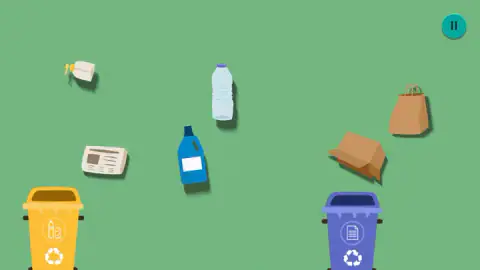
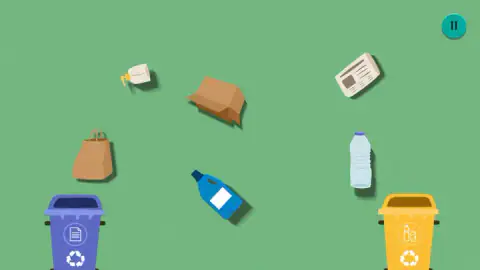
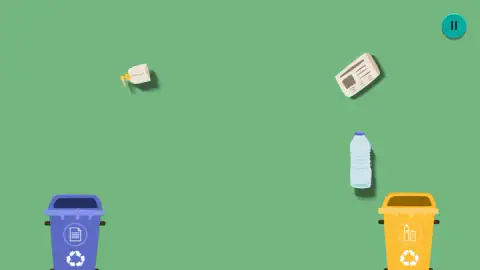
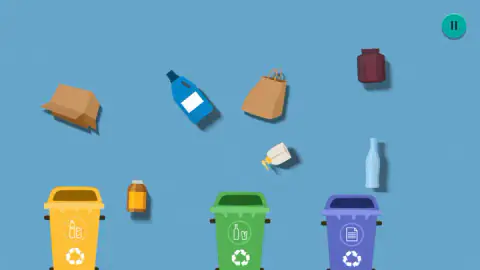
Taken by opening the game ourselves and letting it run — not supplied by the publisher, and not the same picture every other site shows.
How to play Recycle Game
- Read the icons before you touch anything. The colour is not the instruction. The small white symbol under the rim is: a bottle and a can, a bottle and a jar, or a sheet of paper.
- Click a piece of rubbish and drag it onto its bin. That is the whole control scheme; nothing on the keyboard moved anything for us.
- Work the obvious ones first. Newspaper, cardboard and paper bags are unambiguous, and clearing them leaves a much smaller problem.
- Empty the field. There is no finish button and no confirmation: the last piece goes in and the level ends.
- Take the big yellow play button on the result screen to move on. The circular arrow beside it replays the level you just did.
What the session taught us:
- The bins do not stay where they were. We played one green level with the yellow bin on the left, and another green level — same background, same six objects — with it on the right. Checking takes a second and saves you a mistake.
- Speed is the hidden scoring rule. Nothing on the board is timing you, but something is. See below.
- Once a third bin appears, stop trusting silhouettes. The hard level puts a plastic bottle and a glass bottle on screen at the same time. One has a ribbed body and a coloured cap; the other has a narrow neck and no cap at all.
- Metal has no bin of its own. The yellow bin's icon is a bottle and a can, so cans go in with the plastic. If you are hunting for a fourth container for your tin, there is not one.
- Keep drags away from the top-right corner, where the pause control sits tight against the edge.
Controls
| Click and drag a piece of rubbish | Carries it across the field. Every piece we moved went this way |
|---|---|
| Drop it on a bin | The piece is gone and the field is one item emptier. The level ends when nothing is left floating |
| Circle with two bars, top right | The pause control, sitting close to the edge of the play area |
| Big yellow play button, between levels | Takes you on to the next level. The circular arrow beside it restarts the one you just finished |
Features
- A play screen with no score, no clock and no item counter on it — the numbers only appear once a level ends
- Bins that swap sides between levels, so the icon on the front is the only reliable thing to read
- Three waste streams, introduced one at a time: paper first, then light packaging, then glass
- A plastic bottle and a glass bottle on screen together once the third bin arrives, with near-identical outlines
- A result screen with a time, a completion percentage, a point award, three stars and a world ranking
- Animal-crested badges that count rubbish across levels, with the bar moving from ten pieces to twenty-five
- Available since June 2026
Game details
- Developer
- Gnorb
- Release date
- June 2026
- Last updated
- June 23, 2026
- Added here
- May 2026
- Technology
- HTML5 (2D)
- Platforms
- Browser (desktop), Browser (mobile & tablet, touch)
- Saved progress
- Saving, when available, is managed by this game. Mava cannot confirm your level.
FAQ
How do you play Recycle Game?
Rubbish drifts over a flat coloured field and colour-coded bins stand along the bottom. You click and drag each item onto the bin that takes its material, and the level ends when the field is empty. On a desktop the whole game is one gesture; it is also listed for phones and tablets, where the provider says you drag with a finger.
What do the bin colours mean in Recycle Game?
Yellow is light packaging and its icon shows a bottle beside a can, so plastic and metal share it. Green is glass, with a bottle and a jar on the front. Purple is paper and card, marked with a sheet of paper. All three also carry the triangle of arrows, which is why the small icon rather than the colour is the thing to read.
Are the bin colours in Recycle Game the same as the ones in my street?
Probably not, and that is worth knowing before you trust your instincts. Bin colours are set nationally or locally, not internationally. Spain uses yellow for packaging and green for glass, which matches the game, but its paper bin is blue rather than purple. In California, green means food and garden waste and blue is where all your recycling goes together.
How many levels does Recycle Game have?
We cannot tell you. Our session ran about four minutes, we cleared three levels and stopped there without seeing an ending. The game's listing promises progressively harder levels without putting a number on it, and that is the provider's claim rather than something we counted.
Why do the bins keep moving in Recycle Game?
They change sides from level to level. We played one green level with the yellow bin on the left and another, with the same six objects, with it on the right. The effect is that you cannot build muscle memory for a position, so every level starts with a glance at the icons.
How is the score calculated in Recycle Game?
Nothing is shown while you play; the figures arrive on the result screen, which lists a time, a completion percentage and a point award. Across the two levels we can compare, speed was what moved the number: both finished at 100%, but the one we took nearly four minutes over paid 200 points and the one we finished in under a minute paid 1,800.
What are the badges with animals on them?
Between levels a dark panel appears with a crest on it — a mouse on gold for the first one — and the title "Trash Rookie" over a progress bar reading nine out of ten pieces of rubbish collected. The next badge along was "Bin Spotter" at ten out of twenty-five, so the count carries across levels and each badge raises the target.
Is Recycle Game suitable for children?
It fits them well. There is nothing violent or frightening in it, the subject is one most schools cover, and in four minutes of play we never saw a failure state, a life or a countdown. The one caveat is that the sorting rules are the game's, not your council's, so treat it as practice in looking at a label rather than a guide to your own bins.