










About Wrench and Roll
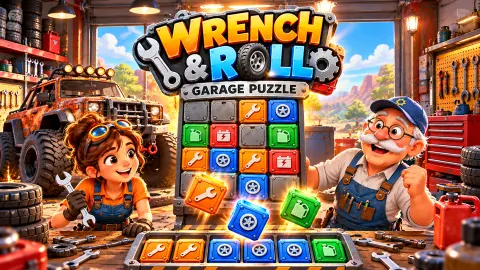
Crates in Wrench and Roll move in one direction. Tap one on the wall and it rolls down to the bench below, and there it sits until two identical twins arrive to join it. There is no hand that puts it back. The bench has six slots, and everything that makes this puzzle hard comes out of that single number.
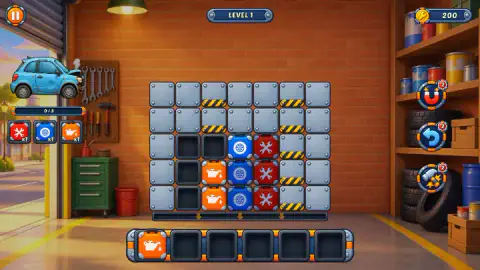
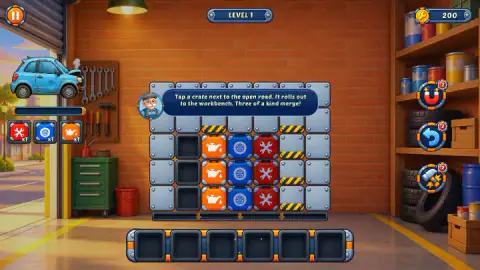
The board is a wall of riveted steel plates, seven across and five down, set into the brick of a garage. Some of the plates are crates: an orange one with an oil can on it, a blue one with a wheel, a red one with crossed wrenches. Running through the wall is a dark channel of empty sockets, and the game writes the rule on screen beside a portrait of the old mechanic: Tap a crate next to the open road. It rolls out to the workbench. Three of a kind merge! Only crates touching that gap can be taken. Every crate that leaves widens it.
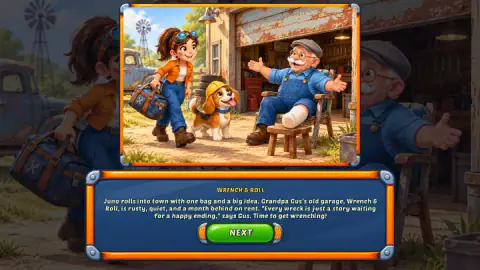
Around the puzzle there is a story, and it is told quickly. Juno arrives in town with one suitcase and a beagle in a hard hat; her grandfather Gus is sitting in a wooden chair with his foot in a plaster cast, and his garage is rusty, quiet and a month behind on rent. The first customer is a woman called Mrs. Pickle, whose line is that her little car coughs every morning. Under the banner reading GUS'S GARAGE sits the only number that matters on that screen: level one of 120.
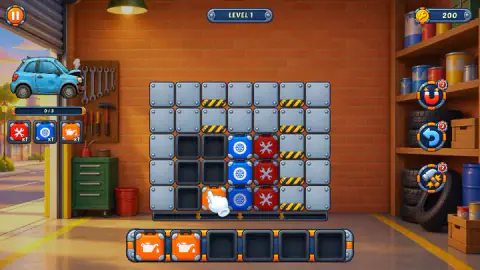
One thing before the rest, because it shapes this page. Our session lasted about ten minutes and most of it was not spent on the board — the game sat on its title screen and its pause panel far more often than it sat on the puzzle, and it had to be reloaded once when it stopped answering. We got into level one, emptied the oil column one crate at a time, watched three orange toolboxes merge on the bench in a burst of gold, and saw the counter turn from none of three repair parts to one of three. We never finished that level. Everything beyond it here is the game's own claim, and this page says so each time.
Six slots, three kinds, nine crates: the arithmetic of level one
The first job lays out its pieces with unusual honesty. Nine crates sit in the wall in three kinds — oil, wheel, wrenches — three of each, in three neat columns. The car asks for one part of each kind. The bench holds six.
Put those together and the level is a small, complete logic problem rather than a warm-up. Six slots divided by two spare copies apiece means the bench is exactly large enough to hold three unfinished pairs and not one crate more. Take two oils, two wheels and two wrenches and you are holding a full bench with no trio in it, three crates still on the wall, and no legal move left. The level is losable on move six, and nothing on screen warns you.
The way out is the opposite of what the board invites. The easiest crates to reach are spread across the front of the road, one of each colour, and taking them in that order walks you straight into the jam. Taking a whole column instead — three of the same thing, merged and gone — frees the bench before it ever fills.
A workbench is a limit, and real garages live by it
This is not a puzzle convention borrowed for the sake of difficulty. It is how a repair shop actually fails.
The binding constraint in a garage is never the number of spanners. It is space: a car up on a lift with its wheels off and its bonnet open is occupying a bay, and it blocks that bay whether the mechanic is working on it or has gone to lunch. Start a second job before the first is finished and you have two half-stripped cars and a floor covered in parts that belong to neither. Start a fourth and nothing can move at all.
Workshops and factories solved this a long time ago by capping the number of unfinished jobs allowed at one station rather than trying to work faster. The idea came out of Toyota's production system in the decades after the Second World War — the insight, largely credited to the engineer Taiichi Ohno, that unfinished work is what jams a line, and that the cure is to refuse to start more of it. That cap is now the first rule on every kanban board in every workshop that uses one: a limit on work in progress, written at the top of the column.
Wrench and Roll has turned that rule into a piece of furniture. The six slots are a work-in-progress limit, drawn as a bench. The crates are jobs you have opened. A merge is a job closed. And the only way to lose is the way a real shop loses: by having too many things started and nothing finished.
What the first level does not show you
Honest inventory. We saw one car, one customer and one board. The counter under the garage banner promises 119 more levels; the game's own listing adds that they run across six chapters and twelve cars, from old junkers up to racing machines, and that later boards bring mystery crates, bomb crates and padlocked plates. We met none of those.
We also never opened the shelf. Four buttons run down the right-hand side of the garage screen — LUCKY TYRE, UPGRADES, SHOWROOM and CHESTS — and two of them wore a red badge reading one, which usually means something is waiting. The coin counter sat at 200 throughout and the star counter sat at zero, because stars are awarded for finishing levels and we did not finish ours.
What we can vouch for is the texture. Seven of the plates in the first wall carry a yellow-and-black hazard band and none of them so much as flickered while we played, which reads as a promise that something later will move them. The merge, when it finally came, was the loudest thing in ten minutes of garage ambience: three orange toolboxes, a flash of gold, a bar sliding a third of the way across, and one grey part tile turning into a green tick. For a game that had spent most of our session sitting on its own title screen, it was a surprisingly satisfying thirty seconds.
More puzzles that fill a tray
If the bench-and-merge loop is what you came for, Happy Zoo: Mahjong Triple Match runs the same idea on stacked tile pyramids, sending animals into a tray where every three of a kind vanish. Master of 3 Tiles is the plainest version of the format, with the board and nothing else. Goods Sort 3D - Triple Puzzle moves it onto shelves, and Sorting Nuts and Bolts by Color: Home Repair keeps the workshop setting while swapping the bench for a row of threaded bolts. The rest are in puzzle games.
Screenshots
How to play Wrench and Roll
- Press PLAY on the title screen, read the card about Juno and Gus, then press PLAY again on the garage screen to take the first job.
- Find the dark channel running through the wall of plates. Tap any crate that touches it, and it will roll down into the workbench below the board.
- Collect three identical crates in the workbench. They merge on the spot and become one of the repair parts the car is asking for.
- Watch the bar under the car. It counts parts, not moves, and when the three part tiles beside it have all turned into green ticks the job is done.
- If a level goes wrong, the pause button in the top left corner opens a panel offering RESUME, RESTART and GIVE UP, with separate switches for sound and music underneath.
What only sitting in front of it teaches:
- Six slots is three unfinished pairs, and no more. A merge needs three of a kind, so you can never be holding more than two of any one crate. Fill the bench with two each of three different kinds and nothing will merge and nothing can come down.
- Finish a kind before you open a third one. The safe habit is to empty one column completely, bank the part, and only then start spreading.
- The road does the work for you. Each crate you take leaves a socket, and those sockets reach sideways into the next column. Clearing the nearest column is usually what makes the one behind it reachable at all.
- The boosters are a safety net, not a strategy. Each of the three started level one with a red badge reading two, which is not enough to play carelessly on.
- It is a pointing game. We pressed Enter and Escape dozens of times across the session and the board never moved once. Keep your hand on the mouse.
Controls
| Left click or tap on a crate | Sends that crate down to the workbench. It only works on crates touching the open road, the dark gap running through the plate wall |
|---|---|
| Left click or tap on a booster | Fires the magnet, the rewind arrow or the hammer from the shelf on the right. Each starts level one with a red badge reading two |
| The pause button, top left | Opens a panel reading PAUSED with RESUME, RESTART and GIVE UP, plus separate buttons for sound and music |
| Keyboard | Nothing we pressed moved the game. Enter and Escape left the board exactly as it was, so this is a game you play with a pointer |
Features
- The workbench holds six crates and a merge needs three of a kind, so the bench can never hold more than two of any one crate
- Only crates touching the open road can be tapped, and every crate that leaves widens that road for the ones behind it
- Level one is a wall of thirty-five riveted plates with nine crates set into it, in three kinds: an oil can, a wheel and a pair of crossed wrenches
- Seven of those plates carry a yellow-and-black hazard band. In our run they stayed exactly where they were
- Three boosters sit on a shelf beside the board — a magnet, a rewind arrow and a hammer — each stamped with a red badge reading two
- A bar under the damaged car counts repair parts rather than moves: one merge filled a third of it and turned the matching part tile into a green tick
- The level banner reads GUS'S GARAGE, and the line under it frames the first job as one of 120
Game details
- Developer
- Partner studio
- Release date
- October 2026
- Last updated
- October 25, 2026
- Added here
- October 2026
- Technology
- HTML5 (2D)
- Platforms
- Browser (desktop), Browser (mobile & tablet, touch)
- Classification
- Puzzle
- Saved progress
- Saving, when available, is managed by this game. Mava cannot confirm your level.
FAQ
How do you play Wrench and Roll?
You tap crates off a wall of steel plates and they roll down to a workbench under the board. The workbench has six slots, and as soon as three identical crates are sitting in it they merge into a repair part for the car waiting in the corner. A level ends when the car has all the parts it is asking for, which on the first job is three.
What does "tap a crate next to the open road" mean in Wrench and Roll?
The open road is the dark gap running through the wall of plates — the sockets where crates used to be. Only crates touching that gap can be tapped; the rest are walled in. Because every crate you take leaves a new empty socket behind it, the road grows as you play, and the crates that were unreachable a moment ago become the ones you can take next.
How many slots does the workbench have in Wrench and Roll?
Six. That number is the whole difficulty of the game, because a merge needs three of a kind, so the bench can only ever be holding two of any one crate at a time. Six slots is therefore exactly three unfinished pairs, and a seventh crate has nowhere to go.
Can you get stuck in Wrench and Roll?
Yes, and the arithmetic says how. If you fill the bench with two crates each of three different kinds, nothing merges and there is no free slot to take a fourth crate with. The way to avoid it is to finish one kind before you open a third, rather than taking whatever is easiest to reach.
What are the boosters in Wrench and Roll?
Three icons sit on the shelf to the right of the board: a red horseshoe magnet, a blue curved rewind arrow and a hammer. Each one carried a red badge reading two at the start of the first level, so they are a limited safety net rather than a tool you lean on. The game's own instructions describe them as a magnet, a rewind and a hammer for when you get stuck.
How many levels does Wrench and Roll have?
The banner over the garage screen reads GUS'S GARAGE and the line beneath it reads LEVEL 1 OF 120, so 120 is what the game promises. Its own listing adds that those levels are grouped into six chapters and cover twelve different cars. We reached level one and did not finish it, so everything past the first job is the game's claim rather than ours.
Is Wrench and Roll a driving game?
No, despite how it is sometimes filed. There is no steering, no throttle and no race. The cars are the thing you repair, not the thing you control, and every input in the game is a tap on a crate, a booster or a menu button.
Is Wrench and Roll free, and who made it?
It is free and it runs in a browser with nothing to install. The studio behind it is not recorded anywhere we can check, so this page names no author rather than guessing one. It reached our catalogue on 24 October 2026, which makes it days old at the time of writing.