




About Pistonio
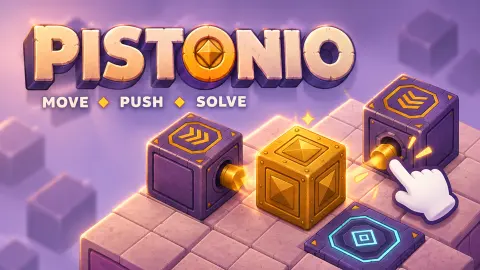
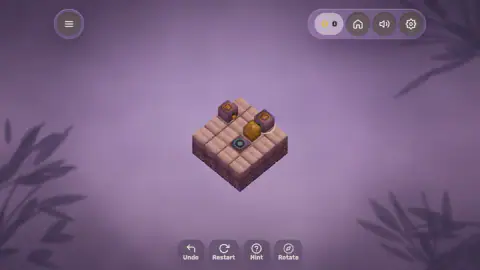
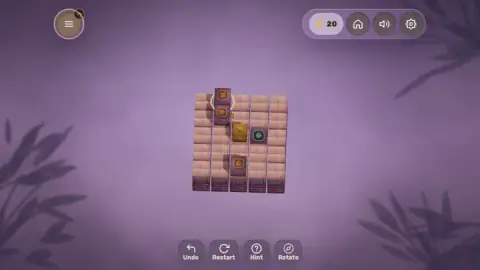
Most push puzzles hand you a little worker and a warehouse to walk around. Pistonio takes the worker away. Nothing on its board walks anywhere: there is a gold cube, a tile with a teal mark where the cube belongs, and a few dark blocks with an orange face. Those are the pistons, the only things you can click.
Click one and it fires. A gold rod shoots out of its face and shoves whatever block stands on the next tile along, one square and no further. That is the whole vocabulary of the game. You cannot nudge the gold cube, drag it or steer it. You decide which piston goes next, and the board does the rest. The face of each piston carries three chevrons that point the way it fires, and learning to read them before you click, rather than after, is most of what the game asks of you.
The game is credited to Grailbit. It was published in mid-September 2026, so it is new and still gathering players. We have now sat down with it three times, the last of them for ten minutes, and we have cleared exactly one level in all that time. That last session still took us somewhere the earlier ones never reached, which turns out to be the point of the whole thing.
The first board is four tiles a side, and two pushes is perfect
The opening level is as small as a puzzle can be: two pistons, the gold cube, and the teal plate one diagonal step from it. A diagonal cannot be done in a single push, because a piston fires in a straight line. So the level is two pushes at right angles. We fired the piston on the right, and the cube slid one tile, landing in front of the other piston and in line with the plate. One more click and it was done.
That is where the scoring comes from. The card that follows carries the line "Perfect · 2 moves" with gold stars dropping onto it. The stars are not about speed, and there is no clock anywhere in the game: they are about matching the number of moves the level was built for. A wasted push is not free, which is why Restart is often a better answer than trying to repair a board. Under the line sit a replay arrow, a map button, a dark "Double it with an ad" and Next.
"Piston pushes piston", and the board where we still stop
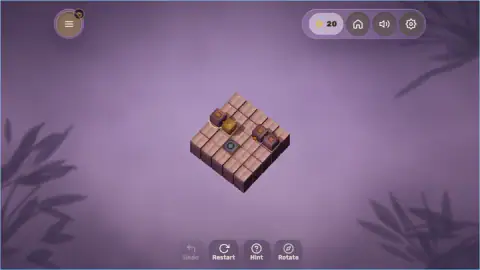
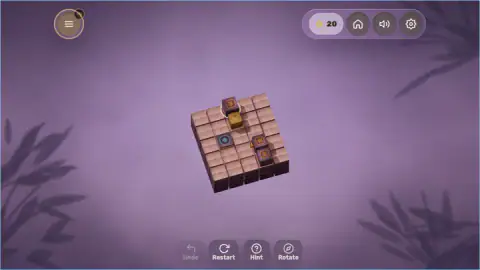
The second level is five tiles a side with three pistons, two of them in a row, one directly behind the other. The game stops and explains the shape: a card titled "piston pushes piston", showing two pistons on a strip of tiles, with a grey Got it button underneath.
That single sentence changes the game. A piston is a block like any other, so firing the rear one shoves the front one along, and the front one now faces a row it could not reach before. The question stops being only where to send the cube and becomes where to send your tools first.
Knowing it has not been enough. Three sittings, and that board has beaten us every time: the opening level is a handshake, and the second one is the game.
What a cleared level actually pays: a chest, a mole, and an island
This is the part we had only glimpsed before. Clearing a level pays twenty coins and drops a wooden chest on the board you just finished. A label points at a row of three slots under it — the first framed in gold with the word "tap" on it, the other two grey — and reads "An island performer ripens here".
Tap it and the puzzle disappears. The chest fills the screen, with "Tap to open" underneath. Open it and a card turns over: "A new performer!", and on it a pale violet cube with two little ears, named Mole and marked COMMON. The card offers to seat it on the island.
Say yes and the loading screen tells you what the game thinks it is about. It does not say loading. It says "Tuning the instruments…", and then "Tuning the orchestra…".
What comes up is not another puzzle. It is a brick island titled Lilac Valley, described in two words as "warm, cosy", with twelve gold-ringed sockets on top and a line above them: "Press a resident below — they'll step onto the island and play". At the foot of the screen sits our mole, beside one padlocked card reading "11 more". Press the mole and it walks up onto a socket; the counter in the corner turns from zero of twelve to one.
So the puzzles are not the collection. The island is. Every level you clear ripens a chest, every chest hands you a resident, and each resident takes a place the other eleven will eventually share. The game's own description says a full island plays a whole song of its own. We cannot tell you what twelve of them sound like — only that the thing you are playing towards is a band, not a level counter.
The skip button asks twice
After a while on a board, a dark button appears above the bottom row: a small camera icon and the words "skip for an ad". Tap it and a line reads "We will skip the level for an ad — tap again", while the button turns red and changes to "really skip?".
That second step matters, because the button sits just above Restart and Hint, where a hurried click can land. We did not take the offer: a puzzle you skip is a puzzle you did not get.
Pushing without pulling is a rule from 1981
The family Pistonio belongs to has a known starting point. Sokoban was created in 1981 by Hiroyuki Imabayashi, and his company Thinking Rabbit sold the first commercial version in Japan a year later. The name is Japanese for "warehouse keeper", and its rule, as Wikipedia's article puts it, is that boxes can only be pushed, never pulled.
That one restriction is what makes the genre hard. A box pushed into a corner stays there, because nothing can get behind it to bring it back. Pistonio keeps the restriction and makes it stricter: in Sokoban the worker walks around a box and pushes it from any free side, while here a piston is bolted to its tile, faces one way and reaches one square. You cannot choose your angle, only your order. What it adds in exchange is the thing the 1981 original never needed: a move can be taken back.
Is Pistonio for you?
It is if you like small boards you can hold in your head. There is no clock, no lives, and nothing moves unless you click. Both boards we have seen could be thought through before the first push, and the star score rewards exactly that.
Anyone after action, or who hates being stuck, will get less from it. We were stuck on the second level within minutes, three times over, and the game was in no hurry to rescue us.
More puzzles where order is everything
For another puzzle about clearing things in the right sequence, try Arrow Cube 3D, where arrows leave a cube one at a time, or Tap 3D Wood Block Away, which also rewards turning the view before you tap. Wood Blocks Jam and ExitBlocks: Color Match Puzzle slide blocks out through the right gate. The rest are under puzzle games.
Screenshots
How to play Pistonio
- Start clicking; there is no start button. The board under the PISTONIO title is the first level.
- Find the gold cube and the teal plate. The cube has to finish on that tile; nothing else is the goal.
- Read the chevrons on each piston. They tell you which neighbouring tile that piston can clear, and in which direction.
- Click the piston whose arrows point at the cube. The cube slides one tile away from it.
- Chain the pushes. After one push the cube has left that piston's reach, so the next push comes from another one. Undo, Restart, Hint and Rotate sit under the board throughout.
What our sessions taught us:
- Rotate until the board looks flat. This is the tip we wish we had had the first time. From the default three-quarter angle a piston at the back hides its own face and you are guessing. Turn the view until you are looking almost straight down the grid and every chevron is legible at once.
- A piston reaches one tile and no further. Click the piston beside the gold cube, the cube slides a square, and a second click on that same piston does nothing.
- The game tells you when a click is wasted. A line appears over the board: "nothing here for the piston to move", and a pale ring shows at the foot of the piston it means.
- Sit still and the game nudges you. After a pause with no clicks, a quiet line appears at the top: "blocks are moved by pistons — tap a piston". It is the only prompting you get.
- Leave the keyboard alone. We pressed Enter and the arrow keys over and over, on the board and on the victory card, and nothing moved. Every button here wants a click or a tap.
Controls
| Click a piston | Fires it; a gold rod shoots out and the block on the next tile along moves one square |
|---|---|
| The three chevrons on a piston | They point the way that piston fires, so read them before you spend a move |
| Rotate (bottom row, compass icon) | Turns the view; from a flat angle every piston's chevrons become readable at once |
| Undo (bottom row) | Greyed out until you have made a move, lit afterwards; the game's own instructions give Z as its key, which we could not confirm |
| Restart (bottom row) | Puts every piece of the board back where it started |
| Hint (bottom row) | A question-mark button; we never pressed it |
| The keyboard | Nothing we pressed moved anything, on the board or on the cards. This is a game for a mouse or a finger |
Features
- Nothing on the board moves unless a piston pushes it, and all you choose is which piston fires and in what order
- Each push moves a block exactly one tile, which is the rule every solution is built on
- Pistons push pistons, so part of the puzzle is moving your own tools into place
- A first board of four tiles a side that doubles as the title screen and takes two pushes
- Clear a level in the number of moves it was built for and the card reads Perfect with that count
- Every clear pays twenty coins and a wooden chest, and the chests hold residents for an island with twelve places to fill
- Undo, Restart, Hint and Rotate under the board at all times, with a plain message when a click is wasted
- Made by Grailbit
Game details
- Developer
- Grailbit
- Release date
- September 2026
- Last updated
- September 21, 2026
- Added here
- September 2026
- Technology
- HTML5 (3D)
- Platforms
- Browser (desktop, mouse), Browser (mobile & tablet, touch)
- Saved progress
- Saving, when available, is managed by this game. Mava cannot confirm your level.
FAQ
How do you play Pistonio?
Click a piston, one of the dark blocks with an orange face, and it pushes the block on the next tile one square along. The aim is to get the gold cube onto the tile with the teal mark. You never move the cube yourself: you only choose which piston fires, and in what order. A push always travels exactly one tile, so a longer trip needs a second piston waiting where the block lands.
How do you get three stars in Pistonio?
By clearing the level in the number of moves it was built for. Finish the first board in two pushes and a card appears with the line "Perfect · 2 moves" and stars dropping onto it. The game's own description ties three stars to matching that par count. Spare pushes cost you, which is why a restart is often cheaper than trying to repair a board.
Can a piston push another piston in Pistonio?
Yes, and the game teaches it with a card titled "piston pushes piston" showing two pistons in a row. A piston is a block like any other: fire the one behind and the one in front slides a tile, which puts it in reach of squares it did not cover before.
What does "nothing here for the piston to move" mean in Pistonio?
It means the piston you clicked has no block on the tile in front of it. It usually appears when you click the same piston twice, because the first click already pushed the block out of its reach. A pale ring marks the piston the message is about.
What are the chests and the island in Pistonio?
Clearing a level drops a wooden chest on the board, and a label points at it reading "An island performer ripens here". Open the chest and it hands you a resident — ours was a mole marked COMMON — and offers to seat it on an island called Lilac Valley. The island has twelve sockets and a counter that read one of twelve once our mole was standing on it.
What does "skip for an ad" do in Pistonio?
It is a button above the bottom row that offers to skip the level in exchange for watching an ad. A first tap turns it red and it asks "really skip?", so it cannot be triggered by one stray click. We did not go through with it.
How many levels does Pistonio have?
The game's own description speaks of 84 levels across five planets. We cannot confirm the figure: across three sittings we cleared the first board and never solved the second, so most of the game is beyond what we saw. What we can confirm is the island, which has room for twelve residents.
Is Pistonio like Sokoban?
It belongs to the same family: blocks on a grid that can be pushed into place, with the order of the pushes as the puzzle. The difference is that Sokoban gives you a worker who walks around the crates, and Pistonio gives you fixed pistons that each face one way and reach one tile.