



About Flag Coloring Puzzle
Most colouring games hand you a finished outline and a paint bucket. This one will not let you near a colour until you have drawn the shape yourself.
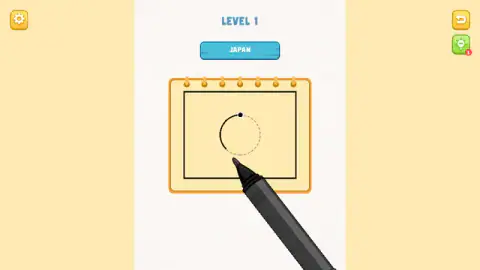
Level one is Japan. You get a notepad — cream paper, an orange border, seven gold rings along the spine — and inside it a black rectangle with a dashed circle floating in the middle. A small black X sits on the rim, marking where to start. A large grey crayon hovers nearby. There is no palette anywhere on the screen, and there will not be one until the loop is closed.
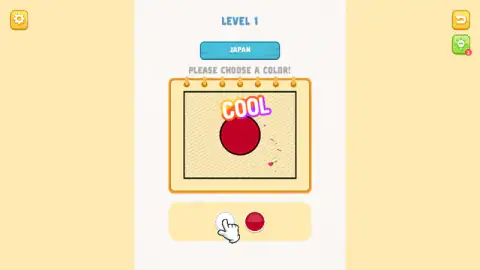
So a level is two jobs rather than one. First you ink: hold the pointer down on the mark and drag around the dashes until the circle joins up. A sticker reading AWESOME lands on the page in a burst of confetti, a tray slides in underneath carrying the colours that flag needs, and a line of grey text tells you what to do with it — "PLEASE CHOOSE A COLOR!". Take the red, and the crayon in your hand turns red too.
The game is credited to Bravestars, a Vietnamese studio. It has been available since the middle of 2026.
Press and hold is the whole game, and that is not an accident
A colouring game built on clicks would be a game about accuracy: find the region, hit it, watch it fill. This one is built on a held stroke, which makes it a game about movement instead.
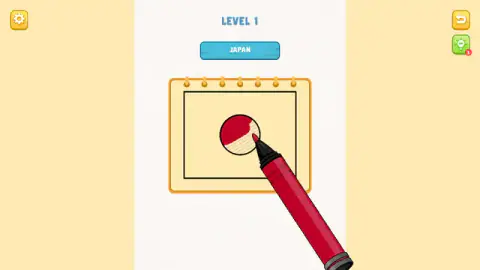
You can see the difference in a half-finished shape. Sweep the crayon across a third of Japan's disc and a third of it is red, with the rest still showing the diagonal hatching that marks bare paper. Nothing snapped to the edges and nothing poured in from the point you touched. The tracing stage behaves the same way: the dashes are a route rather than a target, and the ink follows the crayon along it.
The practical consequence is a game built for a finger and then left to work with a mouse. Holding and sweeping is what a thumb does naturally on a phone; on a desktop it is the one gesture people are least likely to try first.
The tray only ever holds that flag's own colours
Japan's tray held two swatches, white and red. Germany's held three — yellow, black and red — and not one spare. That is the quiet design decision the whole game rests on, and it works because of how national flags are built.
The standard short guide to flag design is a booklet called Good Flag, Bad Flag, compiled by Ted Kaye for the North American Vexillological Association, introduced in 2001 and printed in 2006. It sets out five rules, and three of them are the reason this game can exist in this form.
Keep it simple is the first, and its test is blunt: a child should be able to draw the flag from memory. The reasoning is practical rather than aesthetic — flags are seen at a distance and from the wrong side, so only simple designs survive the journey. That test is almost exactly what the first stage of a level asks of you.
Use two or three basic colours is the third, and it is the rule that makes the tray possible. A flag that obeys it can be rebuilt from a handful of swatches, which is why nothing in this game has ever handed us more than three.
No lettering or seals is the fourth, and it does the most work here. Kaye's line on it is that if you have to write the name of your place on your flag, your symbolism has failed. A flag with a dense state seal in the middle is not something anyone is going to trace with a crayon and fill from a tray. Flags that follow the rule are.
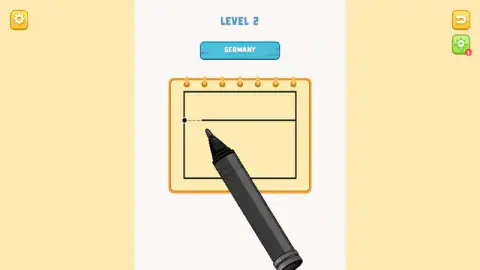
Japan is the extreme case of all three at once: one circle, centred, two colours, nothing written. Germany is the next step up and the shape of the job changes with it — no circle at all, just a rule to draw straight across an empty rectangle, and then another, until the field is three bands waiting for three colours. The fifth rule, be distinctive or be related, is the one that should matter most as the list goes on, because it is what keeps one flag from feeling like a repeat of the last. Two flags in, we cannot tell you whether it does.
What happens when a flag is done
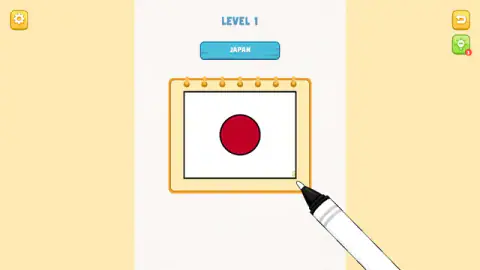
The moment the last hatching goes, the screen clears itself. The level number disappears, so do the gear, the undo arrow and the hint lamp, and the finished flag sits alone on the notepad looking like a flag rather than a puzzle. "COMPLETED!" drops across the top in multicoloured capitals, with a green NEXT button underneath.
Press it and the screen dims into an advert slot before the next country loads, with a button to carry on. Nothing played in the one we hit, so we cannot tell you how long an advert runs here, only that the game breaks for one between flags.
One small thing changed across that break, and it is the kind of detail that only shows up if you get past the first level. The green lightbulb in the corner carries a red badge. It read 1 for the whole of Japan and 2 for the whole of Germany. So the badge is a stock of hints rather than a label, and finishing a flag appears to be how you earn more. We never spent one, so what a hint actually gives you is still open.
Two things we would tell anyone starting out. The undo arrow and the gear are still unexplored, because a session that goes well never needs either. And the German flag will let you paint a band the wrong colour without complaint — the tray limits what you can pick, but it does not police where you put it.
More games by Bravestars
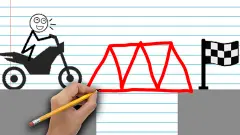
If the drawing is the part you want, Draw The Road turns the same held stroke into a physics problem, and Spray Paint - Coloring Games is the studio's straight colouring title, layer by layer instead of flag by flag. For more flags, Flag Painting Game is the gentler version of this idea, and World Flags Quiz asks you to match the country to the design instead of building it. The rest are in puzzle games.
Screenshots
Taken by opening the game ourselves and letting it run — not supplied by the publisher, and not the same picture every other site shows.
How to play Flag Coloring Puzzle
- Find the X on the dashed outline and press the button down. Do not click. Press, and keep pressing. Nothing on the page moves until the pointer is held.
- Drag the crayon along the dashes. The line inks in behind you, solid black where you have been and still dashed where you have not. Close it and the outline is done.
- Pick a colour from the tray that appears. It only ever holds the colours that flag uses. The crayon changes to whichever one you take.
- Sweep the crayon across the hatching. The unpainted parts of a shape are drawn as diagonal lines. Colour lands where you drag and nowhere else, so this is a sweeping job rather than a tapping one.
- Clear every hatched area. When the last of it goes, the flag is finished and the game says so.
What ten minutes with a crayon taught us:
- The game tells you the control and it is easy to miss. Under the pad, in grey, it says "TAP & HOLD TO DRAW". That line is the entire manual, and a first session spent tapping gets nowhere at all.
- Finished regions are safe. Once Japan's disc was red we swept white right around it to fill the field, and the disc stayed red.
- The wrong colour is not refused. We ran black across the middle band of the German flag, which should be red. The black went down, the level did not end, and nothing told us why.
- The keyboard is not wired up. Arrow keys, the space bar and Enter all got no response of any kind.
- The game is almost silent. One sound played when it opened, and then nothing — no chime for closing a line, no jingle for finishing a flag.
Controls
| Press and hold | The only control that does anything. Holding the pointer down is what inks the outline and what lays down colour |
|---|---|
| Drag while holding | Moves the crayon. You trace the dashed line with it, then sweep it across the hatched area to fill it |
| Colour swatches | A tray that appears under the pad once an outline is closed, holding that flag's own colours. Clicking one loads the crayon with it |
| NEXT | A green button on the end-of-level screen. It takes you to the next flag, by way of an advert slot |
| Gear (top left) | Settings. We never opened it, so what is inside is not something we can tell you |
| Curved arrow (top right) | Undo. We never spent a session tidy enough to see what it takes back |
| Lightbulb (top right) | A hint, with a red badge counting how many you are holding. It read 1 on the first flag and 2 on the second |
| Arrow keys, Space and Enter | Nothing we could detect. This is a pointer game from end to end |
Features
- Every level is two jobs: ink the dashed outline first, colour it second, and the tray stays hidden until the outline closes
- A tray holding that flag's own colours and no others — two swatches for Japan, three for Germany
- Colour laid down stroke by stroke rather than poured in, so a half-swept shape really does look half painted
- Stickers that drop onto the page as you go, "AWESOME" for closing an outline and "COOL" for filling a region
- A finished flag earns a "COMPLETED!" screen with the clean flag on the pad and a green NEXT button
- A hint stock on the lightbulb that went up by one when we finished a flag
- An advert slot between one flag and the next; nothing played in the one we hit
- It has been available since June 2026
Game details
- Developer
- Bravestars
- Release date
- June 2026
- Last updated
- June 26, 2026
- Added here
- May 2026
- Technology
- HTML5 (2D)
- Platforms
- Browser (desktop), Browser (mobile & tablet, touch)
- Classification
- Educational , Kids , Puzzle
- Saved progress
- Saving, when available, is managed by this game. Mava cannot confirm your level.
FAQ
How do you play Flag Coloring Puzzle?
Each level gives you a country's name and a dashed outline on a notepad. You hold the pointer down and drag along the dashes to ink the shape, and once it closes a tray of colours appears underneath. Pick a colour and sweep the crayon across the unpainted area until no hatching is left.
Why is nothing happening when I click in Flag Coloring Puzzle?
Because clicking is not the control. The game asks you to press and hold, and it says so in grey text under the pad, "TAP & HOLD TO DRAW". A tap on a blank area does not fill it, which is worth knowing because the game's own listing says it does.
What is the first level of Flag Coloring Puzzle?
Japan, and the second is Germany. The header reads "LEVEL 1" with a blue bar under it carrying the country's name, and the shape waiting on the pad is the single circle at the centre of the Japanese flag. Germany arrives as the same empty rectangle with a horizontal rule to trace across it.
Does Flag Coloring Puzzle fill the shape in automatically?
No. The crayon paints where you drag it and nowhere else, so a circle you have only half swept looks exactly half painted, with the untouched part still showing as diagonal hatching. It is closer to colouring something in than to tapping a region and watching it flood.
What happens when you finish a flag in Flag Coloring Puzzle?
The clutter clears, the clean flag sits alone on the notepad, and "COMPLETED!" drops across the top in multicoloured capitals with a green NEXT button underneath. Pressing it dims the screen into an advert slot with a button to carry on, and the next country loads behind it.
How many flags does Flag Coloring Puzzle have?
We have seen two, Japan and Germany, in that order. The game's own listing claims hundreds of national flags, but that is the distributor's number rather than anything we have counted on screen, and we are not going to repeat it as ours.
Does Flag Coloring Puzzle stop you using the wrong colour?
It did not stop us. The tray only ever offers that flag's own colours, so you cannot pick something absurd, but nothing prevented us from running black across a band of the German flag that should have been red. The level simply did not end.
Who made Flag Coloring Puzzle?
It is credited to Bravestars. Bravestars is a Vietnamese studio, founded in 2013 and based in Hanoi, with a large catalogue of drawing and colouring titles. No studio name appears anywhere on screen while you play.