










About Marble Factory
Most colour-sorting puzzles let you put every piece exactly where you want it. Marble Factory takes that away. You never place a piece at all. You pick a tray, tip it over, and from that moment the contents belong to the machine: they tumble down a funnel, land on a conveyor belt that never stops turning, and ride it until a box of their own colour comes past.
That leaves one decision, made over and over: which tray, and when. Tip the right one and its pieces drop into the boxes waiting below a second later. Tip the wrong one and they go round, and round, taking up room on a belt the game says must never overflow.
The screen is calmer than that sounds. Flat green background, a cream hopper in the middle holding square trays, a looping belt under its neck, and columns of boxes below the belt. And despite the name, nothing in there is a glass marble: the red pieces are drawn as strawberries with their leaves still on, and the yellow ones as plain round balls.
Marble Factory is credited to Onki Games, the studio name also on Sand Blocks in our catalogue. It was published in September 2026.
We played level 1 through to the end, watched what the game does between levels, and got into level 2 before running out of sensible moves. Everything below is what we saw on the screen.
Nine pieces, three slots, and trays that hide their colour
Every tray in the hopper shows the same grid: three rows of three. Every box under the belt is a short bar with three bumps on it, one per piece. Put those together and the arithmetic of the whole game falls out. A full tray fills exactly three boxes.
That is the planning tool Marble Factory hands you without ever mentioning it. A column whose front three boxes are all red wants one red tray, no more and no less. A column with one red box and two yellows behind it will take a third of a red tray, and the other six pieces have to find red boxes elsewhere or sit on the belt.
The complication is that you cannot see the whole plan from the first screen. Not every tray shows its colour. On level 1 the hopper had two pink squares sitting either side of a yellow tray, looking like part of the furniture. They were not. As soon as that yellow tray had been tipped, both pink squares turned into trays packed with strawberries, ready to use.
So plan two taps ahead rather than five, and keep room on the belt for a colour you did not know was coming.
The belt is a waiting room with a fixed number of seats
Between the funnel and the boxes runs a long loop: two rows of grey sockets joined at the ends. Pieces that land on it ride round in a steady circle. When they pass an open box of their colour, they drop in. When they do not, they come round again.
That makes the belt useful. Parking pieces there is a legitimate move, because they will fall into place the second their box reaches the front. We watched that work: a yellow tray pouring into the funnel while the belt was already crowded with strawberries, and both ended up where they belonged.
But every piece waiting on the belt sits in a socket something else may need, and the game's instructions are blunt about where that ends. Let the belt overflow with pieces that have no matching box in sight and the level is over. We never pushed it that far, so we cannot show you that screen. We did feel it tighten. On level 2 we tipped a yellow tray while every open box on the floor was green, and a dozen yellow balls were still circling, with nowhere to go, when we stopped.
Between levels: a card, thirty coins and an ad break
Fill the last box and the board darkens behind a card reading "Well Done!" and "Level Completed!", with a stack of coins on a blue disc marked +30 and a yellow Next button underneath. The coin counter in the top left still showed the old total at that point; the coins had been added by the time the next level loaded, taking the counter from 100 to 130.
Next is not live yet, though. The ad slot takes the middle of that card first, and the button sits dark behind it until the break is done. Ours came back with a notice reading "We skipped the ad this time", a purple Continue playing button, and Next still waiting underneath. Worth knowing where the interruption lives: it is at the end of a level, not inside one. Nothing cut across a level while we were playing it.
Level 2 changes the board rather than the rules. A third colour arrives, green, and the columns mix green, red and orange boxes instead of the straight red-and-yellow of level 1. Three round buttons hug the right edge the whole time, each one padlocked and marked with a level number: 6, 8 and 11. Tapping them did nothing. Something opens up at each of those levels; we did not get that far, so we will not guess what.
What a real marble factory does with the finished marbles
Search for a marble factory and a lot of the results are about a real one, because the United States has a single marble maker left. Marble King, in Paden City, West Virginia, was founded in 1949 and turns out more than a million marbles a day, according to the West Virginia Encyclopedia. A 2023 report by West Virginia Explorer calls it the country's only domestic marble manufacturer and shows liquid glass being rounded between rollers.
Making them is only half the job. The other half is getting the right ones into the right containers, in fixed counts, without the line backing up behind the sorter. This game keeps only that second half. There is no furnace and no glass here, just a continuous stream of finished pieces that has to be split by colour into boxes that each hold exactly three, on a belt that will not wait for you to make up your mind.
More sorting puzzles to try
Bus n Ball Jam is the closest relative: buses drop coloured balls onto a looping belt over four columns of three-slot boxes, with a parking jam on top. Fruits into Baskets asks for three of a kind in each basket, and Stack Sort sorts blocks into single-colour stacks against a move limit. From the same studio name, Sand Blocks turns colour matching into falling sand. The rest are under puzzle games.
Screenshots
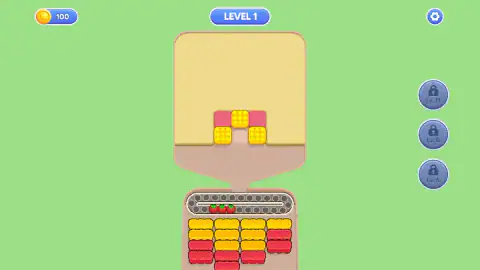
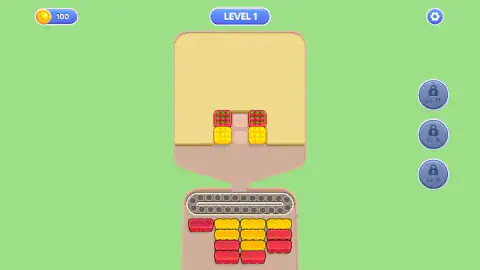
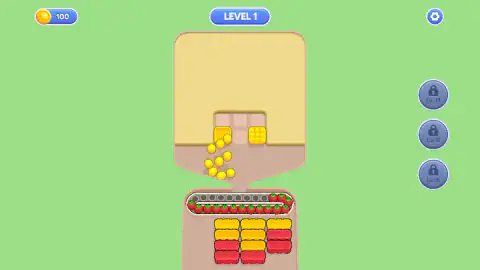
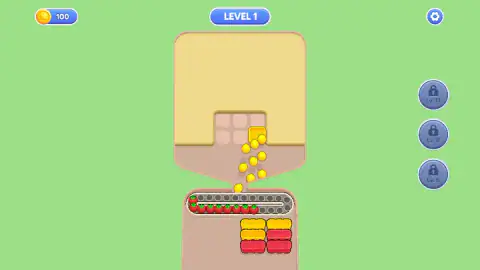
Taken by opening the game ourselves and letting it run — not supplied by the publisher, and not the same picture every other site shows.
How to play Marble Factory
- Start with a tap in the middle of the screen. There is no play button: the board is already laid out and the belt is already turning.
- Look at the boxes under the belt. They stand in columns, and only the box at the front of each column, the one facing the belt, can take anything.
- Tap a tray in the hopper whose colour matches one of those front boxes. The tray tips and its contents pour down the neck of the funnel onto the belt.
- Each piece rides the belt until it passes an open box of its colour and drops in. Three fill a box. The full box leaves, and the one behind it moves up.
- Clear every box and the level ends with a card, a pile of coins and a Next button.
Tips from our game:
- Read the front row, not the hopper. The hopper tells you what you have. The front row of boxes tells you what the game will accept right now, and only that colour is worth tipping.
- One tray is three boxes. Nine pieces, three slots each. If a column shows three boxes of the same colour, one tray clears the lot.
- Look one box deeper. When a front box fills, the box behind it decides what that column will take next. That is the colour to have ready.
- A loaded belt is not a lost level. At one point we had about twenty strawberries riding the loop with no red box open anywhere, and the level still finished cleanly once the yellows were out of the way.
- Switch windows and the line stops. The game pauses the moment it loses focus and shows a "Click to keep playing" banner at the top.
Controls
| Click or tap a tray | Tips that tray and pours its pieces down the funnel onto the belt (the tray tap is what worked in our game, and the game's instructions describe it the same way) |
|---|---|
| Continue playing | Closes the ad slot that covers the end-of-level card |
| Next button | Starts the next level once the card is clear |
| Gear, top right | Opens the settings |
Features
- Every tray in the hopper holds a grid of nine pieces, and every box below has three slots, so one full tray fills exactly three boxes
- Pieces tumble through the funnel onto a looping belt and ride it until an open box of their colour comes past
- Only the box at the front of each column is open to the belt, and a column that fills up leaves the floor entirely
- Some trays start as blank pink squares and reveal their colour only once the tray beside them has been tipped
- Clearing a level pays 30 coins, shown on a "Well Done!" card and added to the counter in the next level
- An ad break sits between the end-of-level card and the Next button, never inside a level
- Three padlocked round buttons on the right edge are marked for levels 6, 8 and 11
- Despite the name, the pieces are drawn as fruit and plain coloured balls, not glass marbles
Game details
- Developer
- Onki Games
- Release date
- September 2026
- Last updated
- September 6, 2026
- Added here
- August 2026
- Technology
- HTML5 (3D)
- Platforms
- Browser (desktop, mouse), Browser (mobile & tablet, touch)
- Saved progress
- Saving, when available, is managed by this game. Mava cannot confirm your level.
FAQ
How do you play Marble Factory?
Tap a tray at the top of the screen and it tips, pouring its pieces down a funnel onto a looping conveyor belt. Each piece rides the belt until it passes an open box of its own colour, then drops in. Clear every box to finish the level, and do not let the belt fill with pieces that have nowhere to go.
How many marbles fit in a box in Marble Factory?
Three. Each box is a rounded bar with three slots, and each tray holds a grid of nine pieces. One tray therefore fills exactly three boxes of its colour, which is the number to plan around.
Which box takes the marbles in Marble Factory?
Only the box at the front of each column, the one facing the belt. The boxes behind it wait their turn. When the front box is full it leaves, the next one moves up, and that column starts accepting the new colour.
Does Marble Factory have ads?
Yes, between levels. When you clear a level the game shows a Well Done card with your coins, and the ad slot then covers it while the Next button stays dark. Once the break is over you press Continue playing and then Next. Nothing interrupted a level while we were playing it.
How do you lose in Marble Factory?
According to the game's own instructions, the level is lost if the belt overflows with pieces that have no matching box in sight. Pieces that cannot land keep circling and take up belt space. We never filled a belt that far, so we have not seen the losing screen.
What are the pink squares in Marble Factory?
They are trays whose colour is still hidden. On level 1 two pink squares sat on either side of a yellow tray. Once that yellow tray had been tipped, both turned into red strawberry trays ready to use.
What do you get for finishing a level in Marble Factory?
A card reading Well Done, Level Completed, with a pile of coins marked +30 and a Next button underneath. The coin counter in the top left still showed the old total on the card itself; the 30 had been added by the start of the next level, taking it from 100 to 130.
Who made Marble Factory?
It is credited to Onki Games, the studio name also on the sand puzzle Sand Blocks. It was published in September 2026.