






About Never by Color!
Almost every sorting puzzle in a browser is about colour. You pour the blue water in with the blue, stack the red sheep on the red shelf, and the game rewards you for seeing hue before anything else. Never by Color! puts the opposite rule in its title. The bricks on your tray come in ten colours, and the game asks you to ignore all of them and look only at the shape: a long brick with eight studs belongs in the box marked Brick 2x4, a short one with two studs in the box marked Brick 1x2, whatever colour either one happens to be.
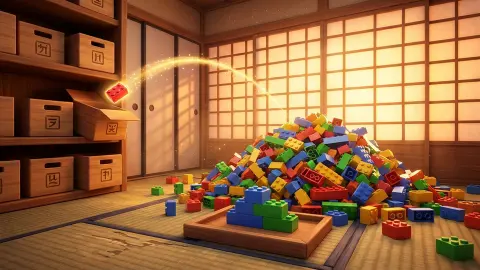
The room you tidy is Japanese. Tatami mats, paper screens, a low bench, a hanging scroll with a plant on it, two red cushions. At the back stands a wooden shelf with two cardboard boxes, in front of it lies a mound of loose building bricks, and at the bottom of the screen sits your tray. There is no clock on screen and nothing that counts down to a loss. The only pressure is the mess.
We ought to be plain about our own run. We spent ten minutes in the first level, Tatami Room, and sorted exactly one brick. The tutorial arrow walked us through it, a character called Sensei congratulated us, and then we spent the rest of the session misreading the tray. So this page tells you what we saw and, more usefully, what we got wrong.
The game is credited to Flagwin Studio. It went up in August 2026 and was last updated at the end of October.
The tray is a queue, and the pile stays shut until it is empty
Here is the mistake we made, so you can skip it. Our tray held twelve bricks in two rows of six. After the tutorial sent one to its box, a gap opened in the top row, and we read that gap as a slot to be filled. For the next eight minutes we tapped and dragged bricks from the pile toward it, convinced the pile was where the work was.
The game told us otherwise every time, in a black sign over the mound: Sort the tray first. It is the only rule beyond shape, and it runs the whole loop. The bricks on your tray are the batch you are working through. Box them all, and the pile releases the next batch. Leave one behind, and the pile will not answer you.
The misreading is easy because the tray looks finished. Twelve bricks in two neat rows is what a tidy result looks like in most puzzles; here it is the starting mess, only smaller. See the tray as the thing to empty rather than the thing to fill, and the game turns from a wall into a rhythm: tap, tap, box; scoop.
Colour is the trap, and the title says so
Our tray carried white, grey, teal, orange, blue, black, cream, brown and red bricks at once, with both shapes scattered across all of them. There is no colour box and no colour counter; the only labels on screen are Brick 2x4 and Brick 1x2.
That is the whole design. Your eye groups by colour before you ask it to, and a red brick next to a red brick feels like a pair even when one has eight studs and the other two. The game makes you override that instinct on every tap, which is why a puzzle with no timer and no failure still asks for attention.
The provider's page promises more shapes down the line, cubes with cubes and plates with plates, and a red trap box that must stay empty. We saw none of that in the first room. There are two boxes on the shelf, neither of them red; the red things on the floor are cushions. Treat the trap box as something for later rooms, not a rule you need on day one.
Ads, the shop and the sieve
The game is free and tells you how it pays for itself. About two minutes into our session the words Ad in 1 appeared in large letters over the pile, the room untouched behind them. The countdown was gone by our next look, so we cannot say how long the ad ran.
The yellow cart in the top-right corner opens a shop with two items. The Zen Set costs 1.9 USD and lists three things: no interstitial ads, a golden room theme and two exclusive models. The Sieve x10 costs 0.9 USD for ten charges, described as auto-sorting the smallest parts. A red cross closes the card; nothing in it is pushed at you.
The sieve is also the funnel button in the bottom-right corner, and the small number on it, a two in our game, is the stock you start with. We never pressed it, so we can only tell you what the shop says it does, not what disappears from the tray when you do.
What we did not reach
- An empty tray and a fresh scoop, so we cannot confirm the provider's claim that the tray also refills on its own if you wait.
- The end of the level, the model it builds for your collection, and whatever the second room is called.
- The four pause icons, a grid, a trophy, a person and a cog, which we left unopened.
- The lifetime counter in motion. The pause card read Bricks sorted in total: 0 even with our one brick in its box, so it either counts at the end of a level or counts something else.
- Sound. Nothing was recorded during our session, so we say nothing about it.
- A phone. The game is listed for PC, Android and iOS in portrait, and every input we used was a tap, which suits a touchscreen. We played in a landscape window on a computer and the interface fitted.
Who it is for, and more from Flagwin Studio
This is a game for people who find pleasure in putting things away. There is no score ticking up, no combo meter we saw, no clock. A child who sorts toys by type will understand it in one tap; an adult who sorts by colour on instinct will find the first tray oddly hard. It is rated for everyone.
Flagwin Studio has a long shelf, and two of its puzzles sit close to this one. Untangle Threads is another calm single-rule puzzle, where you drag glowing nodes until no two threads cross. Block Sculptor also works in 3D with building blocks, though there you remove cubes from a stone block to free a figure, with hearts to lose.
If it is the sorting you came for, Fun Sorting Through The Shelves moves teddy bears and alarm clocks between wooden shelves, Sheep Sort is the colour-first version this game argues with, and Zen Garden Match shares the Japanese calm with a triple-match rule instead. Never by Color! is the only one of the five that tells you to stop looking at the colours.
More in our puzzle games.
Screenshots
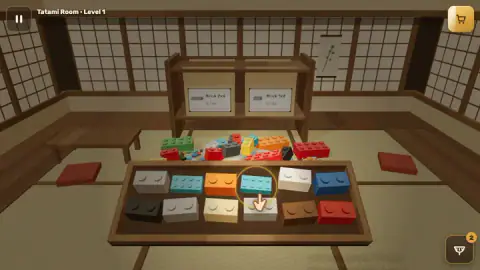
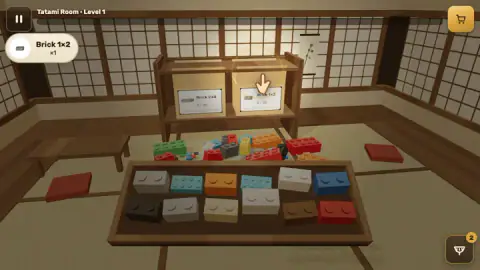
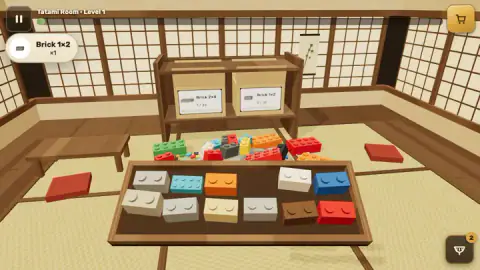
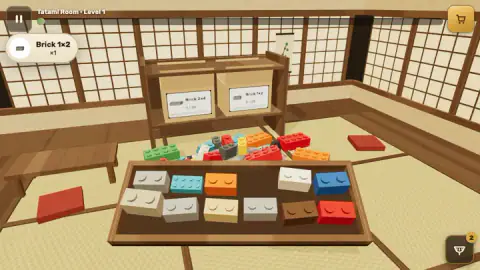
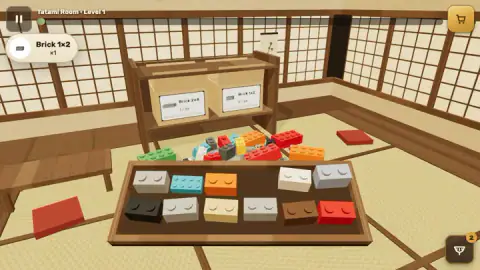
Taken by opening the game ourselves and letting it run — not supplied by the publisher, and not the same picture every other site shows.
How to play Never by Color!
- Tap a brick on the tray. It lifts, turns a pale shade of its colour, and a panel in the top-left corner shows its silhouette with a name and a count: Brick 2x4, x1. Tap a second brick of the same shape and the count rises. Tap a different shape and the panel switches to it; you hold one shape at a time.
- Tap the box with the same label. The shelf holds one box per shape, each with a counter. Both of ours read 0 / 26 at the start, and the first went to 1 / 26 when our teal brick landed, with a tick on the box and a green dot on the bar across the top.
- Empty the tray before you touch the pile. Tapping the mound on the floor while bricks remain on the tray does nothing except raise a dark sign reading Sort the tray first. Only a cleared tray takes a new scoop.
- Keep going until both counters are full. Clearing the pile ends the level. The provider's page says each cleared pile adds a model to a collection; we did not reach it.
- Press Escape to pause. The pause card offers Resume and Replay, four small icons and a lifetime total of bricks sorted.
Tips from our run:
- Do not drag. We dragged bricks from the pile toward the tray and from the tray toward the boxes, over and over. Not one moved. Every action that worked was a tap: brick first, box second.
- Count studs, not colours. The 2x4 brick shows eight, the 1x2 shows two. A white 1x2 and a red 1x2 are the same brick to this game, and a teal 2x4 is a stranger to both.
- The tray is a queue, not a shelf. Bricks on it are waiting to be boxed. The pile is only where more come from, and it stays shut until you have dealt with what you already hold.
- Save the funnel button. The number on it, two in our game, is a stock of sieve charges, and the shop sells more for real money.
Controls
| Tap or click a brick on the tray | Lifts it; it glows pale and a panel in the top-left corner names the shape and counts the bricks you hold |
|---|---|
| Tap or click a box on the shelf | Sends the bricks you hold into that box, if the shape matches its label |
| Tap or click the pile | Meant to scoop fresh bricks onto the tray; with bricks still on the tray it only shows the sign Sort the tray first |
| Escape | Opens the pause card, with Resume and Replay |
| Drag | Nothing we could see; every action in our run was a tap |
| Funnel button, bottom right | The sieve, a helper that auto-sorts the smallest parts; two charges at the start, not tried by us |
Features
- Level 1, Tatami Room, asks for two shapes only: 26 bricks for the box marked Brick 2x4 and 26 for the one marked Brick 1x2
- Colour never matters: our tray held bricks in ten colours and the game cared only about the number of studs
- Tapping the pile while the tray still holds bricks does nothing but raise a dark sign reading Sort the tray first
- A Sensei comments on your sorting from a speech card; ours said Perfect, shape to shape, clear the whole pile
- No timer and no fail state on screen; the pause card keeps a lifetime count of bricks sorted
- Two sieve charges to begin with, sold in tens for 0.9 USD; a Zen Set for 1.9 USD removes interstitial ads and adds a golden room theme and two exclusive models
- An Ad in 1 countdown appeared over the room about two minutes into our run
Game details
- Developer
- Flagwin Studio
- Release date
- August 2026
- Last updated
- October 29, 2026
- Added here
- June 2026
- Technology
- HTML5 (3D)
- Platforms
- Browser (desktop), Browser (mobile & tablet, touch)
- Saved progress
- Saving, when available, is managed by this game. Mava cannot confirm your level.
FAQ
How do you play Never by Color!?
You tidy a Japanese room full of loose building bricks. Tap a brick on the wooden tray at the bottom of the screen and it lifts; tap the box on the back shelf whose label matches its shape, Brick 2x4 or Brick 1x2 in the first level, and the brick flies in. When the tray is empty you tap the pile on the floor for more. The level ends when both box counters are full.
Why is the game called Never by Color!?
Because colour is the one thing the game tells you to ignore. The bricks on the tray come in white, red, teal, orange, blue and half a dozen more, but each box takes a shape, not a colour: a long brick with eight studs goes in the Brick 2x4 box whatever its colour, a short brick with two studs in the Brick 1x2 box. Your eye wants to group by colour first, and the game is built around overriding that.
What does Sort the tray first mean in Never by Color!?
It is the sign that appears when you tap the pile of bricks on the floor while your tray still has bricks on it. The tray is a queue, not a storage shelf: everything on it has to go into a box before the pile will give you a fresh scoop. We spent most of our first session tapping the pile and seeing that sign, so it is the one rule worth learning before you start.
Can you drag the bricks in Never by Color!?
Not as far as we could tell. We dragged bricks from the pile toward the tray and from the tray toward the boxes many times and nothing moved. Everything that worked in our run was a tap: tap a brick to pick it up, tap a box to put it away. Picking a second brick of the same shape adds it to the count in the top-left panel; picking a different shape switches the panel to that shape.
What is the sieve in Never by Color!?
A helper sold in the shop. The button sits in the bottom-right corner with a funnel icon and a small number, two in our game, which we take to be the charges you start with. The shop sells ten more for 0.9 USD and describes a charge as auto-sorting the smallest parts. We did not press it, so we cannot say exactly what disappears when you do.
Does Never by Color! have ads?
Yes. About two minutes into our session a large Ad in 1 countdown appeared over the room, and the shop sells a Zen Set for 1.9 USD whose first listed benefit is no interstitial ads, along with a golden room theme and two exclusive models. The countdown was gone by our next look, so we did not sit through an ad ourselves.
How many bricks are in the first level of Never by Color!?
Fifty-two, going by the two boxes. Each is labelled with a counter that read 0 / 26 when we began, one for the Brick 2x4 shape and one for the Brick 1x2 shape. Our tray held twelve bricks at a time and the rest waited in the pile on the floor. We boxed one brick in ten minutes, so we cannot tell you what finishing the room looks like.
Who made Never by Color!?
The game is credited to Flagwin Studio. The game went up in August 2026 and was last updated at the end of October that year. When we checked, in English and Russian, for PC, Android and iOS.