






About Slither Snake 2048
Most arena snake games keep one number on the screen and call it your score. Slither Snake 2048 writes a number on every segment of your body. Each snake out there is a chain of cubes, each cube stamped with a power of two, and the panel in the top-right corner ranks the whole field by a single figure: size.
You begin at the bottom of that ladder, every time. Press the yellow PLAY button and you are one pale blue cube marked 2, alone on a dark floor speckled like a pegboard. There is no name to type, no skin to pick and no settings screen. A few seconds later the panel fills in, and the snakes above you are not a few points ahead. They are doublings ahead.
We came back to this one on a desktop and gave it about ten minutes, and we should be plain about how it went. Our best size was 8. We eliminated nobody. The pink GAME OVER card came up around fifteen times. What follows is the arena as it looks from somewhere near thirtieth place, and it says where the evidence stops.
The game is made by Foxi Games. It was published in June 2026.
The number beside your name is the biggest cube you own
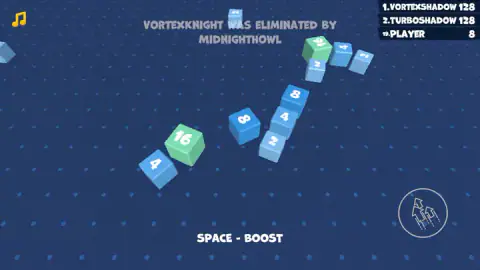
Look at any snake for a moment and you can see how the counting works. In one of the pictures here a chain runs up the screen reading 2, then 4, then 8. In another it reads 4, 8 and a green 16 from the tail forward. The order is never scrambled: the largest cube leads and the numbers shrink behind it.
That is also what the panel is reporting. When our row read 8, the chain we were steering topped out at an 8, and when it read 4, so did we. So size is your head, not your length — a three-cube snake carrying a 16 outranks a six-cube snake made of 2s, and the table is a list of biggest cubes rather than longest bodies.
We still cannot tell you how a merge happens, because we never watched one. Our own number climbed from 2 to 4 to 8 across the session, so it clearly does happen, and the ordered chains show what it leaves behind. The moment itself stayed off camera.
The feed names your killer
For a game with this little text in it, the grey line across the top is doing an unusual amount of work. Most of the time it is reporting other people's business — VORTEXKNIGHT WAS ELIMINATED BY MIDNIGHTOWL, ICEPHANTOM WAS ELIMINATED BY DOOMSEEKER, WILDFALCON WAS ELIMINATED BY VORTEXSHADOW — which is how you learn that the arena is not organised around you.
Then one round ends and the line reads PLAYER WAS ELIMINATED BY NOVADESTROYER, printed directly above the GAME OVER card. That single sentence is the whole of the game's post-mortem, and it is worth more than it looks: it tells you whether you were hunted by something enormous or walked into a 4.
Those names are the same names every time. FROSTBITE, SOLARPHOENIX, CYBERDRIFTER, TURBOSHADOW and EARTHFLAME all turned up in two sessions a week apart, leading the table in one round and being eliminated in the next. That is computer-controlled opposition rather than a lobby of strangers, and the giveaway is that they fight each other as busily as they fight you.
How far the ladder goes
The top of the table is higher than it first appears. For most of the session the leaders sat on 128, which already reads as unreachable from 8. Then one round opened with ATOMICTITAN on 256, with second place on 64 — a gap of two doublings between first and second, and five between first and us.
The panel itself is three rows and no more: first place, second place, and your own row wherever you happen to be. Ours read 17th, 19th, 24th, 37th and 40th in rounds we have pictures of, so the field runs to dozens of snakes, nearly all of them somewhere off your screen. The moment you die, your row vanishes and the panel quietly shows the top three instead.
One thing we could not work out. In one picture a thin dark line curves down the whole height of the floor, dividing it, with cubes on both sides. We never reached it and we have no idea whether it is an edge, a seam or decoration.
Ten minutes, fifteen rounds
Every round ends on the same pink card, with two columns, BEST and LAST, each carrying KILLS and SIZE. Ours read 0 kills throughout and sizes of 2, 4 and 8. That card is the entirety of the game's progress tracking: no coins, no shop, no unlocks, nothing to come back for except a higher number. We did not check whether your best survives closing the page.
Rounds are short — that is the honest headline. Fifteen cards in ten minutes means well under a minute each, and the stretch where you are a lone 2 with no idea which way is safe is most of that. The game's own description says a run ends when your head touches another snake, and the feed naming a rival each time fits it.
There is also a break for advertising. The arena goes almost black, a line of text appears across the middle and a purple Continue playing button waits underneath until you press it; our run was told the advert had been skipped that time, so we can only report that the interruption exists, not what you will be shown in it.
Who it is for
This suits someone who already likes arena snake games and wants one where the maths is visible. Nothing needs reading, nothing needs choosing, and a round costs you less than a minute. Younger players will manage the controls easily; what they will find hard is the opening, where every name above you is a power of two out of reach.
If you came for the calm of the original tile puzzle, this is not that. There is no board to plan here, only a floor to survive on, and the planning window is about as long as the rounds.
More snake and 2048 games
Cube Snake 2048 is the closest relative: also a chain of numbered cubes, but it asks for a name on the start screen and sets a 2K cube as the summit. Snake Arena puts rival snakes on a two-minute clock inside a red wall, which is the opposite answer to the same problem — a deadline instead of an open floor. Snake 2077: Glitch War is a classic dot-eating arena with coins for new skins. If you want the doubling without anything hunting you, 2048 3D: Merge Cubes drops numbered cubes into a glass. Foxi Games also made Cut It 3D, a one-click game about flipping a knife. For more arenas full of rivals, browse the .io games.
Screenshots


How to play Slither Snake 2048
- Press PLAY. You start as a single cube marked 2 in the middle of the screen.
- Steer. The game's own instructions say to hold the left mouse button and move the cursor, and the snake follows it.
- Press Space to boost, as the label under the arena says. A round button with arrows sits in the bottom-right corner for the same job.
- Find yourself. Your lead cube has a pair of eyes drawn on its front face; nothing else on the floor does.
- When the GAME OVER card appears, press CONTINUE to go back to the menu and start again.
What our rounds taught us
- Green means stay away. The 2s are pale blue, the 4s and 8s deeper blue, and everything from 16 upwards is green. You can read the danger before you can read the digits.
- The arrow keys and the A key did nothing we could see or hear, in two sessions a week apart. If your snake is ignoring you, it is the mouse that matters.
- Read the small number, not the big one. The figure beside PLAYER is your size; the tiny one in front of your name is your place in the field, and it is usually the more sobering of the two.
- Watch the line across the top. It is not decoration. It names every elimination in the arena, and sooner or later it names yours.
Controls
| Mouse (hold the left button and move) | Steers the snake towards the cursor, according to the game's own instructions. Our rounds did grow from 2 to 8, so something was getting through, but we never got a clean read on the steering itself |
|---|---|
| Space | Boost, as the label under the arena says. We never saw what it changes |
| Round button with arrows (bottom right) | The on-screen boost button, for the same job |
| PLAY / CONTINUE | Starts a round from the menu, and returns there after the GAME OVER card |
Features
- Every snake is a chain of cubes marked with powers of two, and the chain is ordered: the biggest cube leads, the smallest trails
- Size is the only score. The panel counts 2, 4, 8, 16, 32, 64, 128 and 256, and the leaders in our rounds were doublings above us, not points above us
- Colour does the work of the number: 2, 4 and 8 are blues, and everything from 16 upwards is green
- Your own cube wears a pair of eyes on its front face, which in a crowd of identical blue boxes is how you find yourself
- A feed across the top names every elimination in the arena, your own included, so you always learn who got you
- A live panel of three rows: first place, second place, and your row with your position in small print beside the word PLAYER
- No account, no name to type, no coins and no shop. The menu is one cube marked 2 and a yellow PLAY button
Game details
- Developer
- Foxi Games
- Release date
- June 2026
- Last updated
- June 16, 2026
- Added here
- April 2026
- Technology
- HTML5 (3D)
- Platforms
- Browser (desktop), Browser (mobile & tablet)
- Saved progress
- Saving, when available, is managed by this game. Mava cannot confirm your level.
FAQ
How do you play Slither Snake 2048?
Press PLAY and you enter a dark blue arena as a single cube marked 2. The game's own instructions say to hold the left mouse button and move the cursor to steer, and the label under the arena says Space boosts. Dozens of rival snakes, each a chain of numbered cubes, share the floor, and a panel in the corner ranks the field by size.
What does the number on the leaderboard mean in Slither Snake 2048?
It is that snake's size, and it is always a power of two. You start at 2. In the pictures on this page the leaders are on 32, 64, 128 and once 256, while we were on 4 and 8. The number matched the largest cube in the chain we were steering, and the GAME OVER card uses the same word, SIZE.
How many snakes are in a round of Slither Snake 2048?
Dozens. The panel only shows three rows, but the small number next to PLAYER is your place in the whole field, and in our rounds it read 17th, 19th, 24th, 37th and 40th. An earlier session of ours was listed 64th. Most of that field is somewhere off your screen.
Are the other snakes in Slither Snake 2048 real players?
Almost certainly not. The same names — FROSTBITE, SOLARPHOENIX, CYBERDRIFTER, TURBOSHADOW, EARTHFLAME — came back round after round in two sessions a week apart, swapping places on the table and eliminating each other. The game never asked us to log in or pick a name, and we were always just PLAYER.
Who killed me in Slither Snake 2048?
The game tells you. The grey line across the top of the screen reports every elimination in the arena, and when it is your turn it prints your own name. In one of our rounds it read PLAYER WAS ELIMINATED BY NOVADESTROYER, sitting directly above the GAME OVER card. It is the one piece of feedback the game gives you about how you died.
How do you merge cubes in Slither Snake 2048?
The name borrows from 2048, where two equal numbers join into one worth double, and every size we saw was a power of two. We still cannot describe the merge itself, because we never watched one happen. What we can show you is the result. Our own size climbed from 2 to 4 to 8 across rounds, and rival chains read 2-4-8 and 4-8-16 in order.
Does Slither Snake 2048 have ads?
The round stops for an ad break. The arena goes almost black, a line of text appears in the middle and a purple Continue playing button waits under it until you press it. Our run was told the advert had been skipped that time, so we cannot say what another player is shown there, only that the interruption is real.
Is Slither Snake 2048 the same game as slither.io?
No. slither.io is a separate browser snake game from 2016, and Slither Snake 2048 has no official connection to it. This one is made by Foxi Games, and its snakes are chains of numbered cubes rather than glowing worms. It shares the idea of many snakes in one arena and nothing else.
Who made Slither Snake 2048?
It is credited to Foxi Games. It was published in June 2026.