



About Sudoku - Number Games
A sudoku in a newspaper hands you a grid with most of it missing. This one hands you a grid with most of it done.
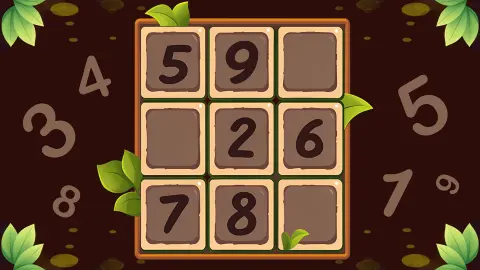
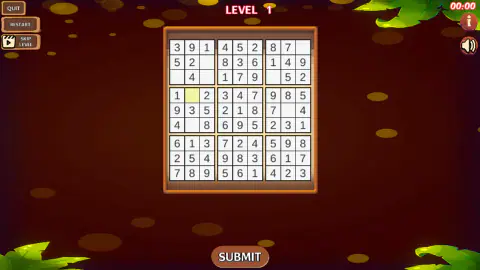
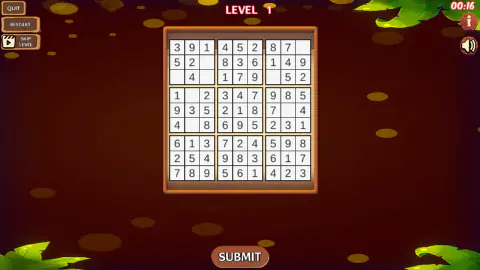
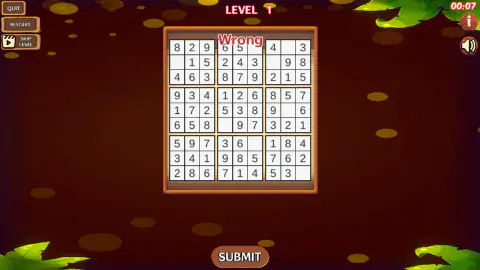
We were dealt two different level one boards, and both arrived with the same amount of work left in them: eight empty squares. Everything else was already printed on the wood. On the first board the bottom three rows were complete before we had touched anything at all.
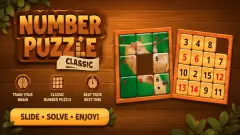
The board itself sits in a wooden frame against a dark brown background, with green leaves spilling into the corners. LEVEL 1 runs across the top in pink letters, a clock ticks away in the top right beside a speaker and a small information button, and QUIT, RESTART and SKIP LEVEL are stacked in the opposite corner. Under the board, one rounded button: SUBMIT.
The game is credited to Ermac Alex, a name.
It was published in the spring of 2025 and was revised again this August.
A word on how far we got, because it shapes what this page can honestly tell you. We played level one on a desktop with a mouse and never finished it. Clicking an empty square lights it pale yellow, so the game is clearly listening — but we never found where the numbers themselves come from. Nothing on screen offers them: no keypad under the board, no row of digits beside it, and nothing we pressed on the keyboard put a figure into a square. So what follows is the board, the buttons and what the game says when you hand in a grid that is not finished. It is not an account of winning.
Level one is not one puzzle
The clearest thing we learned is that the level number does not name a board. It sets a difficulty and then deals.
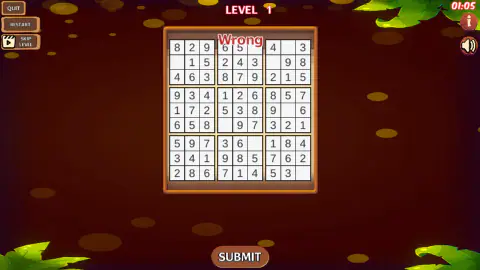
Our first grid had its eight blanks bunched in the top half, three of them crowded into the top left block, with the bottom three rows arriving finished. Our second grid — same level, same wooden frame, clock back near zero — had an entirely different set of numbers, and its blanks ran from the top row down to the bottom right corner.
So there is nothing to memorise and nothing to look up. You cannot learn this level, only the rules. It also means a layout you dislike costs you one button: press RESTART and a fresh arrangement of the same eight holes appears somewhere else.
Wrong is what an unfinished grid gets
SUBMIT is a verdict, and it is blunt about it. We pressed it with squares still empty and the word Wrong dropped across the top of the board in red capitals.
Then it stayed. Almost a minute later the grid was identical, the blanks were still blank, and the red word was still sitting there while the clock counted on behind it. Nothing was taken away for it: no life lost, no board wiped, no return to the map. The warning simply waits.
Two things follow for anyone playing. The first is that SUBMIT will not help you find your mistake — it tells you the grid does not pass, and not which square is the reason. The second is that an incomplete grid and a wrong grid get the same answer, so pressing the button to see how you are doing teaches you nothing.
Seventy-three numbers given, when seventeen is the floor
The puzzle under the wooden frame is older than the name on the title screen. It ran in American puzzle magazines from 1979 as Number Place, devised by an architect named Howard Garns, and a Japanese publisher, Nikoli, picked it up in the following decade and gave it the short name everyone uses now.
What has been studied hard since is the opposite end of this game's design: how few numbers a grid can start with and still have exactly one answer. The answer is seventeen. In 2012 a team at University College Dublin led by Gary McGuire settled it by exhaustive computer search, showing that no sixteen-clue grid has a unique solution.
Hold that against what this game deals you. Seventeen is the theoretical floor, a newspaper puzzle usually starts somewhere in the twenties, and the boards here start you with seventy-three.
That is not a small difference in difficulty. It is a different activity. On the first board we were dealt, five of the eight blanks were the only hole in their own row — and a row missing a single number does not need technique, it needs arithmetic you can do at a glance. Only the third row had more than one gap in it, and a look down the columns settled those as well. No pencil marks, no candidate lists, no guessing, no branch to back out of.
So the clock makes sense in a way it would not on a hard grid. When every square is forced, the only thing left to measure is how fast you can read the board. This is a sudoku built for speed and calm rather than for thinking. If you came looking for a puzzle to sit with for half an hour, this is not it. If you want nine rows that resolve almost as quickly as you can scan them, it is nicely judged — and the eight blanks moving to a new place every time you restart are what keep it from going stale.
More number grids on Mava Games
If this one is too gentle, Catdoku Sudoku Puzzle and DoggyDoku are the same grid with the blanks earned rather than given. Nonogram swaps the numbers for a picture you reveal by counting runs along each row. From the same studio, Hard Puzzle: Color Lines is Ermac Alex working in a far less forgiving mood.
The rest of our grids, tiles and logic boards are in Puzzle games.
Screenshots
How to play Sudoku - Number Games
- Pick a level from the map. Levels sit as stops along a winding path across a floating island, the first one lit.
- Read the row before you look at the square. On a board this full, the row usually hands you the answer outright.
- Select a square. A click or a tap turns it pale yellow. That is the game acknowledging the square, nothing more.
- Fill the blanks, then press SUBMIT. The button under the board is a checker, not a helper.
- If the answer is Wrong, decide quickly. RESTART deals you a new puzzle; SKIP LEVEL moves you along without one.
What our own game taught us:
- The clock is not chasing you. It counts up. Ours ran past a minute with a red warning sitting on the board and nothing came of it.
- Wrong does not clear itself. The word stayed put while the clock carried on underneath it.
- RESTART is not undo. You do not get your board back; you get a different one.
- Do not hunt for the hardest square. On a grid this full there usually is not one — see below.
- The keyboard is not part of this, as far as we could tell. Every number we tried to type went nowhere.
Controls
| Left click or tap on a square | Selects it. The square turns pale yellow, which is the game telling you it heard you |
|---|---|
| SUBMIT (under the board) | Hands the grid in to be checked. It answers in red across the board if the grid does not pass |
| RESTART (top left) | Deals a fresh level one grid — a different puzzle, not the same one again — and puts the clock back to zero |
| SKIP LEVEL (top left) | Moves you past the level you are on without finishing it. We never pressed it, so we cannot tell you what it costs |
| QUIT (top left) | Leaves the board. The third of the three buttons in the corner |
| Speaker icon (top right) | The only sound control on screen, beside the clock and a small information button |
| Keyboard | Nothing we could find. We never got a number into a square by any key we tried, and no keypad is drawn anywhere on screen |
Features
- Both level one boards we were dealt had exactly eight empty squares. The other seventy-three numbers were already on the grid when it appeared
- RESTART is not a rewind. Press it and you get a different puzzle with its own layout of blanks, and the clock starts again
- The clock counts up, not down. Ours ran past a minute with a red warning sitting on the board and nothing came of it
- SUBMIT is a pass or fail check, not a hint. It does not point at the square that is wrong
- QUIT, RESTART and SKIP LEVEL stay in the corner the whole time, so a board you do not like is one click from being replaced
- Levels are picked from a map screen: a winding path of stops laid across a floating island, with the first one lit
- Made by Ermac Alex.
Game details
- Developer
- Ermac Alex
- Release date
- April 2025
- Last updated
- August 10, 2026
- Added here
- May 2025
- Technology
- HTML5 (Unity WebGL)
- Platforms
- Browser (desktop), Browser (mobile & tablet, touch)
- Classification
- Educational , Puzzle
- Saved progress
- Saving, when available, is managed by this game. Mava cannot confirm your level.
FAQ
How do you play Sudoku - Number Games?
It is standard sudoku: every row, every column and every three by three block has to hold the numbers one to nine with nothing repeated. What is not standard is how much of the work is done for you. Both level one boards we were dealt arrived with only eight squares empty, so most rows already hold eight of their nine numbers and simply name the one that is missing. When the grid is full you press SUBMIT under the board to have it checked.
How many squares are empty at the start of Sudoku - Number Games?
Eight, on both of the level one boards we played. Everything else is printed on the grid before you touch it. The blanks move around between boards: on the first one they all sat in the top six rows, with three of them crowded into the top left block, and on the second they were scattered as far as the bottom right corner.
What does Wrong mean in Sudoku - Number Games?
It is what the board answers when you press SUBMIT and the grid does not pass. It appears in red capitals across the top of the puzzle. In our game it was an unfinished grid rather than a mistaken one, because we never managed to get a number into a square at all. The message does not tell you which square is at fault, and it does not clear itself: ours was still there a minute later with the board untouched.
Does restarting a level give you the same puzzle in Sudoku - Number Games?
No. We restarted level one and got a completely different grid, with its own set of eight blanks in different places, and the clock went back to the beginning. So the level number is not a particular puzzle; it is a difficulty setting that deals you a new board each time. That also means a layout you do not like is one button away from being replaced.
Is there a time limit in Sudoku - Number Games?
None that we saw. The clock in the top right counts upwards from zero rather than down, and ours passed a minute without anything happening — no penalty, no board reset, no message beyond the one already on screen. It reads like a record of how long you took rather than a countdown you have to beat.
Can you skip a level in Sudoku - Number Games?
There is a SKIP LEVEL button in the top left corner of the board, stacked under QUIT and RESTART, and it stays there for the whole level. We did not press it, so we cannot tell you whether skipping costs you anything or simply moves you along the map.
Who made Sudoku - Number Games?
It is credited to Ermac Alex. The game went up on the portal in April 2025 and was last revised in August 2026. We found no studio website and no independent second source, so the name rests on that one portal.
Does Sudoku - Number Games work on a phone?
It is listed for Android and iOS as well as PC, and in both landscape and portrait, which is unusual: most browser games of this kind are landscape only. A grid you fill by tapping squares should suit a touchscreen well. We played it on a desktop with a mouse, so we have not tested the phone ourselves.