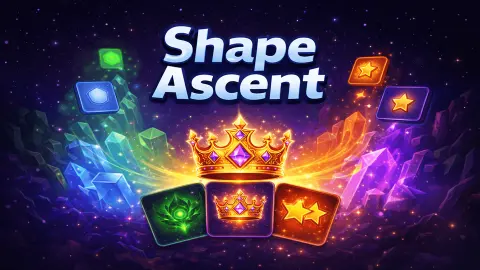






About Shape Ascent - Roguelite
In 2048 you read the board by doing sums. Two and two make four, four and four make eight, and the number painted on every tile tells you both what it is and what it is worth. Shape Ascent takes the numbers away. What is left is a triangle, a square, a pentagon and a hexagon, and you read the board by counting corners instead — which your eye does faster than arithmetic, right up to the moment the geometry runs out.
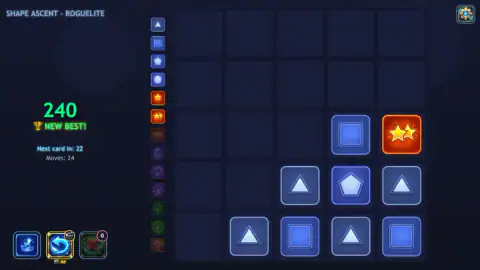
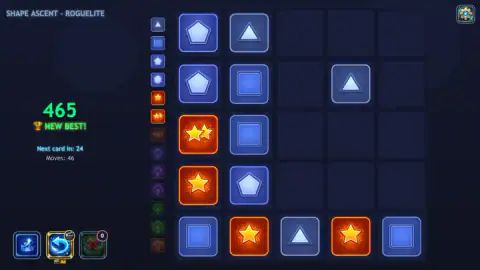
It runs out after the hexagon. The ladder does not go on to heptagons and octagons, because nobody tells a nine-sided shape from a ten-sided one at a glance. It switches to stars: one, then two. Above that, on the narrow column of thirteen tiles down the left edge of the board, sit seven rungs we never lit — dark silhouettes in brown, purple and green, ending in a gold one.
The move is the one from 2048, unchanged. Swipe in any of the four directions and every shape on the five-by-five grid travels that way at once until a wall or another shape stops it. Two of the same kind that meet merge into the next kind up, and a new shape drops onto the board. There is no way to move one tile on its own, which is the cruelty of the format: every time you reach for the pair you want, you move the other twenty-odd tiles as well.
The game is credited to Ceng Games. The listing gives February 2026 for the release and August 2026 for the last update. Our own run lasted about four minutes, and we will be specific about where it stopped, because the honest version is the useful one.
The shapes are numbers underneath, and one card says so out loud
The game never prints a value on a tile. It does print one in a place that is easy to miss.
Every couple of dozen moves the board dims and three power cards fan out across the screen for you to choose between. One of ours was called Pentagon Boost, marked Common, and its small print read: Pentagon (8) merges have +5% chance to jump +1 tier. Max 50%. The pentagon is the third rung of the ladder. For the third rung to be worth eight, the triangle has to be two and the square has to be four — the game does not say that anywhere, but its own card arithmetic leaves no room for anything else.
So this is 2048 underneath, deliberately, and the shapes are a costume over the doubling. What the costume changes is how fast you can read.
A number is precise and slow: you see 256 and you know exactly what it is, but you have to look. A shape is vague and instant. You never confuse a triangle with a pentagon, and you spot a matching pair across the board without reading anything at all. For the first four rungs that makes this quicker to play than the original.
Then it breaks, on purpose. The stars are not polygons, and on the evidence of the ladder the tiers above them are not either — those rungs are drawn in purple and green rather than blue, and the last one is gold. Once your best tiles stop being shapes you can count, the instant reading goes and you are checking the column on the left like a reference table. The game gets harder to read exactly where the stakes get high, and that is the thing that makes it worth playing instead of plain 2048.
What the roguelite in the title actually buys you
The word gets attached to a great many games that only mean you start again when you lose. Here it means something you can point at.
A roguelite is a run-based game in which randomness hands you modifiers you did not pick from a menu, so the run is shaped by what you were offered rather than by what you planned. Shape Ascent does that on a clock measured in moves. The counter falls, the board dims, three cards fan out with Choose a Card written above them, and each carries a rarity in its corner.
Two of the ones we were shown make the pattern clear. Lowest Cleanse, Common, removes one random lowest-tier tile — a card that buys you space, which on a filling board is the only currency there is. Pentagon Boost, also Common, adds a five per cent chance that a pentagon merge jumps an extra tier, up to a cap of fifty. That cap is the interesting half: it tells you the same card can come round again and stack, and that a run which keeps offering it can turn into a specialist one.
What the cards do not do is leave anything behind. We reached no shop, saw no currency on the play screen and watched nothing unlock itself. The randomness lives inside the run, and when the run ends it goes with it.
Six rungs of thirteen, and what the buttons were doing the whole time
We did not get far, and the page is better for saying so plainly.
One unbroken run took the score to 762 over sixty-one moves, and every reading on the way was marked NEW BEST with a small gold trophy beside it. The biggest tile we ever built was the two-star: rung six of thirteen. The seven rungs below it never lit once.
Underneath the board sit three buttons, and we finished having used none of them. The blue one with the rising chart we never opened. The gold one is the undo, and it is worth a look before you need it: a film-clapper badge in its corner and a small yellow Ad tag underneath, which is the game being upfront that taking a move back is paid for by watching something. The red one with the cross removes a tile, and its badge read zero from the first move to the last, the button dimmed throughout. The listing says that tool unlocks at the triple star, one rung above where we stalled; we cannot confirm it, and we would rather say so than pretend.
Which leaves the honest summary: four minutes is enough to learn how Shape Ascent works and nowhere near enough to see most of what it holds. The gold tile at the bottom of that column is a long way down.
More puzzles to play next
If it is the merging that appeals, Watermelon Game is the other famous version of the idea — fruit instead of polygons, dropped rather than slid, two of a kind making the next size up. If it is the slow suffocation of a grid running out of room, Block Puzzle Jewel Block is that pressure with nothing on top of it, and Oddly Sorted Color Sort turns the same problem into tidying rather than stacking. We have not taken those three as far as we took this one, so treat them as signposts. The rest of the shelf is in puzzle games.
Screenshots
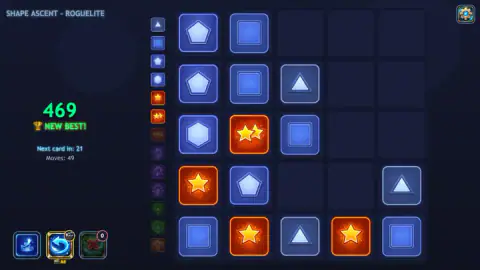
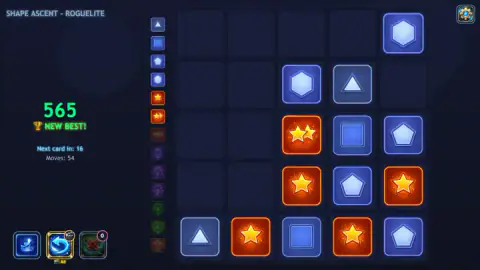
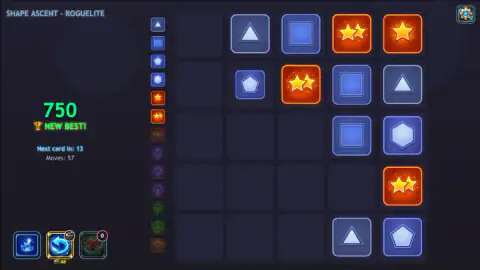
How to play Shape Ascent - Roguelite
- Swipe or drag up, down, left or right. Everything on the board moves that way at once. The game's opening cards also offer the W, A, S and D keys and the arrow keys.
- Line up two of the same shape so that the slide pushes them into each other. They merge into the next shape up and the score jumps.
- Watch the ladder down the left of the board. It tells you which shape comes after which, and it is the only place to check once the stars begin.
- Keep the board from filling. A new shape arrives after every move, so an empty cell is a thing you spend, not a thing you have.
- When the counter beside the score hits zero, pick a card. The run will be built out of the ones you take.
What we only learned by being there:
- The counter beside the score is not a clock. It says Next card in and it looks like seconds ticking down, but it falls by exactly one for each move you make. On four of our captures the counter and the move count always added up to the same total, and the card screen arrived on the move the counter reached zero. If you want a card sooner, make moves; sitting still does nothing.
- The score is not linear and it is not close. Three moves early in our run were worth four points between them. Three moves late in the same run were worth a hundred and eighty-five. Low merges barely register. The run is decided at the top of the ladder, not the bottom.
- The pack tells you what just happened. After every move the tiles sit jammed against one wall with no gaps, and a single tile sits apart from them — the new arrival. If you cannot remember which way you last swiped, look at which wall everything is leaning on.
- Twins can be too far apart to ever meet. Our best board held three two-star tiles at once, scattered across three rows, and no single swipe would bring any two of them together. That is the position that ends runs, and it looks like a good board right up until you try to move.
Controls
| Swipe up or down, or drag the pointer up or down across the board | Every shape on the grid moves that way at once, until it hits the wall or another shape. This is the whole of the input |
|---|---|
| Swipe left or right, or drag the pointer sideways | The same thing horizontally. There is no way to move one shape on its own |
| Two matching shapes meeting as they slide | They merge into the next shape up the ladder and the score jumps. You do not press anything to make it happen |
| W, A, S, D and the arrow keys | The game's own tutorial card offers them, W and S or the up and down arrows for vertical moves, A and D or the side arrows for horizontal ones. We played the whole run with a pointer and did not test them properly, so we are not claiming either way |
| The gold button with the back-curving arrow, bottom left | Undo. It carries a film-clapper badge and a small yellow Ad tag underneath, which is the game telling you what it costs. We never pressed it |
| The dark red button with the cross, bottom left | Removes a tile from the board. Its badge read zero for our entire run and the button stayed dimmed, so we never got to use it |
| The blue button with the rising arrow over bars, bottom left | Unconfirmed. It is there in every frame and we never opened it |
Features
- A five-by-five grid, twenty-five cells, and a single kind of move: the whole board slides at once, the way 2048 does
- Thirteen tiers of shape, counted off the ladder down the left edge — triangle, square, pentagon, hexagon, one star, two stars, and seven more that stayed dark for us, the last of them gold
- Two of the same shape merge into the next one up, so the board is read by counting corners instead of reading numbers
- A power card every couple of dozen moves, chosen from three, each with a rarity on it; the counter beside the score is measured in moves, not in seconds
- Cards stack and say so: the Pentagon Boost we were offered adds five per cent to a pentagon merge jumping an extra tier, up to a cap of fifty
- Three tools under the board — a stats panel, an undo wrapped in a film-clapper badge and an Ad tag, and a remove tool that sat on zero charges the whole way
- No timer, no lives and no levels on the play screen: the score, the move count and the card counter are the only numbers in front of you
Game details
- Developer
- Ceng Games
- Release date
- February 2026
- Last updated
- October 24, 2026
- Added here
- December 2025
- Technology
- HTML5
- Platforms
- Browser (desktop), Browser (mobile & tablet, touch)
- Classification
- Puzzle
- Saved progress
- Saving, when available, is managed by this game. Mava cannot confirm your level.
FAQ
What is Shape Ascent - Roguelite?
It is a free browser puzzle built on the 2048 idea, with the numbers replaced by shapes. You slide every tile on a five-by-five grid at once, and when two identical shapes collide they merge into the next shape up. The order runs triangle, square, pentagon, hexagon and then stars, and a column down the left edge of the board shows the whole ladder of thirteen tiers, with the ones you have not made yet greyed out.
How do you play Shape Ascent - Roguelite?
There is one move and you make it in four directions. Swipe or drag up, down, left or right, and every shape on the board travels that way until something stops it. Two matching shapes that run into each other merge on their own. The game's opening cards also offer the W, A, S and D keys and the arrow keys, although we played our whole run with a pointer.
Is Shape Ascent - Roguelite the same as 2048?
It is the same engine with a different dial. The sliding, the merging of identical pairs and the new tile that arrives after every move are all straight out of 2048. What changes is how you read the board: instead of doubling numbers you count corners, and once the hexagon is passed the shapes stop being polygons and the ladder on the left becomes the only way to tell what is worth more than what.
What is the Ascent Crown in Shape Ascent?
It is the top of the ladder and the stated goal. One of the opening cards shows two green crowns making a single gold one and says, in those words, that your goal is to reach the Ascent Crown. On the column down the left of the board it is the thirteenth and last rung, a gold tile that stayed dark for the whole of our run. We never came close to it, so nothing on this page describes what happens when you get there.
What makes Shape Ascent a roguelite?
The cards. A counter beside the score falls by one with every move you make, and when it reaches zero the board dims and you are offered three power cards to choose from, each marked with a rarity. They change the rules of the run rather than giving you a one-off boost: the Pentagon Boost we saw adds a chance for pentagon merges to jump an extra tier, and says it can stack up to a cap. Your choices stay with you until the run ends.
What do the three buttons under the board do?
From left to right: a blue one with a rising chart on it, a gold one with an arrow curving backwards, and a dark red one with a cross. The gold one is undo, and it carries a film-clapper badge and a small yellow Ad tag underneath. The red one removes a tile from the board, but its badge read zero for our entire run and the button stayed dimmed. The listing says that tool unlocks further up the ladder than we managed to climb.
How far did you get in Shape Ascent - Roguelite?
One run of about four minutes and sixty-one moves, which took the score to 762 with every reading along the way marked as a new best. The biggest tile we ever built was the two-star, the sixth rung of thirteen. We never lit the seven rungs below it, never saw the Ascent Crown and never had a game over we could show you, so this page stops where our run stopped.
Who made Shape Ascent - Roguelite and when did it come out?
It is credited to Ceng Games, a studio with three games on the same platform. The listing gives February 2026 for the release and August 2026 for the most recent update. Only the month is printed anywhere we could find, never a day, which is why this page does not claim a precise date.