








About Slides And Climbs
Slides And Climbs changes the name on the box and nothing else. The slides are snakes, drawn with striped bodies and round eyes, and the climbs are ladders. The board is the one you already know: a hundred numbered squares on a patch of grass, a die, and a race from the bottom-left corner to the top-left one.
There is nothing to decide once the game starts. Each player has one pawn, so the die picks your square for you. What the game does is take care of everything around the die: it counts the squares, moves the pawns up ladders and down snakes, keeps the turn order and plays the other colours if you are alone.
The game is credited to Games Hub Studio. It was published on 17 June 2025.
We should be plain about how far we got. Our session lasted about four minutes: one game with four pawns, ours blue, against three computer players. Nobody finished. When we stopped, our pawn was on 67. We did not see a winner's screen. This page covers what those four minutes showed and stops there.
Square 80 is the real finish line
The ladders are worth learning, because they are not equal. There are nine, and three of them shape the whole game.
The first stands on square 1 and goes to 38. Our blue pawn's first move ended there: out of the pen, onto square 1, and more than a third of the way up the board before anyone else had left the bottom two rows. In the same round the white pawn took the small ladder from 4 to 14.
The longest runs from 28 to 84, six rows in one move.
The third is the one that decides games. It stands on 80 and its top rests on the finishing square. Land on 80 and you have won, twenty squares early.
The full set, as we read it off the board:
| Ladder foot | Ladder top |
|---|---|
| 1 | 38 |
| 4 | 14 |
| 9 | 31 |
| 21 | 42 |
| 28 | 84 |
| 36 | 44 |
| 51 | 67 |
| 71 | 91 |
| 80 | 100 |
Ten snakes, and the top row is the worst place for them
We counted ten snakes. The longest is a green one whose head sits on 87 and whose tail ends on 24. That is most of a game undone by one roll, and it lies three squares past the top of the longest ladder.
The top row is where the board is meanest. Three snakes have their heads up there, between you and the finish, and their tails end on 78, 75 and 73. That is the row that holds square 80. So the fall that costs you about twenty squares can also leave you a single roll from the ladder that wins the game. It is the neatest thing about the board, and you only notice it once you have read where the tails go.
A six rolls again, for everyone
The game's instructions say a six earns another roll. We saw the sign of it once: a banner reading EXTRA DICE came up across the middle of the board, and the ring in the turn panel was on the white pawn, one of the computer players. The rule is not a favour to the human player.
What we cannot tell you is what happens at the very end. Some versions of this game want an exact roll to land on 100 and others let you overshoot. Our game did not get that far.
The board was a lesson before it was a game
Snakes and ladders comes from India, where it was known as Moksha Patam or gyan chaupar and was a lesson in morals: ladders stood for virtues, snakes for vices, and the top of the board for liberation. It reached England in the Victorian era, and the first English edition, with a hundred numbered squares, was registered by F. H. Ayres in October 1892. Milton Bradley's American version of 1943, Chutes and Ladders, swapped the snakes for playground slides because children were thought to dislike them. That board has nineteen chutes and ladders in all. So does this one: nine ladders plus ten snakes.
The moral lesson explains the one thing that has never changed. A game about fate cannot have a good move in it, and this one still does not.
Who it suits
It suits a small child learning to count to a hundred, with an adult or against the computer, because the game does the counting on screen and nobody can make a mistake. It suits a group that wants something to play with no rules to explain.
It suits less anyone who wants to make a choice. If that is you, the games below have dice or pieces and something to think about as well.
More board and dice games
Ludo World is the nearest step up: the same die and the same race, but with four pawns each, so you choose which one to move. Yatzy keeps the dice and drops the board, and lets you decide which ones to roll again. Domino Battle and English Checkers are table classics with no luck in the moves at all. The rest are under kids games.
Screenshots
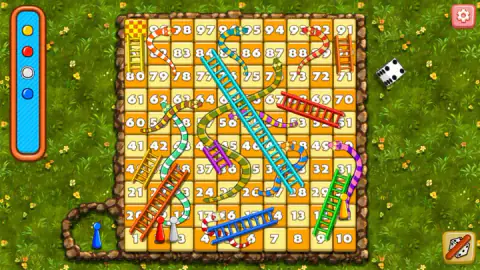
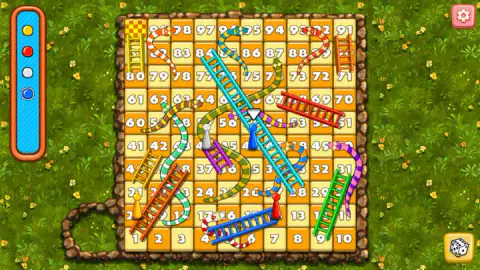
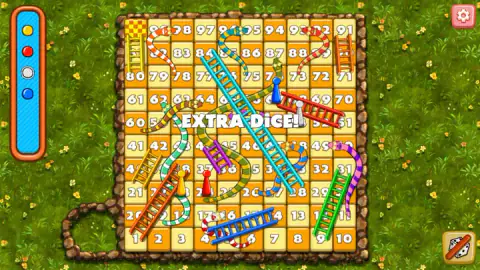
Taken by opening the game ourselves and letting it run — not supplied by the publisher, and not the same picture every other site shows.
How to play Slides And Climbs
- Get through three menus. The game asks for a game mode, then for opponents, then for your colour. There are six pawns to choose from.
- Wait for your colour. A panel on the left lists the players from top to bottom, and a ring marks whose turn it is. A white arrow also appears over the pawn that is about to move.
- Click the dice button. It sits in the bottom-right corner. While other players move it has a red line through it; on your turn the line goes. The die tumbles onto the grass beside the board.
- Watch the pawn. It walks the number rolled. If it stops at the foot of a ladder it climbs, and if it stops on a snake's head it slides down to the tail.
- Reach 100. The finishing square is the chequered one in the top-left corner.
What we picked up while playing:
- Pawns start off the board. They wait in a small stone pen outside square 1, so the first square you can land on is square 1, and square 1 has a ladder.
- The board snakes back and forth. The bottom row runs left to right, the next one right to left, and so on up. A pawn on 10 is directly under 11, not at the far end from it.
- The computer players are quick. A full round of four players went by in under half a minute. You are not left waiting.
Controls
| Click the dice button (bottom right) | Rolls the die on your turn; the button is struck through while the other players move |
|---|---|
| Click the gear (top right) | Settings button; we did not open it |
Features
- A 100-square board with nine ladders and ten snakes
- One pawn per player and six colours to choose from: white, purple, blue, green, yellow and red
- Computer opponents that take their turns without input; we played one against three
- A turn panel on the left that rings the colour whose move it is, and an arrow over the pawn about to move
- A ladder from square 80 straight to the finish, and three snakes on the top row that send you back to the seventies
- Made by Games Hub Studio
Game details
- Developer
- Games Hub Studio
- Release date
- June 2025
- Last updated
- August 10, 2026
- Added here
- June 2025
- Technology
- HTML5
- Platforms
- Browser (desktop, mouse), Browser (mobile & tablet, touch)
- Classification
- Arcade , Cards & Board
- Saved progress
- Saving, when available, is managed by this game. Mava cannot confirm your level.
FAQ
How do you play Slides And Climbs?
Pick a mode, your opponents and a colour, then click the dice button in the bottom-right corner when it is your turn. Your pawn moves the number rolled along a board numbered 1 to 100. Landing at the foot of a ladder takes you up it, and landing on a snake's head takes you down to its tail. The aim is to be the first pawn on square 100.
Is Slides And Climbs the same as snakes and ladders?
Yes. It is the classic board under a different name: a ten-by-ten grid numbered 1 to 100, one die, ladders that carry you up and snakes that carry you down. The board has nine ladders and ten snakes.
Is there any skill in Slides And Climbs?
No. Each player has a single pawn, so after the roll there is no move to choose. The die decides everything, which is true of every snakes and ladders board. That is also why it works for very young players: nobody can play it badly.
What is the best square to land on?
Square 80. A ladder runs from it directly to the finishing square, so landing there ends the game. Early on, square 1 is the one to hope for, because its ladder goes to 38, and the longest ladder on the board runs from 28 to 84.
What does a six do in Slides And Climbs?
The game's instructions say a six earns another roll. While we played, a banner reading EXTRA DICE came up across the board during a computer player's turn, so the rule applies to rivals as well as to you.
How many people can play Slides And Climbs?
The game's instructions say up to six, and the colour menu shows six pawns. The opponents menu has two options, one of them against the computer. We played a four-pawn game against three computer players and did not try the shared-screen option.
Who made Slides And Climbs?
It is credited to Games Hub Studio. It was published on 17 June 2025. It is listed for PC, Android and iOS, in landscape.