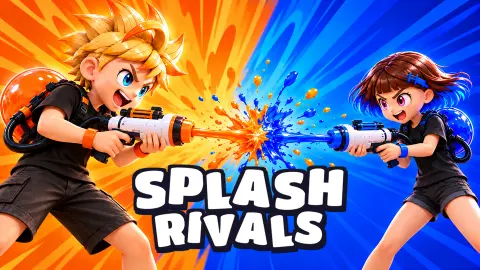


About Splash Rivals
Three minutes after the word "GO!" the clock hit zero, a splat of yellow paint filled the screen with "TIME'S UP!", and then Splash Rivals did something most games are too impatient to do. It refused to say who had won. A card came up reading "JUDGING…", question marks where both percentages should have been, and for a few seconds the game stood there counting the floor.
Then it gave the verdict. Lemon 33.5 per cent, Grape 32.6, and a badge under the word "VICTORY!" that read photo finish, margin of nine tenths of a point. Between them, eight players had left a third of the stage bare.
The scoreboard underneath is where it gets strange. It lists every player's paint score, and the four Grape players had laid down more paint than the four who beat them — 4,951 points against 4,573. The losing team painted more and lost anyway. That row of numbers is what this game actually is, and we will come back to it.
On the surface it is simpler. Four of you against four of them, a stage with a name and a weather forecast, three minutes on a clock, and a ground that changes colour wherever somebody shoots it. We played three matches: a win at dusk in a snowed-in village, a defeat on a mountain top, and a third in a seaside plaza the clock never finished. One thing up front rather than buried — across all three we never fired a shot, and our line on both final scoreboards reads zero paint.
Paint points and painted ground are two different scores
Here is that first scoreboard again, because it is the most useful thing in the game and it goes by in four seconds.
Every player ends with three numbers: a paint score in points, the rivals they splatted, the times they were splatted. The team totals had Grape comfortably ahead. The percentage bar above them had Lemon ahead. Both were true at once.
The plain reading is that the points count everything you ever sprayed, while the percentage counts only what is still yours when the whistle goes. Paint over your own colour and the points go up and the territory does not move. Paint over the other team's and you gain a square they lose. That is the difference between a busy match and a winning one.
So the instinct that wins here is the opposite of the one that wins in most shooters. In our second match the player who led the splat column with eight eliminations finished on the losing side, beaten by almost fourteen points of ground. Chasing people is the trap. The map is the opponent.
The other half of that lesson is less comfortable. We contributed nothing at all to the match we won: three teammates painted, we walked around, and the team still took it by nine tenths of a point. A fourth player who never shoots is not a disaster in a game like this — but it is nine tenths of a point away from being one.
The top bar is eight people, and it tells you when to push
The strip across the top of the screen is the densest piece of design in the game, and it rewards learning.
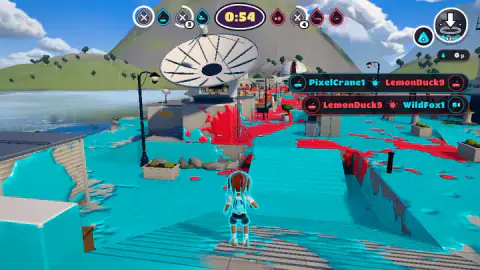
In the middle is the clock. On either side of it sit four drop-shaped icons, one per player, your team's in your colour and theirs in theirs — the whole lobby at a glance, with nothing to open. When somebody is splatted their drop becomes a grey cross with a number beside it, counting down the seconds until they are back.
That turns the bar into a timer for pushing. Two crosses on their side means two rivals cannot stop you rolling over their half of the floor, and the number tells you exactly how long you have before they can. Two on yours means the opposite, and you should be defending your own colour rather than hunting.
Underneath, banners stack up on the right whenever anybody is splatted, naming who did it, who went down and the weapon used, each in their team's colour, with yours boxed. The same information in words, for when you are too busy to read icons.
The roller that splatted us is barely eighty years old
The thing that killed us in the first match had a name. The screen went entirely purple, the game printed SPLASHED BY above the name ZippyOrca7, and underneath, in small letters, the weapon: a Swell Roller.
A paint roller. Not a rifle, not a cannon — the thing in every decorator's bucket. And it feels ancient without being it. Walls were painted with brushes for centuries; the roller arrives only around 1940, invented by a Canadian called Norman Breakey, who has a monument to him in Pierson, Manitoba. What happened next is disputed: some accounts say he patented it, built them at home and sold tens of thousands; others that he could never afford to protect the idea, watched other people patent their own versions, and died without earning from it. We would rather tell you the sources disagree than pick the better story.
What is not disputed is why a roller exists. It covers a large flat area many times faster than a brush and is useless at an edge, which is why anyone painting a room carries both. That trade — reach and precision given up for sheer area — is exactly what a weapon class in a territory game needs to be, and the game treats it that way. The roller is the close-up sweeper: it paints what it touches and splats whoever it touches. In our second match the only player on our side carrying the roller icon led everybody for eliminations with eight.
Who are the other seven players?
We should be straight about the one question the name of this game invites.
Before every match the screen says it is searching for players, then that it is connecting to the server. The menu has a leaderboard, a log-in button, a private room option, three empty slots marked INVITE and a current-stage panel with a countdown ticking beside it, which only makes sense if everyone is moved through the same rotation. All of that points one way.
Against it: every name we saw follows the same pattern — an adjective, an animal and a digit. CometRobin1, WildFox1, MegaSloth6, LemonDuck9, ZippyOrca7. That includes the name the game gave us, without asking and without a log-in. We cannot tell you from the screen whether a person was behind any of them, and we are not going to pretend otherwise.
It does not change the match. The teams are named after flavours — Lemon and Grape in the village, Aqua and Cherry on the mountain — and the stages carry small stories on their loading cards: a snowbound village at dusk, a mountain observatory by day, a seaside plaza in the rain. Three minutes each, and one of them was decided by less than a point.
More arenas with other people in them
If what appeals here is the team match rather than the paint, Special Ops: GO runs five against five in the browser with the same no-download start, and Hazmob FPS: Online Shooter does several modes against whoever is online. Armed Forces.io is the sparser, server-arena version of the same idea. And if it is the paint you came for rather than the opponents, Paint & Roll takes the covering-every-surface problem and makes a quiet puzzle out of it. The rest are in shooting games.
Screenshots
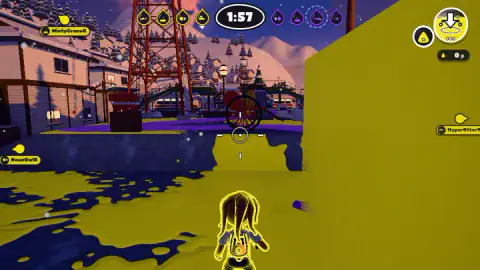
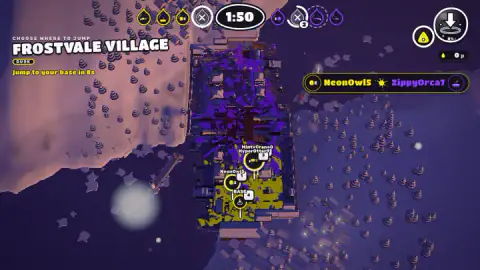
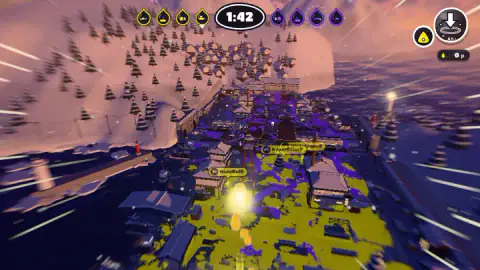
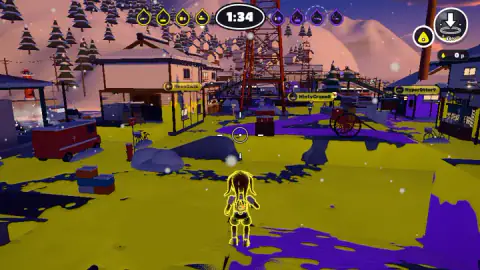
How to play Splash Rivals
- Press PLAY. The game searches for players, shows the stage on a card with a one-line story and a weather setting, then lines up the four rivals and your own four teammates.
- Pick your landing spot. The view pulls up above the stage, the words CHOOSE WHERE TO JUMP appear, and you have eight seconds before the game drops you at your base anyway.
- Move with WASD, aim with the mouse, hold the left button and sweep. The floor takes your colour where the paint lands, not where your feet go — walking across bare ground does nothing.
- Watch the dial in the top right. Painting fills it, and the instant it is full the game prints READY and the letter F beside it. That is your special, and it is the one control the game teaches on screen.
- When you are splatted, wait out the countdown and choose where to come back in. You re-enter from the sky, so you can redeploy wherever the map is emptiest rather than trudge back from a corner.
What only sitting in front of it teaches:
- The clock changes colour at one minute. White on black above sixty seconds, yellow on purple below. That colour is the cue to stop fighting and start covering ground.
- Dying costs you your special. Our dial read seventy per cent going into a fight and one per cent on the way back down from the respawn. Spend it before you take a risk, not after.
- Low walls stop you dead. These stages are full of kerbs, benches, railings and market stalls, and we lost whole stretches of time nudging into things a tap of Space clears.
- The overhead respawn screen is the only map you get. There is no minimap in play. Those few seconds above the stage are your one look at which districts are the wrong colour.
Controls
| WASD or ZQSD | Walks and runs you around the stage. Painting happens where you fire, not where you step, so moving is how you reach ground rather than how you take it |
|---|---|
| Mouse, and the left button | Aims and fires. We never pressed it, and both scoreboards show exactly what that costs |
| Right mouse button | Your secondary ability, per the game's own control list |
| Space | Jumps. Useful for the low walls and kerbs that otherwise stop you dead in a stage full of street furniture |
| F | Fires your special once the dial in the corner is full. The game confirms this itself; the moment the dial fills it prints READY and the letter F beside it |
| Left Shift | Swims through your own team's paint, which the listing says refills your tank and heals you |
| Hold Tab | Shows the full scoreboard mid-match, per the listed controls |
| P or Esc | Opens the pause menu. The listing also says a controller works and that keys can be remapped in the settings |
Features
- A match is four against four and lasts exactly three minutes: the clock starts at 3:00 on the word GO and the screen prints TIME'S UP when it reaches zero
- The winner is the team holding the larger share of the floor at the whistle, and the game withholds the result for a few seconds behind a JUDGING card with question marks where the percentages go
- Paint points and held ground are counted separately, and they can disagree: in our first match the losing side finished with more paint points than the winners
- Eight drop icons flank the clock, one per player, and a downed player's drop becomes a grey cross with the seconds until they are back
- Getting splatted floods your whole screen in the other team's colour and names both the player who did it and the weapon they used
- Every stage carries a name, a one-line story and a weather or time-of-day condition; we played Frostvale Village at dusk, Starlight Summit by day and Tidewater Plaza in the rain
- You re-enter a match from the sky, choosing where to land from an overhead view of the stage with the painted districts laid out beneath you
Game details
- Developer
- Partner studio
- Release date
- October 2026
- Last updated
- October 25, 2026
- Added here
- October 2026
- Technology
- HTML5 (3D)
- Platforms
- Browser (desktop)
- Saved progress
- Saving, when available, is managed by this game. Mava cannot confirm your level.
FAQ
How do you play Splash Rivals?
You join a team of four against another team of four and spend three minutes covering the floor of a stage in your colour. You move with WASD, aim with the mouse and fire with the left button, and the paint goes where you shoot rather than where you walk. When the clock runs out the game measures how much ground each side holds and the larger share wins.
How long is a match in Splash Rivals?
Three minutes exactly. The clock appears on the word GO reading 3:00, counts down in the middle of the top bar, turns from white-on-black to yellow-on-purple under the final minute, and ends with a TIME'S UP card. Add roughly a minute either side for the matchmaking screen, the stage card and the results, so a full round trip is about five minutes.
How do you win in Splash Rivals?
By holding more of the floor than the other team when the clock stops, which is not the same as doing the most painting. Our first match ended with the winners on 33.5 per cent of the ground and the losers on 32.6, and the game stamped it a photo finish with a margin of nine tenths of a point. On that same screen the losing four had piled up more paint points than the winning four.
Are you playing against real people in Splash Rivals?
The game certainly behaves like it is: before each match it says it is searching for players and connecting to the server, and the menu has a leaderboard, a log-in and private rooms you can invite people to. But every name in every match follows the same adjective-animal-number pattern, including the one the game handed us without asking, so from the screen alone we could not tell a person from a rival run by the game.
What happens when you get splatted in Splash Rivals?
Your whole screen floods with the other team's colour and the game names who did it and which weapon they used — ours read Swell Roller. A circle counts down the seconds until you are back, five in our case, and your drop icon at the top of the screen turns into a grey cross with the same number beside it so both teams can see you are gone. You then drop back in from the sky.
How many weapons does Splash Rivals have?
The game's own listing says seven. We never changed ours and never fired it, so all we can confirm is what the end-of-match scoreboard shows: four clearly different weapon silhouettes among the eight players, including a roller, a long-barrelled gun and a short one. The listing also promises character and power customisation, which lives behind a locker we did not open.
Is Splash Rivals free, and who made it?
It is free, runs in a browser with nothing to install, and the game is not tied to an account — we played without logging in. Its credits screen names three people and no studio at all: one credited with the development, one with the original version of the game, and one with the stages, weapons and modes. Rather than guess at a company, this sheet names none. It reached our catalogue on 24 October 2026.
Does Splash Rivals work on a phone?
We cannot promise that it does. The controls the game lists are a keyboard, a mouse and a controller, with keys you can remap in the settings, and nothing resembling an on-screen stick or fire button appeared in any of the three matches we played. We played on a computer, which is what this sheet describes.