


About Cube Rivals
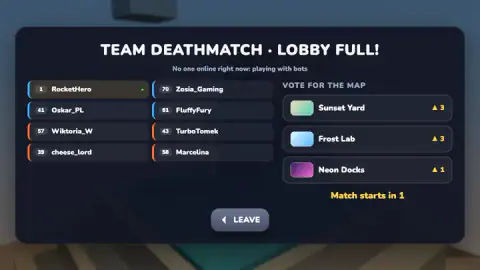
Most online games would rather you did not ask who is on the other end. Cube Rivals answers before you ask. Its lobby card is headed "TEAM DEATHMATCH · LOBBY FULL!" in confident capitals, and then, in small grey type directly underneath, it says: "No one online right now: playing with bots".
That line is not an error message and it is not buried in a settings page. It sits in the middle of the screen while the countdown runs. Everything else on that card is the furniture of a real match — eight slots in two columns, a level badge in front of every name, a map vote with its tallies, a LEAVE button. We were RocketHero, level 1, with a small green dot beside our row. The rest ran from 39 to 70.
The screen rewards a second look. The slots are coloured, and the colour is not decoration: a thin blue or orange stripe down the left edge of each one is the team you will be on, which the two columns do not. Blue put us with Oskar_PL, Zosia_Gaming and FluffyFury, and the final card confirmed it by listing exactly those three under YOUR TEAM. The map vote offered Sunset Yard, Frost Lab and Neon Docks; the triangles beside them added up to seven, one for every name but ours, since we never pressed any of them.
What follows comes with a scoreline attached. We played one session, queued twice, and lost the match we saw through to the end. On the card afterwards our own line read zero eliminations and thirteen deaths. We never opened the loadout, never pressed the button that doubles your coins, and our level never moved off 1.
"Lobby full" means a full lobby, not a full game
Filling empty seats with computer-controlled players is ordinary. A match of four against four needs eight people wanting the same mode, in the same region, in the same minute — a harder number to reach than it looks. A browser game can have a healthy day's traffic and still have nobody queueing at three in the afternoon, because visits spread across the hours and split again across modes and maps. The choice in front of every small online shooter is to make you wait for strangers who may not come, or to start now.
What this one does differently is write it on the screen. The usual version of this is silence: the lobby fills, the match starts, and you are left to wonder why that opponent moved like that. Here the game searches first, visibly — a counter reading FINDING PLAYERS 1/8 and the words "Searching for players online..." — and when the search comes back empty it says so and starts anyway.
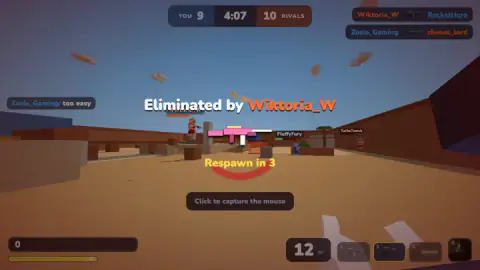
The costume around that admission is the interesting part. Each stand-in arrives with a name of the kind a real player picks, a level badge well above a beginner's, a weapon of its own and a quick-chat key it is not shy about using. One of our own side typed "too easy" into the match chat in the same breath as eliminating a rival; a rival in the second match managed "how?!". The second queue produced an entirely different roster.
What you gain from this is obvious: a match in under a minute, every time, and four against four that stays four against four. What you lose is subtler. The difficulty is a setting rather than a population, so a hard night and an easy night mean nothing about you; the eliminations leaderboard the provider advertises is a ladder whose other rungs you cannot see; and the small satisfaction of beating a person is simply not on offer. The provider's own description adds a detail we could not test: that a real player who shows up mid-match takes a stand-in's place. Worth knowing, unverified by us.
The card at the end is a report, and ours made grim reading
Lose, and a card headed DEFEAT gives you the score — ours read 39 : 50 — and then a table: every player, their eliminations, deaths, assists and score, our side above the rivals. Our row sat highlighted in the middle of it with a zero in the first column and thirteen in the second.
The numbers also explain how the scoring works, if you add them up. Our three teammates took sixteen, thirteen and ten eliminations, we took none, and the team score at the top was 39 — the sum exactly. The score beside "YOU" during a match is your side's total, not yours, worth knowing before you congratulate yourself on a lead.
One more pattern, offered as an observation rather than a law, because one card is one card: on our team the eliminations fell in the same order as the level badges. Level 70 took sixteen, level 61 took thirteen, level 41 took ten, and our level 1 took none. The rival with a star beside her name, and seventeen eliminations, was level 57.
The rewards panel is plain about money. Match played paid fifty coins and Time paid twenty-four, which is where the 74 in the middle of the panel comes from; experience is counted separately, and ours read a hundred and twenty with level 2 still some way off. Under all that sits an orange button reading "WATCH AD: X2 COINS". It is an offer, not a toll — we left it alone and still kept the coins — and between matches the game twice printed its own notice instead: "We skipped the ad this time - enjoy the game!"
Everyone is a cube, and that is a tactical problem
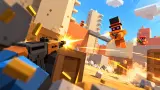
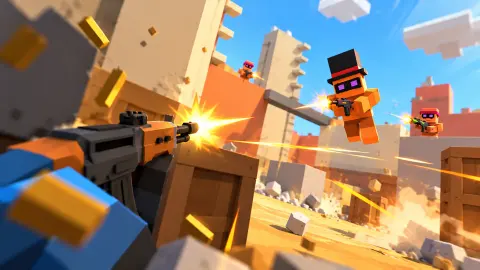
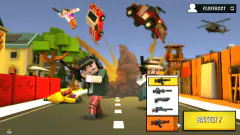
The art is doing a job. Characters are stacks of coloured blocks, the map we were given twice is pale sand, long brown walls and wooden crates, and the odd cube hangs in the sky doing nothing. Nothing bleeds; being shot means a name in a list, the words "Eliminated by" and a countdown from three. It is a shooting game, and we would not pretend otherwise, but the violence is the abstract kind, closer to tag than to anything gory. The provider's listing calls it an arena shooter "for everyone", which is the only steer on age that exists.
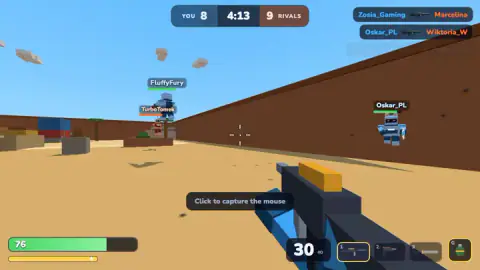
The cost of that simplicity is that friend and enemy are built from the same parts. Across the sand, a blocky figure is just a shape, and the tag over it — blue for your side, orange for theirs — is the whole of your identification. The habit to build early is reading tags rather than silhouettes, and not firing at the one that turns out to be your own level 70.
More shooters we have played
If the appeal here is the quick match rather than the blocks, Hazmob FPS: Online Shooter runs the same kind of short arena round with a heavier look, and Special Ops: GO advertises five against five in the browser with no download. Armed Forces.io takes the hunt out into a wider map where the first shot usually comes from somewhere you were not watching, and Ninja Clash Heroes swaps the rifles for a squad of characters with different jobs in a garden rather than a desert. The rest are in shooting games.
Screenshots
How to play Cube Rivals
- Press play and wait out the FINDING PLAYERS counter, which counts up to eight. While it runs you can vote for one of three maps.
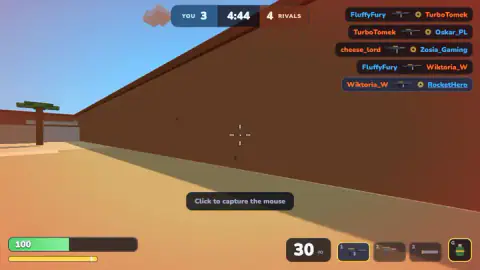
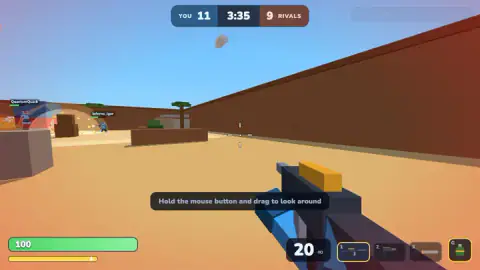
- Click once inside the picture. The game asks you to — "Click to capture the mouse" — and until you do, turning means holding the button down and dragging.
- Move with W A S D, jump with Space, dash with Shift and slide with Ctrl or C while running. Fire with the left mouse button, aim down the sights with the right.
- Switch weapons with 1, 2 and 3, throw your gadget with G, reload with R. Tab shows the scoreboard; Esc pauses and prints the entire control list on the panel.
- When you are killed, the screen says who did it and counts down from three. The match ends when a side reaches fifty eliminations, or when the five-minute clock expires.
What only a match in front of it teaches:
- Capture the pointer first, before anything else. We spent a whole match holding and dragging to look, which is like aiming a rifle by turning your whole body. The card at the end read zero eliminations and thirteen deaths, and that is the reason, not the opposition.
- The name tag colour is the only way to tell friend from foe. Everyone is the same stack of blocks. Tags over your own side are blue, rivals are orange, and at distance the tag arrives long before the shape means anything.
- The reserve ammunition is an infinity sign. You carry thirty rounds in the magazine and an endless supply behind it, so there is no reason ever to hold fire. Reload in cover on principle.
- Health is a bar, not a pickup. It read 100 at the start, 76 after one exchange and zero on the death screen, and there is nothing on the map to collect. The provider's listing says it comes back once you stop taking damage; we were killed too often to time it.
- The elimination feed in the corner is a map. Each line names killer and victim in team colours, so a glance tells you where the fighting is.
Controls
| Click the screen | Captures the mouse pointer. Until you do, the game prints "Click to capture the mouse" and you can only look around by holding the button and dragging |
|---|---|
| W A S D | Moves you around the map |
| Mouse | Looks and aims, once the pointer is captured |
| Left mouse button | Fires. Right mouse button aims down the sights |
| Space | Jumps |
| Shift | Dashes. Ctrl or C slides |
| 1, 2 and 3 | Switch between the two guns and the melee weapon in the bottom-right slots. Q goes back to your last weapon |
| G | Throws or places your gadget, the green item in the slot beside the guns |
| R | Reloads. The magazine holds thirty rounds and the reserve beside it is an infinity sign |
| Tab and Esc | Tab shows the scoreboard. Esc opens a panel headed PAUSED, with RESUME, SETTINGS and LEAVE MATCH, and the full control list printed underneath |
| T | Opens the quick chat, the one the other names in the match use |
| Touch | A floating joystick on the left of the screen, dragging on the right to look and buttons for the rest, per the provider's listing. We played with a mouse, so this is their claim rather than ours |
Features
- The lobby says out loud when the other seven names are not people: under the heading, in small grey type, «No one online right now: playing with bots»
- Four against four, a five-minute clock, and the match stops the moment one side reaches fifty eliminations — ours stopped at 39-50
- A level badge sits in front of every name, in the lobby and on the final card: ours read 1, the rest ran from 39 to 70
- The thin coloured stripe on the left edge of each lobby slot is your team, blue or orange; the two columns are not
- Spare ammunition is an infinity sign. The magazine holds thirty rounds, the reserve never empties, so reloading costs you nothing but the second it takes
- Coins are paid for the match, not for your part in it: ours came to fifty for playing and twenty-four for time, with an optional video to double the total
- The pause panel prints the whole control list, dash and slide and quick chat included, so nothing is hidden in a settings menu
Game details
- Developer
- Partner studio
- Release date
- October 2026
- Last updated
- October 25, 2026
- Added here
- October 2026
- Technology
- HTML5 (3D)
- Platforms
- Browser (desktop, mouse and keyboard), Browser (mobile & tablet, touch)
- Saved progress
- Saving, when available, is managed by this game. Mava cannot confirm your level.
FAQ
Do you play against real people in Cube Rivals?
Sometimes, and when you do not the game tells you. Its lobby screen is headed "TEAM DEATHMATCH · LOBBY FULL!" and the line directly under that heading reads, word for word, "No one online right now: playing with bots". Before that screen appears you see a FINDING PLAYERS 1/8 counter and the words "Searching for players online...", so the search is real; the computer-controlled players are what fills the gap when nobody answers.
How do you play Cube Rivals?
You move with W, A, S and D, look and aim with the mouse, and fire with the left button, in a small arena of blocky scenery. Space jumps, Shift dashes and Ctrl or C slides, and the keys 1, 2 and 3 switch between two guns and a melee weapon, with G for a gadget. Team Deathmatch puts four players on each side and ends when one side reaches fifty eliminations or the five-minute clock runs out.
Why can you not aim properly in Cube Rivals?
Because the game has not taken control of your mouse pointer yet. A banner reading "Click to capture the mouse" sits in the middle of the screen until you click, and a second one reads "Hold the mouse button and drag to look around", which is the slow way of turning. Click once inside the picture and the pointer locks to the view; pressing Esc releases it again, and the banner comes back.
How do you win a match in Cube Rivals?
In Team Deathmatch, the first team to fifty eliminations wins, and the clock starts at five minutes. The score at the top of the screen is the team total rather than your own tally, so a side can be ahead while you personally have scored nothing. The match we played ended 39-50 against us, with a DEFEAT card and a table showing every player's eliminations, deaths, assists and score.
What maps does Cube Rivals have?
Three are offered for a vote before every match: Sunset Yard, Frost Lab and Neon Docks, each with a small coloured thumbnail and a running tally of votes. Both of our matches were played on a desert map of pale sand, long brown walls and wooden crates. The provider's listing names those same three maps and no others.
Are there ads in Cube Rivals?
Yes, and they are mostly optional. The card at the end of a match carries an orange button reading "WATCH AD: X2 COINS", which doubles the coins that match paid; we declined it. While the game was looking for players it twice printed a notice reading "We skipped the ad this time - enjoy the game!" with a button to carry on, so the between-match advert slot does not always fill.
Is Cube Rivals suitable for children?
It is a shooting game, so that is a parent's call rather than ours, but the violence is abstract and bloodless. The characters are blocks with name tags, a hit produces no blood or injury, and being killed means a line in a list, the words "Eliminated by" and a three-second countdown before you are back on your feet. The provider's own description calls it an arena shooter "for everyone"; nothing in the game or the listing gives an age rating.
Who made Cube Rivals, and is it free?
It is free, runs in a browser and needs nothing installed. No studio is recorded for it anywhere we can check, so this sheet names none rather than guessing. It reached our catalogue on 24 October 2026, which makes it days old at the time of writing rather than a back-catalogue title.