







About Cubic Coil
Every snake game ever written rests on one quiet promise: the floor is flat. Up is up, the grid runs the same way in every corner of the screen, and the only thing that can kill you is your own tail. Cubic Coil takes the floor away. The playfield is the inside of a cube, drawn as a black wireframe on flat lime green, and your snake crawls around its walls.
Which would be a novelty on its own, except that the game then hands you a second job. The arrow keys steer the snake, the way they always have. W, A, S and D turn the cube. Both are live at the same moment, with no key to switch between them and nothing handing over, so one hand is driving and the other is rearranging the world the driving happens in. The game states this and then leaves you to it, on a card headed Tutorial with two lines on it: WASD for cube, ARROWS for snake, and a button marked Okay.
Olexander made it, and it has been available since October 2025.
Now the part most pages about a game like this would skip. We played a session of it, and our counter read 0000 at the start and 0000 at the end. We never ate anything, never scored a point and never finished whatever counts as finishing here. The four-digit counter is already sitting at the top of the title screen, zeros and all, before you have pressed a thing, and for us it stayed exactly that way. A game can be worth your time and still refuse to give you a single point; this one managed both, and you should know that before you start.
A cube is the cruellest surface you can give a snake
Here is the thing nobody tells you, and it is not the game's fault. A cube has no corners you can turn normally.
Stand anywhere on flat ground and the ground around you adds up to a full turn. Stand at a corner of a cube and only three square faces meet there, which is a quarter of a turn short. That quarter has to go somewhere, and where it goes is into you: a line that walks straight across a corner comes out the other side pointing somewhere it was not pointing before. Every cube has eight of those corners, and the missing quarters add up to exactly two full turns across the whole shape. Mathematicians call it the defect, which is a good name for what it does to your sense of direction.
So the grid of an ordinary snake game — the thing you have been relying on since you were nine — does not survive the trip around this box. It works beautifully on one face. It breaks at every edge. Then you press W, the whole cube swings, and the map you had just rebuilt in your head is pointing the wrong way again.
That is the game. Not reflexes, not speed. Keeping a picture of a six-sided room in your head while something inside it refuses to stop moving.
The rule you are playing is almost fifty years old
The thing that makes a snake game a snake game — you cannot stop, you can only turn, and your own trail is the wall — arrived in an arcade cabinet in November 1976. It was called Blockade, Gremlin Industries published it, and Lane Hauck and Ago Kiss wrote it as a game for two people racing to outlast each other. The clones came fast, the snake theme got attached to them along the way, and the whole thing reached everybody at once when Nokia put a version on its phones in 1998. Half a century on, the rule has not needed a single amendment. Cubic Coil does not touch it either. It just folds the paper it is written on.
What we did not get to
One short session is a short look, so here is the honest ledger. We do not know what a block is worth, whether the large ones the game mentions really are rarer, or what the counter does when it finally moves. We do not know whether there are levels, because nothing we saw named one. We never heard or saw a crash announced; our session simply ended back on the title screen, which is consistent with losing but does not prove it. And we played with a keyboard, so the split-screen swipe controls the game describes for phones are untested by us.
What we can tell you is the shape of the problem, which is the part that was always going to decide whether you like this one.
More snakes, on other surfaces
Cube Snake 2048 is the closest relative we have, with a snake and a cube and numbers to add on top. Snake Arena is the flat classic, played against everyone else at once, and Snake Puzzle: Slither to Eat! slows the whole genre down into a route you work out before you commit. Drill the Snake moves the same rule underground, and Snake Tangle is built around the other fear of the genre, the knot. The rest of the depth is in 3D games.
Screenshots
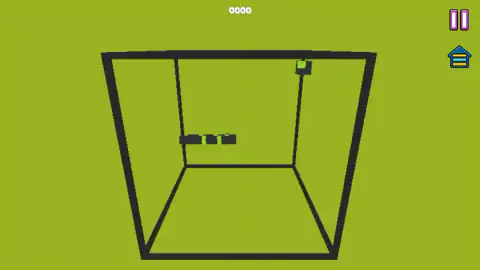
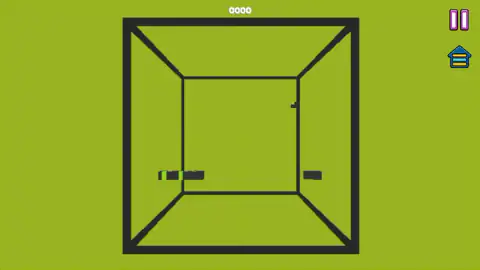
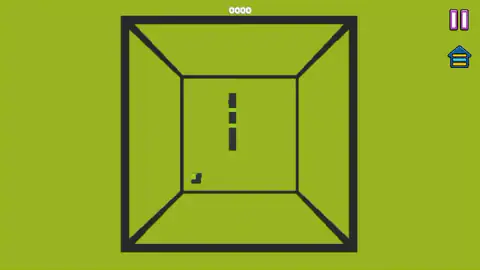
Taken by opening the game ourselves and letting it run — not supplied by the publisher, and not the same picture every other site shows.
How to play Cubic Coil
- Press Start on the title screen. The logo has a snake's head where the O of COIL should be, which is the only joke the game makes.
- Read the tutorial card and click Okay. It will not appear again, and the two lines on it are the whole manual.
- Steer with the arrow keys. The snake moves on its own and never stops; all you ever choose is the turn.
- Turn the cube with WASD when the wall you want is out of sight. The view really does swing round: one of the screenshots on this page caught the cube at an angle, and the others caught it square on.
- Watch the counter at the top. It is four digits with the zeros left in, so it is readable from across the room.
What we only found out by sitting in front of it:
- Nothing on screen is clickable while you play. We tried the cube itself more than once and got nothing. The pause button and the blue house are the only things that answer a mouse, and the house drops you out of the run.
- Spin first, then steer. Doing both in the same breath is how we spent most of our session flat against a wall. Turn the cube until the stretch you want is in front of you, then give the snake its direction.
- The loose blocks are not the snake. Both are dark on the same lime background. The snake is the one with the green bands running through it; anything else sitting on a wall is a block, and in our session the blocks never did anything we could measure.
- There is no clutter to read. Two colours, no textures, no text during the run. When you lose your bearings, it is the shape that has beaten you, not the picture.
Controls
| Arrow keys | Steer the snake along the wall it is on |
|---|---|
| W A S D | Turn the cube itself, which changes the face you are looking at |
| Click Okay | Close the tutorial card, which is the last thing between you and the run |
| Pause button, top right | Hold the run |
| House button, top right | Leave the run and go back to the title screen |
| Swipe | On phones the game splits the screen, with the cube on the left half and the snake on the right |
Features
- Two sets of controls run at once: the arrow keys own the snake, WASD owns the cube it is crawling on
- The playfield is the inside of a wireframe cube, so the floor becomes a wall and the wall becomes a ceiling
- A four-digit counter sits at the top of the screen, already showing 0000 before you press Start
- The snake is a short chain of dark segments banded in green, which is what tells it apart from the loose blocks
- Everything is drawn in two colours, black on lime, with no textures and nothing decorative on screen
- The whole game is keyboard: clicking on the cube while a run is going does nothing at all
- A tutorial card names both control sets before the first run and has to be dismissed by hand
Game details
- Developer
- Olexander
- Release date
- October 2025
- Last updated
- August 10, 2026
- Added here
- August 2025
- Technology
- HTML5 (3D)
- Platforms
- Browser (desktop, keyboard), Browser (mobile & tablet, touch)
- Classification
- 3D , .io , Multiplayer
- Saved progress
- Saving, when available, is managed by this game. Mava cannot confirm your level.
FAQ
How do you play Cubic Coil?
You press Start, close the tutorial card and then steer a snake around the inside of a cube. The arrow keys turn the snake, exactly as in any snake game, and WASD turns the cube itself so that a different face comes to the front. The snake never stops moving, so steering is the only thing you ever do.
What do WASD and the arrow keys do in Cubic Coil?
They drive two different things at the same time. The game's own tutorial card puts it in two lines: WASD for the cube, arrows for the snake. Nothing hands over between them and there is no key to switch modes, so both halves of the keyboard stay live for the whole run.
How do you score points in Cubic Coil?
A four-digit counter sits at the top of the screen, and the game describes the loose blocks inside the cube as fruit, with rarer large ones worth a bonus. We have to be straight with you: our counter read 0000 at the start of our session and 0000 at the end, so we never saw it move and cannot tell you what a single block is worth.
Why is Cubic Coil so hard to steer?
Because a cube has no gentle corners. Three square faces meet at each of its eight corners, which is ninety degrees short of the full turn you get on flat ground, so a line that crosses an edge arrives pointing somewhere you did not expect. Add a cube that you are also spinning yourself and the map in your head stops matching the screen.
Does Cubic Coil have levels?
We cannot tell you. We never finished anything in our session, the counter never moved, and no screen we saw named a level or showed a level number. Anything else would be us guessing.
Can you play Cubic Coil on a phone?
It is listed for desktop, Android and iOS, in landscape only, and the game's own instructions describe a split screen for touch: swipe on the left half to turn the cube, swipe on the right half to steer the snake. We played it on a desktop with a keyboard and have not tested the touch controls ourselves.
Who made Cubic Coil?
It is credited to Olexander. The game was published in October 2025 and last updated in August 2026. We found no studio site or store listing to check that against, so the game's listing is the only source for any of it.
Is Cubic Coil the same as classic Snake?
The rules are the old ones. You steer a line that never stops, it grows as it eats, and running into something ends the run. What is new is the surface. Classic snake happens on a flat rectangle where the grid is the same everywhere; here it happens on six square faces that meet at edges, and the grid stops being the same everywhere the moment you cross one.