








About Room Makeover: Design And Aesthetic
Most decorating games open on an empty room and ask you to have taste. This one opens on a room that is already finished.
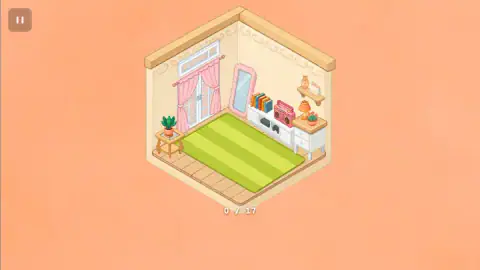
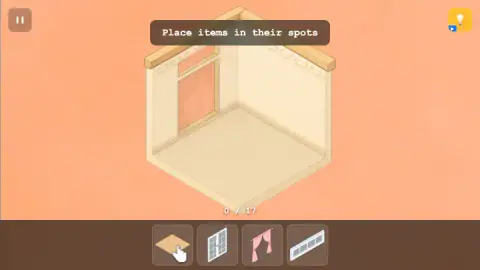
The first thing on screen is a bedroom corner seen from above, and it is done: pink curtains gathered at a tall window, a green striped rug on bare boards, a mirror in a pink frame, a shelf of books with a pink radio on it, a chest of drawers, a plant on a wooden stool. Underneath, a counter reads nought of seventeen. Then the room is taken away. The same corner comes back with cream walls and nothing else, no floor at all and a hole in the wall where the window should be, and the seventeen things you were just looking at are what you have to put back.
That order of events quietly changes what the game is asking of you. You are not deciding where the rug looks best. You are remembering, and then recognising, and the answer has already been shown to you once.
The playing is a single gesture. A tray of slots runs along the bottom of the screen, four of them in the first room, and you drag a piece out of the tray and drop it on the place in the room where it goes. A banner across the top says Place items in their spots, and a pale hand points at the piece the game wants first. Miss, and the piece drifts back to its slot: no sound, no penalty, no record that you tried. It is by Whalebox, and it has been available since the end of March 2026.
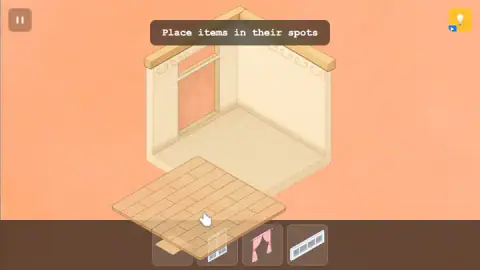
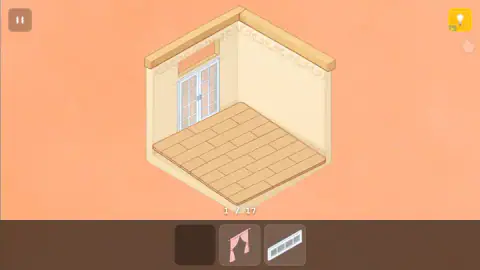
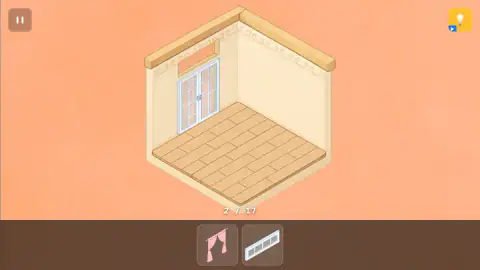
Our own run should be declared up front. We got two pieces of seventeen into that first room in about four minutes, and most of those minutes were spent missing. We laid the wooden floor and we put the glazed doors into the left-hand wall. We never finished a room, never saw a second one, and never saw a win screen, a score, a timer or a setting of any kind beyond pause.
Nothing in this room gets smaller as it goes away from you
Look at the floor in that empty room and something is subtly wrong with it as a picture. The far corner of the boards is exactly as wide as the near one. The two walls lean away at the same angle, and neither narrows. Hold a photograph of a real room next to it and the difference jumps: everything shrinks with distance.
This is isometric projection, and it is not a shortcut or a stylistic tic. It was set out as a formal method in 1822 by William Farish, a professor at Cambridge, in a paper called On Isometrical Perspective. Farish taught engineering using a kit of interchangeable brass and wooden parts, and he had a practical problem: he needed drawings of machines from which any part could be measured directly off the page. True perspective, the kind painters had been refining since the 1400s, makes a beautiful picture and a useless blueprint, because the same rod is a different length on paper depending on where it sits in the scene. Farish's answer was to throw away the vanishing point. Tilt the object, keep all three axes at the same scale, and a centimetre is a centimetre everywhere in the drawing.
Two hundred years later, that decision is what makes this game playable with one gesture.
Think about what dragging and dropping actually requires. You are holding a picture of an object over a picture of a room, and you have to judge whether it belongs there before you let go. In perspective, that judgement would be impossible: a rug held near the bottom of the screen would be drawn large, the floor it is destined for would be drawn small and skewed, and the two shapes would never match until the moment the game decided to snap them together. In isometric, the piece in your hand is drawn at exactly the size and angle it will have once it is placed. The shape in your hand and the gap in the room are the same shape. You are not guessing, you are matching, and that is a thing a nine-year-old can do at a glance.
The order you fit out a real room is the order the game deals you
There is a second piece of real-world logic buried in this first level, and it is in which pieces turn up first.
The game gives you a floor. Then it gives you a window. The curtains sit in the tray waiting, and so does the white slatted panel we never found a home for.
That is the order a real room is finished in, and every trade knows it. Decorators work from the top down: ceiling, then walls, then woodwork, then the floor last of all, because paint drips and the thing you have not finished yet is the thing you want it to land on. Flooring goes down before the furniture goes in, for the plain reason that you cannot lay boards underneath a wardrobe without first moving the wardrobe. Glazing comes before curtains, because the rail is fixed to the wall around a window that is already in and already sealed.
So the sequence this game hands you, floor and glass before soft furnishings, is not a puzzle designer's arbitrary ramp from easy to hard. It is the sequence a builder would use, and it carries the same reasoning: the pieces that determine where other pieces can go have to be settled first. Playing in that order feels right long before you work out why.
What the room never told us
Two pieces out of seventeen, one room, four minutes: that is the size of our sample, and it leaves three questions open. We never saw a style choice: the listing suggests you pick between looks, and nothing of the kind appeared while we played, with every object we touched having exactly one correct place. We never found out what the lightbulb does, because we pressed it and could not see what changed on the board. And we never learned what the white slatted panel is, a flat rectangle of horizontal louvres that could be a radiator, a blind or a shelf, and which was still sitting in the tray when we stopped.
What we can report with confidence is the texture of the thing. It is quiet, it is slow, it never punishes you, and the counter in the corner only ever goes up. For a game whose whole challenge is accurate dropping, that forgiveness is doing more work than it looks.
More rooms to put in order
Satisroom - Perfectly Organized is the nearest neighbour in spirit, with the same satisfaction of a space that ends up right. Tidy Up the Dollhouse runs the opposite errand, taking things out of a room rather than putting them in. Home Makeover Cleaning Game turns the same idea towards scrubbing, and My Town Home: Family Playhouse is the loose, no-wrong-answers version for anyone who wanted the freedom this game deliberately withholds. The rest are in casual games.
Screenshots
How to play Room Makeover: Design And Aesthetic
- Study the finished room before you touch anything. The screen you see first is not a title card, it is the solution, and it is the only time you get to see where everything ends up.
- Take a piece out of the tray. It leaves the slot at full size, drawn as large as it will be once it is in the room, and it follows the cursor or your finger.
- Drop it on its spot. A piece has one home. The floor goes on the floor, the window goes in the window hole, and nothing improvises.
- Watch the counter. It sits under the room and counts what you have placed against what the room wants. Ours went from nought to two, the tray went from four slots to two, and the two numbers move together.
What our session taught us:
- Start from the shell and work in. The game gives you the floor first and the glazing second, and that is not an accident of shuffling. Big structural pieces define where everything else can sit, and until the floor is down there is nowhere to put a rug.
- The near miss is invisible. This is the one thing to be ready for. A drop that lands slightly off looks exactly like a drop that lands in the wrong room: the piece just goes home to the tray. We let go a fraction short of the floor several times in a row before realising we had the right idea and the wrong hand.
- Aim at the middle of the target, not its edge. Once we started releasing over the centre of the empty space rather than its outline, pieces began to stick.
- The tray is your to-do list. It only ever shows what is left, so a glance at it tells you how much of the room is still missing without reading the counter.
- Nothing is racing you. No clock appeared, no piece expired, and four minutes of fumbling cost us nothing except four minutes.
- If you stall, the hand will offer. After we had failed often enough, the pointing hand left the room and moved to the yellow lightbulb in the corner, which is the game suggesting you ask it for help.
Controls
| Click and drag, or touch and drag | The only input the game needs. You pick a piece out of the tray at the bottom of the screen and drop it on the spot in the room where it belongs |
|---|---|
| Drop on the right spot | The piece settles into the room, its slot empties, and the counter at the bottom goes up by one |
| Drop anywhere else | The piece goes back to the tray. Nothing is lost, nothing is deducted, and nothing tells you how close you were |
| The tray along the bottom | Everything still waiting to be placed in this room. The first room hands you four pieces at a time |
| Yellow lightbulb, top right | The help button. A pale hand points at it when you have been stuck for a while. It carries a small blue play symbol in its corner |
| Pause button, top left | Stops the room. It is the only other control on the screen |
Features
- Shows you the completed room before it takes it apart, so you are rebuilding something you have already seen rather than inventing it
- Seventeen pieces in the first room, counted off one by one under the floor
- One gesture does everything: pick a piece out of the tray, drop it where it goes
- Drawn in isometric projection, so a piece is the same size in the tray, in your hand and in the room
- A wrong drop costs nothing at all: no penalty, no sound, no attempt counter
- Nothing times you. We spent four minutes mostly missing and the counter never went down
- It has been available since March 2026
Game details
- Developer
- Whalebox
- Release date
- March 2026
- Added here
- January 2026
- Technology
- HTML5 (2D isometric)
- Platforms
- Browser (desktop), Browser (mobile & tablet, touch)
- Classification
- Casual , Fashion & Beauty
- Saved progress
- Saving, when available, is managed by this game. Mava cannot confirm your level.
FAQ
How do you play Room Makeover: Design And Aesthetic?
You drag pieces out of the tray along the bottom of the screen and drop them on the spot in the room where they belong. Each piece has one correct place, so the game is recognition rather than taste. The counter under the room tells you how many you have placed and how many the room wants in total, which was seventeen in the first one.
Does Room Makeover let you choose your own style?
Not in the part we played. Every piece we handled had exactly one home, and dropping it anywhere else simply returned it to the tray. The listing talks about choosing between design styles, but no selector appeared on screen during our session, so we cannot confirm it exists and would rather say so than repeat it.
What happens if you put something in the wrong place?
Nothing. The piece floats back to its slot in the tray, there is no sound, no counter of failed attempts and no penalty of any kind. The only cost is that the game will not tell you whether you were two pixels out or in completely the wrong half of the room, which is the one genuinely fiddly thing about it.
How many items are there in a room?
The first room asks for seventeen, and says so in a counter at the bottom of the screen that reads nought of seventeen before you start. That number counts objects inside the one room, not rooms completed: the corner on screen was still the same corner when the counter had reached two. We did not finish it, so we cannot tell you whether later rooms ask for more.
Who made Room Makeover: Design And Aesthetic?
Whalebox. The game has been available since 29 March 2026. It runs in a browser tab at a widescreen size and supports touch as well as a mouse.
Can you play Room Makeover on a phone?
Yes, and the single gesture it uses suits a touchscreen well: picking an object up and setting it down is more natural with a finger than with a mouse. Our own session was on a desktop, so we cannot say how comfortably the tray of pieces scales down to a small screen.
Are there ads in Room Makeover: Design And Aesthetic?
None interrupted our session, which lasted about four minutes. The only thing that pointed at advertising was a small blue play symbol in the corner of the yellow help button, the mark these games usually use for help you get in exchange for watching something. We pressed that button and could not see what it changed.
Is Room Makeover a puzzle game or a decorating game?
It looks like a decorating game and plays like a puzzle. There is no arranging and rearranging, no budget and no palette to balance: there is a shape, a hole that shape fits, and seventeen of them per room. If you came for the freedom of a dollhouse this is a stricter game than it appears, and if you came for a quiet thing to solve it is a kinder one.