

About Attack & Dash
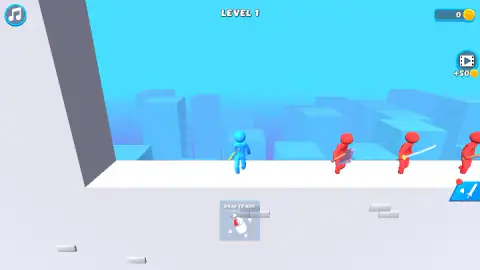
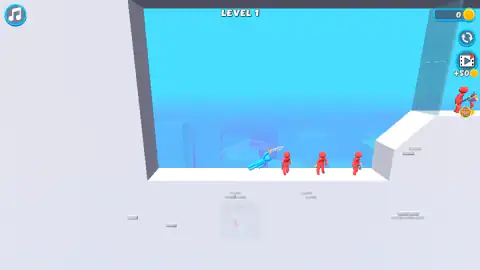
We put a row of red figures on the floor and the counter in the top corner never moved off zero. That is not a complaint, and it is the most useful thing this game says about itself in its first minute: the kills are not what you are collecting. At the far right of the level, on a raised platform with two armed figures standing over it, there is an orange-brown chest with a gold clasp. That is the finish line. In ten minutes we never reached it.
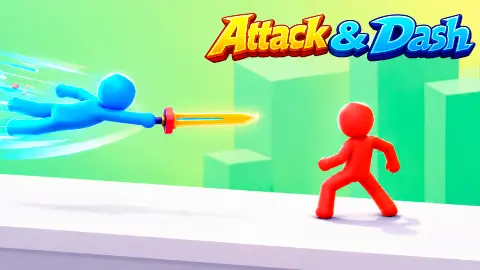
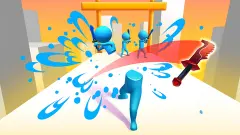
You never walk. There is no run key, no left and no right. The hero — a rounded blue figure holding a short sword with a yellow blade — stands exactly where he landed until you hold the left mouse button, pull a line in the direction you fancy, and let go. Then he stops being a figure at all. In two of the pictures on this page he is a bright cyan shape flying head first with the sword stretched out ahead of him and a thin white trail curving behind, and whatever red he passes through does not stay standing.
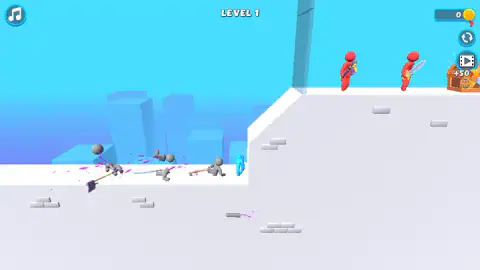
What he leaves behind is the best thing on screen. A beaten enemy turns grey and comes apart on the spot: arms at angles no body makes, a head rolling away as a separate piece, an axe skidding off across the white floor with its orange handle spinning. A purple splash stays on the ground where each one fell. Glance at the platform and you can read how much of it you have already spent without counting anything.
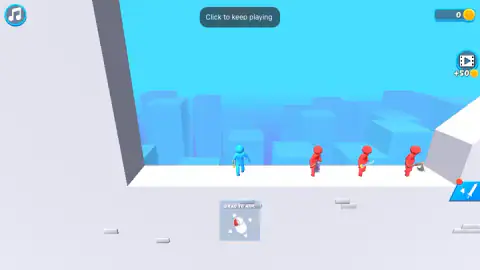
One limit sits over this whole page and it is better said out loud than buried. The banner above the arena read LEVEL 1 in every screen of our session and in all four captures here. Dozens of dashes, no second level, no failure card, no sound of defeat, and a coin counter that stayed on zero from the first drag to the last. This page is written from one level, and it says so wherever that matters.
You cannot steer a jump, and neither can a long jumper
The rule the whole game is built on is not a game rule. The moment anything leaves the ground, the path its centre of mass will follow is already fixed. Speed and direction at take-off decide where it comes down, and nothing done in the air changes that. You can thrash, twist and flail. The curve does not care.
Athletes have known this for a long time and work around it rather than against it. A long jumper windmilling his legs in mid-air — the hitch-kick — is not reaching for extra distance; he is cancelling the forward rotation the take-off gave him, so he can get his feet out in front and land without folding backwards. The jump itself was settled at the board. Everything after that is housekeeping.
The most famous demonstration is a cat. In 1894 the French scientist Étienne-Jules Marey dropped one in front of a camera taking roughly sixty pictures a second, and the sequence showed exactly how it lands on its feet: it folds in the middle and counter-rotates its front and back halves against each other, with nothing to push against. The cat turns itself over in free air. What it cannot do, and what the pictures also show, is move the spot where it is going to land.
Attack & Dash hands you the same deal and makes it the game. Your hero gets no air control, no double jump, no nudge. He gets one line, chosen while standing still, and then he is a projectile with a sword on the front. That is why the thinking happens before the flick rather than during the flight, and why a dash that looked promising and landed you beside an axe is not bad luck. It is a line you drew.
A level is a chest, a gap, and a row of armed strangers
The arena reads like a corridor seen from the side. Long white platforms, a step up to a higher shelf on the right, gaps between the slabs, loose rubble on the ground below, and behind it all a skyline of pale blue blocks. A wall of grey rock closes the left edge, so there is nowhere to retreat to.
The red figures are not interchangeable, which matters more than it sounds. In our level one carried a heavy grey axe, another a long silver sword with a gold hilt, a third something with a wooden shaft, and they stood at different distances along the platform rather than in a neat line. Two more waited up on the shelf beside the chest, one with a gold and purple axe, one with a broad silver blade. Reach is the thing you are reading: a long weapon covers ground a short one does not, and the gaps between the figures are the only places a dash can safely end.
The camera moves with you and pulls back when you cover distance. One of our pictures is framed tight on the hero, the next shows the whole arena at once, and that is useful for planning but awkward in the moment: the line you are about to pull is measured on a picture whose scale just changed.
What one level will and will not tell you
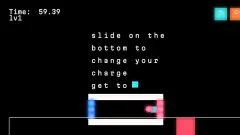
The display is four things and no menu. A musical note in the top left. The level number across the middle. A dark pill in the top right holding your coins beside a gold coin, and under it a white film-strip play icon labelled +50 — a video offer, not a payout for fighting, which is why ours stayed on zero while the floor filled with grey bodies.
The fourth is a circular button with two curved arrows, and it has a small story. It is absent from both captures that still show the tutorial card and present in both that do not, so it appears to turn up once the game decides you are properly under way. We pressed it once; the arena came back to its opening arrangement with no screen in between. There is also a banner we saw more than once, reading "Click to keep playing", in the place where the level number normally sits — the game pausing itself and waiting for you rather than pushing anything at you.
Beyond those four things we are quoting rather than reporting. The game's own listing calls the hero a stickman ninja, promises short levels in the plural, and describes each arena as a test of planning in which one wrong direction leaves you exposed. The first of those we cannot confirm — our hero is a blue figure with a short sword and no mask. The last of them we can confirm in full, several dozen times over.
More stick figures, swords and ragdoll physics
Stick Duel : Medieval Wars puts two stick fighters on opposite sides of a physics playground with medieval weapons and a second player on the same keyboard, and Epic Sword Battle stages its duels in three dimensions, where the loose-limbed collapse is the whole joke. Ninja dash: Cozy tactic puzzle slows the same idea of planning a route through armed strangers down to a turn-based grid, and Undercrown sends you through eighteen rooms of a dungeon with treasure at the bottom and the awkward job of carrying it back out. Stickman Ghost Online is the side-scrolling version, where the sword swings on a button instead of a line. The rest are in action games.
Screenshots
How to play Attack & Dash
- Hold down the left mouse button anywhere on the arena. A pale blue card appears near the bottom reading "DRAG TO AIM:", with a drawing of a mouse whose left button is lit red.
- Pull a line in the direction you want to travel. You are choosing a heading and a distance in the same gesture.
- Let go. The hero launches along that line, sword first, and deals with whatever is on it.
- Wait until he stops, look at where he has ended up, and aim again. Every dash begins from a standstill.
- Work right along the platforms towards the chest, past the figures posted between you and it.
What only sitting in front of it teaches:
- Aim through an enemy, not at him. The dash is a line, not a lunge. A pull that stops short of a red figure leaves you standing next to him with your turn spent.
- The floor has holes in it. The arena is white platforms with gaps between them and a raised shelf on the right. A dash aimed low and long does not land on nothing — it lands in nothing.
- Short pulls barely move you. The ones that did useful work in our run were long, and usually angled up and to the right to clear the step onto the higher platform.
- The same drag gives you the same result. This is not a game that rewards persistence with an identical gesture; if a line failed, the next one has to be a different line.
- The keyboard was silent for us. Arrows, A, Enter and the space bar changed nothing we could see. The mouse is the whole interface.
Controls
| Hold the left mouse button | Starts aiming. A card appears near the bottom of the screen reading DRAG TO AIM, with a drawing of a mouse whose left button is lit red |
|---|---|
| Drag a line, then release | Launches the hero sword-first along that line. This is the only way we ever moved him |
| Swipe across the screen | The touchscreen version of the same aim and release, per the game's own listing. We played with a mouse, so this is the listing's claim rather than ours |
| The circular two-arrow button, top right | Restart. It is missing from the two captures that still show the tutorial card and present in the two that do not, so it seems to arrive once you are properly under way |
| The musical-note button, top left | Sound. It sits in the same corner in all four of our captures |
| Arrow keys, A, Enter and the space bar | Nothing we could see. We pressed all of them during our run and the screen did not answer, which is not the same as saying they do nothing |
Features
- One input runs the whole game: you aim a line from a standstill and let go, and there is no walking, no steering and no second chance mid-flight
- The hero stops being a figure while he travels — he becomes a cyan streak with the sword out in front, trailing white behind him
- Defeated enemies turn grey and come apart on the spot, heads and limbs at broken angles, weapons skidding away across the white floor
- Purple splashes stay on the ground where each figure fell, so the arena keeps a record of every dash you have already spent
- The red figures are not identical: ours carried a heavy grey axe, a long silver sword with a gold hilt and a wooden-handled weapon, posted at different distances along the platform
- An orange-brown treasure chest with a gold clasp sits at the far right of the level with red figures standing beside it
- The arena is built from white platforms with real gaps in them, so the floor itself is one of the things that can finish a dash
Game details
- Developer
- Partner studio
- Release date
- October 2026
- Last updated
- October 25, 2026
- Added here
- October 2026
- Technology
- HTML5 (3D)
- Platforms
- Browser (desktop), Browser (mobile & tablet, touch)
- Saved progress
- Saving, when available, is managed by this game. Mava cannot confirm your level.
FAQ
How do you play Attack & Dash?
You hold the left mouse button, pull a line in the direction you want to go, and release. The hero launches along that line with his sword out in front, and anything he passes through is dealt with on contact. He does not walk and he cannot be steered in flight, so every dash is a separate decision made from a standstill.
What are the controls in Attack & Dash?
One drag with the left mouse button, aimed and released. The game shows you this itself with a small card reading DRAG TO AIM and a picture of a mouse with its left button lit red. The game's own listing adds a swipe for phones and tablets; we played with a mouse, and the arrow keys, A, Enter and the space bar produced no change we could see on screen.
What happens when you hit an enemy in Attack & Dash?
The red figure turns grey and falls apart where it stood. Arms end up at angles no body makes, heads roll away as separate pieces, and whatever it was carrying skids off across the floor. A purple splash stays behind on the white ground, which is how you can read at a glance how much of the arena you have already cleared.
What is the treasure chest in Attack & Dash?
An orange-brown chest with a gold clasp that sits at the far right end of the level, on the raised platform, with red figures standing beside it. It is plainly the end of the run. We never reached it, so this page will not tell you what opening it does.
How many levels does Attack & Dash have?
We cannot tell you, and we would rather say so than guess. The banner above the arena read LEVEL 1 in every screen of our session and in all four pictures on this page. The game's own listing describes short, dynamic levels in the plural, but we never saw a second one.
What is the coin counter and the +50 button in Attack & Dash?
A dark pill in the top right corner holds a number beside a gold coin, and under it sits a white film-strip play icon labelled +50 with a coin of its own. That is a video offer rather than a reward for playing. Our counter read 0 in all four captures, through dozens of dashes and a good many defeated enemies, so coins do not simply fall out of the fighting.
Can you play Attack & Dash on a phone?
The game's own listing says yes and describes a swipe across the screen in place of the mouse drag, and our catalogue has it flagged as a mobile title. We played it in a desktop browser with a mouse, so the touchscreen version is the listing's word rather than something we have tested.
Is Attack & Dash free, and who made it?
It is free and it runs in a browser with nothing to install. The studio behind it is not recorded anywhere we can check, so this sheet names no author rather than inventing one. It reached our catalogue on 25 October 2026, which makes it days old at the time of writing rather than a back-catalogue title.