





About Seven Down
Most puzzle games put the thing you are solving on the screen. This one puts it under the die.
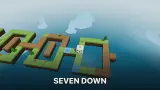
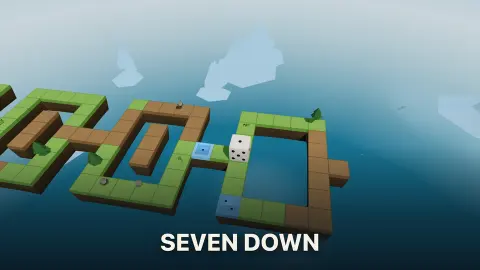
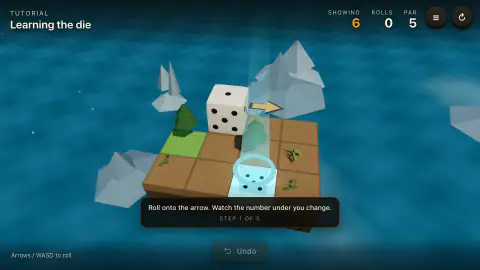
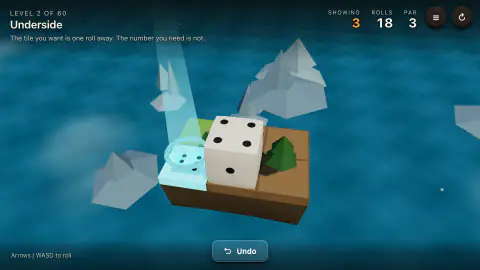
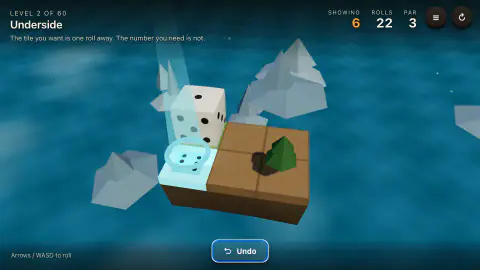
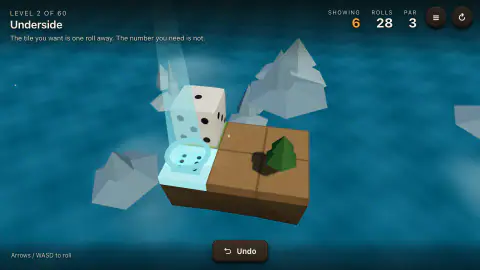
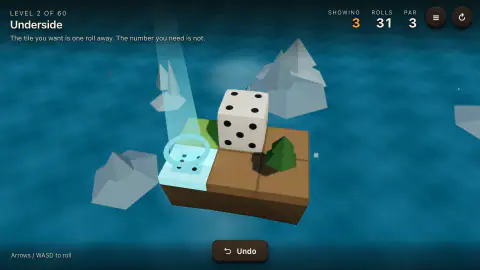
A white die sits on a handful of earth and grass tiles, floating over open water with low-poly icebergs drifting past. You tip it one square at a time with the arrow keys. Somewhere on the board there is a pale blue pad with a shaft of light falling on it and a number printed on it in pips, and the game wants you standing on that pad — not merely on the tile, but with that exact face of the die pressed against it. The face against the tile is the only one you cannot see.
That would be unfair if a die were an arbitrary object. It is not. Opposite faces add up to seven, always: one against six, two against five, three against four. So the number you are standing on is seven minus the number on top, and it is never a guess. It is arithmetic you can do in less than a second, from information that is sitting right in front of you.
The game is credited to Fernbek and was published in early September 2026. Our session got through the five-step tutorial on exactly par, then walked straight into the second puzzle board and stayed there. What follows is what that board taught us, including the thing we got wrong for most of it.
Opposite faces have added up to seven for about two thousand years
Pick up any die in your house and check. The one is opposite the six, the two is opposite the five, the three is opposite the four, and every pair comes to seven. This is not a law of nature — a cube can be numbered any way you like, and early dice were. Archaeologists turn up ancient dice with the one next to the two and the three next to the four, numbered in simple order around the faces. By the Roman period the sevens arrangement had become the standard one, and it has stayed standard ever since, through every version of the object that followed.
Two good reasons kept it. One is physical: opposite faces carry the same amount of drilled-out material, so the cube stays closer to balanced. The other is practical: with sevens you only ever have to read one face, because the top tells you the bottom. Every dice player in history has had that shortcut without thinking about it.
This is the first game we have played that makes the shortcut the entire point. The counter is labelled SHOWING, your target is drawn on the floor, and the number that scores is the one under your feet.
And the rolling is where it turns into a puzzle rather than a sum. When a cube tips over an edge, the face that lands underneath is the face that was on the side — not the one that was on top. So each roll swaps your number for one of the four neighbours of the pair you are in, and which neighbour depends entirely on the direction you went. Your number is a record of your route. That is why the second board is called Underside, and why its one line of text reads: The tile you want is one roll away. The number you need is not.
SHOWING is the number you cannot see, and we found that out the slow way
Here is the confession. For most of that second board we read the counter as the face we could see, and planned every roll from the wrong end of the die.
The evidence is in our own screenshots, and it is unambiguous. In every single frame we kept, the pips on the top face and the figure beside SHOWING added up to seven: one on top and six showing, four on top and three showing, over and over. SHOWING is the underside. The game is telling you the hidden number — the one piece of information you could not otherwise read — and we were treating it as the obvious one.
What that mistake costs is easy to measure, because the game measures it for you. Underside is a board of three tiles with a par of three rolls. Our roll counter passed eighteen, then twenty-two, then twenty-eight, and was still climbing past thirty when we stopped. Two of our captures are the same die, on the same tile, with the same single pip facing up, six rolls apart: a full loop of the island that changed nothing at all, which is precisely what happens when you are solving for the wrong face.
Nothing punished us for it. The board did not reset, no timer ran out, no lives were spent; the level header read LEVEL 2 OF 60 the whole way through while the counter climbed. That is the design. The only consequence of being wrong is the number next to the word PAR.
Par, sixty boards, and the two modes we did not play
Par is borrowed from golf and used honestly. It is printed next to your roll count from the first second of a board, so you always know what a clean solution would have cost. The tutorial is par five across its five steps; we matched it, and the game put up a panel reading "Par!" over the line "Perfect — that is the shortest route", with a retry, the main menu, or the next board.
That panel is the game's whole reward structure, as far as we saw it: no currency, nothing to buy, no energy meter, no advertisement between boards during our session. There is a route, a number of rolls, and a par.
The puzzle run is sixty boards long — the header counts them for you. The menu offers two more runs beside it, a set of action stages and a set of mazes, along with a daily puzzle, an awards screen and leaderboards. We did not play any of them, so we will not describe them. What we can say about the part we did play is that it is unusually quiet: one die, a few tiles, a pad, and a single arithmetic fact doing all the work.
More puzzles that hide the answer
TetraDice is the obvious neighbour — a block puzzle where every square of every piece carries a die face, so the pips are data rather than decoration. Mini Dice Chess hands the dice the other job: two of them decide which pieces you are allowed to move, on a board small enough to hold in your head. Nonogram shares the real pleasure of this game, which is deducing something you cannot see from numbers you can. And Neon Maze is about ordering your moves so they do not block each other, which is the skill the sixty boards here keep asking for. The rest are in puzzle games.
Screenshots
How to play Seven Down
- Roll with the arrow keys, or with WASD. Every board prints the reminder in its bottom-left corner. One press, one tile, one quarter-turn of the cube.
- Find the pad. It is the pale blue tile with a glowing ring and a shaft of light on it, and it has pips printed on its face. Those pips are your target number.
- Read what is underneath you. The counter at the top right says SHOWING. That is the face on the ground. It is also seven minus whatever you can see on top, so you can check it without looking at the counter at all.
- Plan the route, not the destination. Getting to the pad is the easy half. Getting there with the right face down is the whole puzzle, and the only thing that controls which face lands down is which way you came.
- Use Undo. It sits in the middle of the bottom edge on every board. A roll you regret costs you a place on the scorecard, not the level.
What the session taught us:
- A die has twenty-four ways to sit on a tile — six faces down, four turns each — and rolling changes which one you are in. This is why two players can stand on the same square with different numbers underneath.
- The face on top never goes straight to the bottom. Tipping a cube brings a side face down. So the two numbers you can never reach in one roll are the one you are already standing on and the one directly above it.
- When the tile is right but the number is wrong, take a walk around the block. Four rolls in a square — right, down, left, up — bring the die back to the tile it started on with a different face underneath. Try it with a real die on a table: it comes back on a new number every time.
- But only go round twice. That little circuit has exactly three steps in it. Walk the same square a third time and you are back to the number you began with, four rolls poorer.
- Par is a target, not a limit. Going over it does not end the board, and nothing stops you rolling. That is generous, and it is also how a par-three board turns into a long afternoon.
Controls
| Arrow keys | Tip the die one tile in that direction. Every board prints the reminder in its bottom-left corner: Arrows / WASD to roll |
|---|---|
| W A S D | The same four moves on the letter keys, for anyone who keeps a hand on the left of the keyboard |
| Undo | A button in the middle of the bottom edge, there on every board we saw, including the tutorial. It takes back a roll |
| Menu button, top right | Opens the game's own menu. A circular-arrow button sits beside it; we never pressed it, so we will not tell you what it resets |
| Drag on a touchscreen | The game is listed as playing on desktop, mobile and tablet. Our own session was on a desktop, entirely on the arrow keys |
Features
- A die you steer rather than throw: it tips over one edge at a time, so the face it lands on is decided by the route you took, not by chance
- The number that counts is the one touching the ground — the counter labelled SHOWING, in orange at the top right, is the face you cannot see
- Goal pads printed with pips: reaching the tile is the easy half, arriving on it with the right face underneath is the puzzle
- A par for every board, printed beside the roll counter. The five-step tutorial is par five; the second puzzle board is par three
- Sixty numbered puzzle boards, counted in the header of every level — ours read LEVEL 2 OF 60
- An Undo button under every board, which makes experimenting cheap and makes par the only thing keeping you honest
- A menu that also offers action stages, mazes, a daily puzzle, awards and leaderboards. We played the puzzle boards only
- Made by Fernbek
Game details
- Developer
- Fernbek
- Release date
- September 2026
- Last updated
- September 10, 2026
- Added here
- August 2026
- Technology
- HTML5 (3D)
- Platforms
- Browser (desktop), Browser (mobile & tablet, touch)
- Saved progress
- Saving, when available, is managed by this game. Mava cannot confirm your level.
FAQ
What is Seven Down?
It is a free browser puzzle in which you roll a die across small islands of tiles floating over water. Somewhere on each board is a pad with a number printed on it, and you have to arrive on that pad with that number face-down on the die. Because opposite faces of a die add up to seven, the number underneath is always seven minus the number on top, which is where the game gets its name. It is single-player and needs no download.
How do you play Seven Down?
With the four arrow keys, or with W, A, S and D — every board prints that reminder in its bottom-left corner. Each press tips the die onto the next tile, which changes the face touching the ground. An Undo button sits at the bottom of the screen, so a roll you regret costs you a place on the scorecard rather than the level.
What does SHOWING mean in Seven Down?
It is the number on the underside of the die, not the number you can see. We checked it against every screenshot we took: the pips on the top face and the SHOWING figure always added up to seven. Reading that label the other way round is the single easiest mistake to make in this game, and it will quietly cost you a board.
Why do opposite sides of a die add up to seven?
Because that is how dice have been numbered for a very long time: one against six, two against five, three against four. Roman dice were already arranged that way, although earlier dice were not all consistent about it. It survives because it balances the cube and because it makes a die easy to read — and this game turns that convention into its central rule.
What is par in Seven Down?
Par is the number of rolls the shortest route takes, and it is printed beside your roll counter the whole time you play. It works the way it does in golf: finishing on par is the good result, and the game said so when we matched it on the tutorial, with the words Perfect — that is the shortest route. Going over par does not end the level. Our second board was par three and we were still rolling at thirty-one.
How many levels does Seven Down have?
The puzzle boards are numbered out of sixty — the header of each one reads LEVEL 2 OF 60 and so on. The menu offers two more runs beside it, a set of action stages and a set of mazes, plus a daily puzzle, awards and leaderboards. We played the tutorial and the puzzle boards, so sixty is the figure we can vouch for.
Can you play Seven Down on a phone?
It is listed as playing on desktop, mobile and tablet. Our own session was on a desktop and we drove the die entirely with the arrow keys, so we cannot describe the touch controls from experience. On a desktop there is nothing to set up: the game runs in the browser tab.
Who made Seven Down and when?
It is credited to a developer called Fernbek, and the game was published in early September 2026 with an update a week later. Those are the platform's own dates for the game's page, and we found nothing that contradicts them.