







About Flip 8
Most card games hide the odds and leave you to count. Flip 8 prints them on the table. Next to the deck, before every card, a small line of text tells you the chance that the next flip ruins your turn.
The game is press-your-luck in its plainest form. On your turn you flip cards one at a time, and each number is added to the round. Stop and press CASH, and the points go to your bank. Flip a number you already hold in that round, and the round is wiped. First to 150 wins.
We played one solo match for about four minutes with a mouse, against three computer players called Wilder, Opal and Nyx. We had four turns of our own, banked twice early, busted once and did not finish the match. When we stopped, Opal led with 103 and we were last with 27. So this is a report on how a match feels and what the screen tells you, not on what winning looks like.
The game is credited to a developer listed as Blitz. It has been on that catalogue since August 2026.
The bust meter is the round total with a percent sign
Here is what we did not expect. We wrote down the meter each time we had a clear view of it, on our turns and on the rivals', and set it beside the points on the table.
| Cards held | Round total | Bust meter |
|---|---|---|
| 5 | 5 | 4% |
| 8, 11 | 19 | 19% |
| 9, 12 | 21 | 22% |
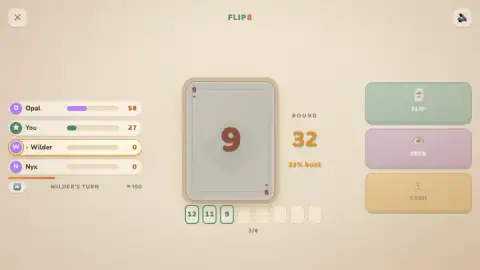
| 12, 11, 9 | 32 | 33% |
In every reading the bust meter was the round total with a percent sign, give or take a point. A lone 5 cost about four points of risk. A 12 added about twelve.
That pattern has a simple explanation, though it is ours and the game never states it: the deck seems to hold more copies of the high numbers than of the low ones. A 12 is worth more than twice a 5, and it is also more than twice as likely to come round again.
The consequence for play is direct. You do not need to count cards or remember what has gone. Whatever you would bank right now is, near enough, the percentage chance of losing it on the next flip. At 19 points we had about a one in five chance of a bust. At 32, Wilder was facing one in three.
The meter also changes colour. It was green at 15% and 19% and orange at 33%. We did not see where exactly it turns.
What our four turns looked like
Turn one ended with 8 in the bank. Turn two was an 8 and then an 11. With 19 on the table and 19% on the meter we pressed CASH, and the bank went to 27.
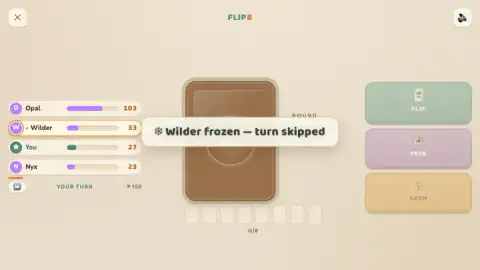
Then we lost a turn without touching anything. Opal froze us, and the game skipped our go. Later the same thing happened to Wilder: a snowflake appeared beside the name, the row went pale, and a banner read "Wilder frozen — turn skipped". We never held a freeze ourselves, so we cannot say how you get one or whether you choose the target.
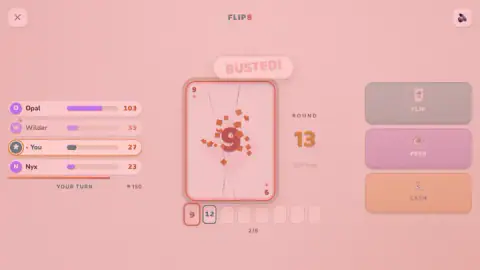
Turn three is the one to learn from. We flipped a 9 and then a 12, which put 21 points on the table with the meter at 22%. We flipped again and got a second 9.
The screen went pink, the card cracked, and BUSTED! came up over the deck. The whole round went with it. Cashing one flip earlier would have nearly doubled our score.
Turn four was a 5, cashed, as our time ran out.
Meanwhile the rivals played longer rounds than we did. Opal went from 58 to 103 in a single turn. Wilder sat on zero for half the match and then banked 33 in one go.
During that round Wilder turned over a card marked +6 BONUS. The slot counter stayed at 2/8, so bonus cards appear to add points without using up one of the eight places.
Those eight slots are the game's name. The game's listing says that eight different cards in one round bank themselves with a bonus. The most we saw anyone hold was three, so that is the listing's claim and not something we watched happen.
Pig, and the oldest decision in games
The choice Flip 8 asks for is much older than the game. Pig is a dice game first described in print by John Scarne in 1945: roll one die as often as you like and add up the rolls, but a 1 wipes the turn. First to 100 wins. The designer Reiner Knizia later gave the family a name, jeopardy dice games, because the only real decision is whether to put what you have at risk for more.
Pig makes you do the sum in your head. Each roll has the same one in six chance of ruin, and a popular rule of thumb is to stop once the turn is worth 20.
Flip 8 differs in one way that matters: the risk is not fixed. It grows with every card you hold, and faster with high cards. That is why the meter is there, and why a turn that starts with a 3 and a turn that starts with a 12 are not the same decision.
The two advert offers, and when they appear
Every time we cashed, a card came up asking "Double your bank?", offering the same points again for watching a short advert. It appeared after all three of our cashes, including the one worth 5.
After the bust a different card appeared: "Second chance?", offering to keep the 21 points and carry on flipping, again for an advert. Both cards have a No thanks button on the left. We pressed it each time, and the match went on as normal.
Be aware of what that means for the scores. A player who accepts every offer doubles every round. We did not, and we cannot say whether the computer players' big rounds work the same way.
Who it is for
Anyone who likes a decision more than a reflex. There is nothing to aim and nothing to time; the whole game is one question asked again and again.
It is slow in solo play. With three rivals taking full turns, most of our four minutes went on watching. A fast-forward button appears at the bottom left during their turns. We did not press it, but it is the first thing we would try next time. And it is a game of luck: the meter tells you the odds, it does not change them.
More card games to try
21 Rush asks the same stop-or-go question with a different limit: bring a lane to exactly 21 and no further. Durak is a card game against computer opponents where the skill is in what you hold back. Solitaire Tripeaks is for when you want the cards without the rivals, and Mini Dice Chess puts a die in charge of a board game. The rest are under multiplayer games.
Screenshots
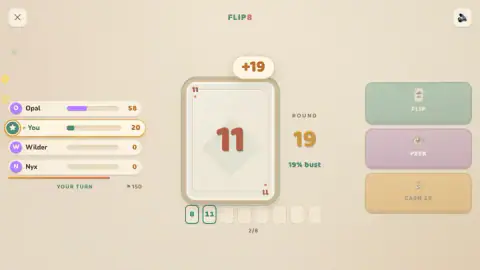
Taken by opening the game ourselves and letting it run — not supplied by the publisher, and not the same picture every other site shows.
How to play Flip 8
- Choose SOLO PLAY on the main menu. You sit at a table of four with a target of 150 points.
- When the list on the left says YOUR TURN, press FLIP. A card turns over and its number goes into the first of eight slots under the deck.
- Read the bust line under the round total. That is the chance the next card repeats one you hold.
- Press CASH to bank the round, or FLIP again to add to it.
- Wait while the other three play. Their turns run by themselves, and then it is yours again.
What one match taught us:
- ROUND is not the round number. The big figure under that word is the points of the current turn. We misread it at first, because it showed 32 during a rival's go.
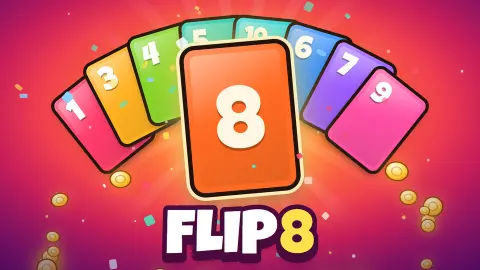
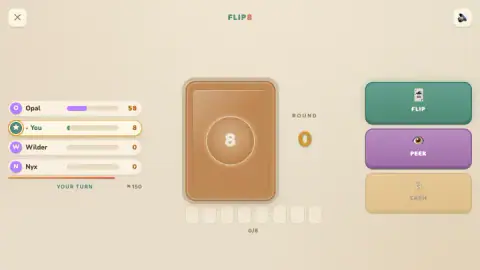
- The 8 on the deck is the logo. The face-down card always shows an 8 in a circle. It tells you nothing about the next card.
- Trust the CASH button, not the counter. The round figure counts up with a short delay. Right after we flipped a 9 it still read 5, while the button already said CASH 9.
- You cannot cash nothing. CASH stays grey until you hold at least one card, so every turn starts with a flip.
- A bust takes the round, not the bank. Our 27 banked points were untouched after we lost 21 on the table.
Controls
| FLIP (green button) | Turns over the next card and adds it to your round |
|---|---|
| CASH (yellow button) | Ends your turn and moves the round's points to your bank; the button shows the amount, and it is greyed out until you hold a card |
| PEEK (purple button) | Offered next to FLIP on your turn; we did not get a clean use of it |
| No thanks | Closes the two advert offers, "Double your bank?" and "Second chance?" |
| Fast-forward button, bottom left | Appears only while a rival is playing; we did not press it |
| X and speaker icons, top corners | Leave the table and mute the sound |
Features
- A solo table of four, you against computer players named Wilder, Opal and Nyx, racing to 150 points
- A bust meter that prints the risk of the next flip as a percentage, green when low and orange when high
- Eight card slots under the deck, with a counter that runs from 0/8
- Bonus cards such as +6 that add points to the round without taking one of the eight slots
- Freezes that make a player miss a turn, marked with a snowflake on the scoreboard
- A scoreboard that re-sorts itself by bank as the scores change
- Two optional advert offers, one after each cash and one after a bust, both with a No thanks button
Game details
- Developer
- Blitz
- Release date
- August 2026
- Last updated
- October 12, 2026
- Added here
- July 2026
- Technology
- HTML5
- Platforms
- Browser (desktop)
- Classification
- Cards & Board
- Saved progress
- Saving, when available, is managed by this game. Mava cannot confirm your level.
FAQ
How do you play Flip 8?
On your turn you press FLIP to turn over a card, and its number is added to the round. You can flip again or press CASH to move the round's points into your bank. If you flip a number you already hold in that round, you bust and the round's points are gone. The first player to reach the target, 150 in our match, wins.
What does the bust percentage mean in Flip 8?
It is the chance that the next card you flip repeats a number you already hold and wipes the round. In our match the figure stayed within a point or two of the round's total, so holding 19 points showed 19% and holding 32 showed 33%. High cards score more and raise the risk more.
What happens when you bust in Flip 8?
You lose the points of that round only. We busted on a second 9 with 21 points on the table, and our bank of 27 from earlier rounds did not move. The game then offered a "Second chance?" card that keeps the points in exchange for watching an advert, with a No thanks button beside it.
What does ROUND mean on the Flip 8 screen?
It is not the round number. The big figure under the word ROUND is the points you have collected in the current turn, the amount you would bank by pressing CASH. It counts up with a short delay after each flip, so the number on the CASH button is the one to trust.
Does Flip 8 have ads?
It has two optional offers. After each cash a "Double your bank?" card offers to add the same points again for watching a short advert, and after a bust a "Second chance?" card offers to save the round. Both have a No thanks button, and declining cost us nothing. A break screen from the distributor also came up as the match opened.
Can you play Flip 8 with friends?
The main menu has a MULTIPLAYER button next to SOLO PLAY, and the game's listing describes quick matches and private rooms with a code. We only played the solo mode against the three computer players, so we cannot tell you how the online rooms behave.
Who made Flip 8?
The game is credited to a developer listed as Blitz. It was published on 17 August 2026.