







About Log Flyer: Grandpa Takes Off
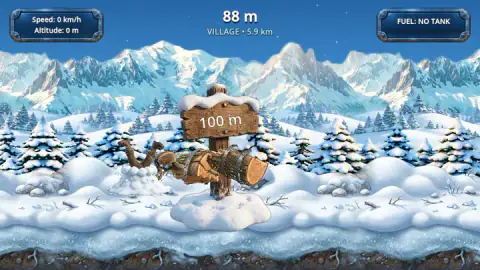
Most launch games tell you how far you went and leave you to guess why. Log Flyer: Grandpa Takes Off puts the answer on a signpost. Out in the snow stands a wooden board reading 100 m, and until you go shopping you will land at the foot of it, every time, without getting past.
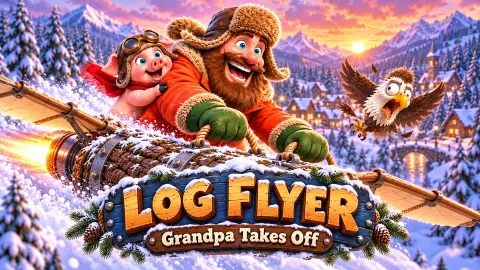
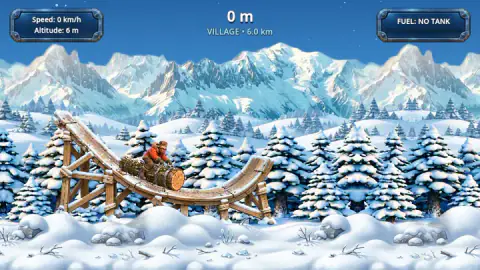
The setup is a grandpa in a red coat and fur hat astride a banded log, parked at the top of a curved wooden ramp in a valley of snowed-in pines. Above him the screen counts metres flown, and under that, the line that matters: VILLAGE • 6.0 km. That is the goal. In the top right corner a second panel reads FUEL: NO TANK, which is the game telling you, before you have pressed anything, that you are going to need more than gravity.
We launched sixteen times. Grandpa went down the ramp, up the lip, out over the trees and into a burst of snow, and the counter stopped at 88 metres every time. Each flight ended the same way: the log on its side at the foot of that signpost, and grandpa planted upside down beside it, legs in the air.
That is not a complaint. It is the game's whole argument. The ramp gives everyone the same throw; everything past 88 metres you have to buy.
The 100-metre signpost and what it is for
A lot of upgrade games hide their first wall. This one paints it. You fly past a 50 m board on the way, and the 100 m board sits close enough to the landing spot that every crash happens in its shadow. It is the smallest possible goal on the way to a six-kilometre one, and it is placed so that you cannot fail to notice how close you came.
Then the arithmetic takes over. A flight is worth 88 coins. The wooden nose cone costs 120, so the first purchase is two flights away, and the pension that drops in every few launches shortens that further. The game never makes you grind for long before the next decision.
That loop — throw, land short, earn, buy, throw again — is the oldest shape in browser games, and it lives or dies on whether each purchase visibly moves the landing point. We cannot tell you how far the first part moves it, because we did not buy one. What we can tell you is the size of the job: 88 metres out of 6,000 is about one and a half per cent of the way to the village.
A ski jump without the skier
The ramp is not just decoration. It is drawn as a timber in-run, a curved dip and a lip that kicks upward — the same three parts as a ski jump, and the comparison explains why the log falls where it does.
On a large competition hill, a ski jumper leaves the take-off table at roughly 90 km/h and lands well past 120 metres. Our log leaves its ramp faster than that and comes down far shorter. The difference is not the speed. It is the shape of what is flying. A modern jumper spreads the skis into a V and leans out over them, turning skis and body into one wide, flat surface that the air pushes up against. Hill sizes are measured in metres, and boards along the landing slope let the crowd read the distance at a glance, the way the 50 and 100 m posts do here.
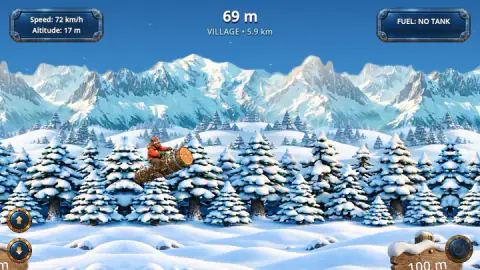
A log does none of that. It is a cylinder: all front, no lift. Thrown off a ramp it behaves like any thrown object — up for a while, then down, losing speed the whole way, which is exactly what the dashboard shows between 126 and 72 km/h.
So read the workshop as a list of things a ski jumper has and the log does not. A nose cone cuts the drag at the front. Wings give it the flat surface that turns speed into height. The ramp tab changes the throw itself. And the engine, fed by a fuel tank, adds the one thing no ski jumper is allowed: a push after take-off.
The workshop, the coins and the adverts
The workshop is a timber shed with grandpa and his log on the left and the shop on the right. Five tabs run along the bottom: nose cones, wings, engine, fuel and ramp. We read the first one. A wooden cone for 120 coins, a copper pot for 225, a steel wedge for 450, and a scroll bar promising more below. The other four tabs we did not open, so their prices are not ours to give.
Next to the coin counter sits a small button with a film icon and +300. The game's listing describes it as an optional video reward that pays 300 coins only once the advert has finished. We left it alone. Between some flights the screen did dim for an advert break before letting us carry on.
The listing also says the menu's Missions & Records holds permanent missions, that you can unlock paint jobs and pilot titles, and that a SCORE leaderboard keeps your best single flight. We saw one title — Rookie log pilot — and it never changed, which fits a game where the title tracks distance and ours never moved.
Who it is for, and what we never reached
It suits anyone who likes watching a number go up for reasons they chose. There is no timer, no enemy and no way to lose anything but a few seconds, so a young player can launch grandpa all afternoon, while an older one will want to know which part buys the most metres per coin.
Now the honest inventory. We never bought a part, so we never flew past 88 metres, never used the engine, and never saw the fuel panel read anything but no tank. The listing promises a startled eagle, the village at six kilometres, a piglet copilot as the reward for reaching it, and English and Russian text and voice acting. None of that appeared on our screen, so it is the game's claim rather than our report. And we played on a computer: the round touch buttons are drawn on screen, but we never pressed them with a finger.
More things to launch
If it is the throw-and-upgrade loop that hooks you, Knight Launch swaps the ramp for a trebuchet and spends its gold on getting a knight further. Launch the Dummy sends a crash-test dummy down a hill and pays for distance and damage. Build and Fly Obby is the workshop without the ramp: bolt a plane together and see whether it flies at all. And Golf Orbit chases height and distance one shot at a time, with a golf ball instead of a grandpa. The rest are under arcade games.
Screenshots
How to play Log Flyer: Grandpa Takes Off
- Press Let's Fly on the main menu. A short Preparing... sign holds the screen for a moment while grandpa settles on the ramp.
- Press the green Launch button when it appears. The log slides down the dip of the ramp and leaves the curved lip pointing upwards.
- Steer in the air. The game's listed controls are W or the Up Arrow to raise the nose and S or the Down Arrow to lower it; on a touchscreen, two round buttons on the left do the same.
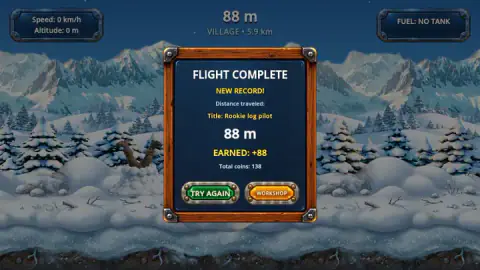
- When the log hits the snow, a Flight Complete panel shows your distance, your best, your pilot title and the coins you earned — one per metre.
- Choose Try again to go straight back to the ramp, or Workshop to spend what you have.
What only sitting through the flights teaches:
- The first flight sets the floor, not the ceiling. The panel shouts New record the first time and then quietly switches to Best: 88 m. If yours is also stuck there, nothing is wrong with your timing.
- Speed is the thing you are losing. The log leaves the ramp at about 126 km/h, and by the time it passes 80 metres it is doing 72 and sinking. Every part in the shop is an answer to that one line on the dashboard.
- The highest point comes early. You start 12 metres up at the top of the ramp, peak at about 22 around the 50-metre board, and spend the rest of the flight coming down.
- Take the pension. Every few flights a Pilot's Mail letter interrupts with "YOUR PENSION IS HERE!" and 200 coins. It even tells you when the next one is due; ours said after flight number three.
- Do not hoard. We finished our session with 1,858 coins and had spent none of them, which is exactly why we never flew a metre past 88. The cheapest part costs 120.
Controls
| LAUNCH! button | Sends the log down the ramp. It appears in the middle of the screen once the short Preparing... sign clears |
|---|---|
| W or Up Arrow (round up button on touch) | Raises the nose in the air, per the game's listed controls |
| S or Down Arrow (round down button on touch) | Lowers the nose, per the game's listed controls |
| Space (round button bottom right on touch) | Runs the engine, once you have bought one and a tank to feed it. Without them the panel reads Fuel: no tank and the button stays grey |
| Try again or Workshop | The two choices on every results panel. One puts you back on the ramp, the other opens the shop |
Features
- The village you are flying towards is 6.0 kilometres from the ramp, and the distance left is printed under your metre counter for the whole flight
- With nothing bought, the log flew 88 metres sixteen times out of sixteen, landing each time just short of a wooden 100 m signpost
- The ramp alone throws you out at about 126 km/h; by 80 metres the log has bled down to 72 and is coming back to the snow
- Every metre pays one coin, and a Pilot's Mail pension adds 200 more every few flights, so the shop fills even when the distance does not
- The workshop sells five kinds of part — nose cones, wings, engine, fuel and ramp — and the first three nose cones cost 120, 225 and 450 coins
- Each results panel gives you a pilot title; ours read Rookie log pilot from the first flight to the last
Game details
- Developer
- Partner studio
- Release date
- October 2026
- Last updated
- October 25, 2026
- Added here
- October 2026
- Technology
- HTML5 (2D)
- Platforms
- Browser (desktop), Browser (mobile & tablet, touch)
- Saved progress
- Saving, when available, is managed by this game. Mava cannot confirm your level.
FAQ
How do you play Log Flyer: Grandpa Takes Off?
Press Let's Fly from the menu, wait for the short Preparing sign to clear, then press the green Launch button. Grandpa slides down a curved wooden ramp on his log and flies until he hits the snow. Each metre earns a coin, and you spend the coins in the workshop on parts that should carry him further, towards a village six kilometres away.
How far can you fly in Log Flyer without upgrades?
In our run, 88 metres, every time. We completed sixteen flights without buying a single part and every one stopped at 88 metres, a few metres short of a wooden signpost marking 100. The ramp on its own is not enough to pass the signpost, which is the game's way of sending you to the workshop.
What upgrades are there in Log Flyer: Grandpa Takes Off?
The workshop has five tabs — nose cones, wings, engine, fuel and ramp. The nose cones we saw were a wooden one for 120 coins, a copper pot for 225 and a steel wedge for 450, with more further down the list. We did not buy any of them, so we cannot say how many metres each one adds.
How do you get coins fast in Log Flyer?
Every metre flown is one coin, so a short flight is still worth taking. On top of that a Pilot's Mail letter delivers a pension of 200 coins every few flights; ours said the next one would come after flight number three. The workshop also shows a +300 button with a film icon, which the game describes as a video reward paid only after the advert finishes.
Why does the fuel say no tank in Log Flyer?
Because you start with nothing but the log. The engine runs on Space or the round button in the bottom right, but it needs fuel, and fuel needs a tank bought in the workshop. Until then the panel in the top right reads Fuel: no tank and the engine button stays grey, so every early flight is a pure throw off the ramp.
How far is the village in Log Flyer: Grandpa Takes Off?
Six kilometres from the ramp. The distance left is printed under your metre counter all through the flight, and after our 88-metre flights it read 5.9 km. The game's own listing says reaching the village earns a piglet copilot and that you can keep flying past it for a distance record; we never got there.
Can you play Log Flyer on a phone, and who made it?
The flight screen draws round up and down buttons on the left and an engine button on the right, which are the touch controls, and the listing confirms mobile play; we played with a mouse and keyboard. The game is free in the browser with nothing to install. The studio behind it is not recorded anywhere we can check, so this sheet names no author.