
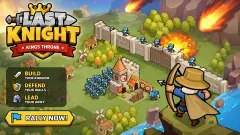

About Knight Launch
Our knight flew nine metres. Then he flew nine metres again. By the end of the session that figure had come back on the result card more than a dozen times, always under the same word — OUCH. — and the village we were aiming at was still a hundred and twenty metres away.
That rut is not a flaw. It is the game introducing itself. Knight Launch straps a man in armour to the sling of a wooden trebuchet and gives you one decision: when to let go. A tall meter fills while you hold the button down, and a short dashed gold band sits near the top of it under the word PERFECT. Release inside that band and the counterweight does its work. Release anywhere else and the knight leaves the frame head first under a speech bubble reading "NOT AGAIN!"
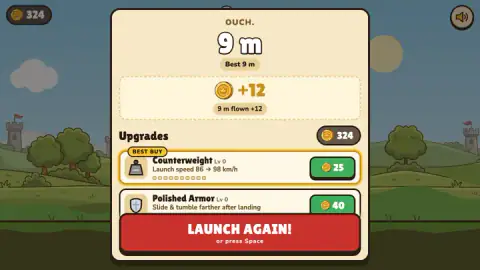
Everything else follows from that half-second. The landing pays in coins, and the card that appears afterwards writes the exchange rate out in plain words: nine metres flown, plus twelve. Under it sits a shop with two things in it, and under that a red button the width of the panel reading "LAUNCH AGAIN!"
One thing before the rest, because it shapes this page. Our best flight was 35 metres, well short of the village; we never bought an upgrade, even while sitting on 324 coins; and we never saw a cow, a haystack or a powder keg, all of which the game says are out there.
The gold band is the whole game, and it is near the top
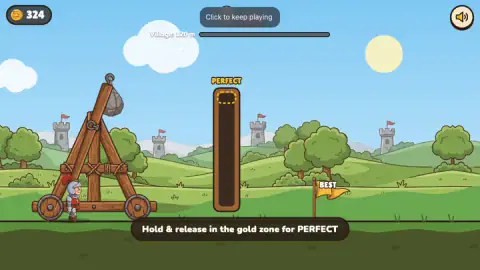
The meter is a tall dark column with no numbers on it. All it carries is that dashed gold rectangle near the top, its label, and a line along the bottom of the screen reading, word for word, Hold & release in the gold zone for PERFECT.
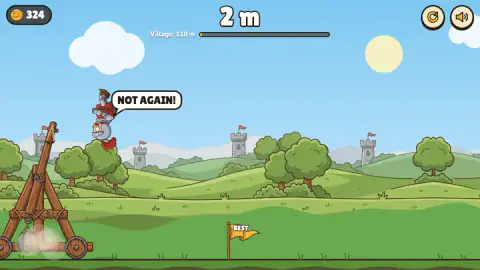
Two things make it harder than it looks. The band is small, a sliver of the column's height, and it sits where an untrained thumb has usually let go already. Most of our flights sent the knight almost straight up, landing him a couple of metres from where he started, and the screen says so in the bluntest way available: a big "2 m" across the top while he is still in the air.
The second thing is that there is no aiming. No angle slider, no wind, no second input. The geometry of the machine is fixed and the only variable you touch is the strength of the throw, so a bad flight is never bad luck. It was early or it was late, and you knew which as you did it.
Nine metres is worth twelve coins, and that is the whole economy
The result card is the most honest screen in the game, because it shows its own arithmetic. The distance goes at the top in large figures, your best underneath, then a dashed box with a coin in it and the phrase 9 m flown +12. Distance is the currency. Nothing else pays.
Watching the purse climb twelve at a time while the headline figure stayed at nine was the clearest explanation of the design we got. The game will let you grind a bad launch into money. It just takes a long time, and the shop is right there telling you how long.
Both rows are open from the first landing. Counterweight costs 25 coins, carries a BEST BUY ribbon and states its effect as a launch speed going from 86 to 98 km/h. Polished Armor costs 40 and promises that you slide and tumble farther once you have hit the ground. Those are the two halves of a flight — how hard you leave and how long you keep moving after — and the pricing says the designers think the first matters more.
The arithmetic agrees with them. For anything thrown, range grows with the square of the launch speed: double how fast it leaves and it travels four times as far. So the fourteen per cent that first upgrade adds is worth roughly thirty per cent more ground, which is a better deal than it looks for 25 coins.
A trebuchet is a falling rock, and the hard part has always been letting go
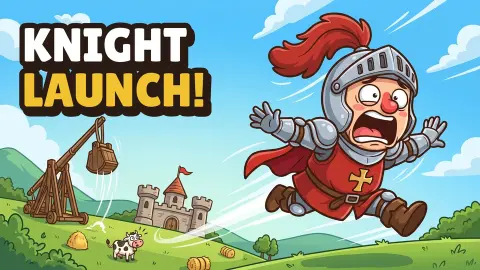
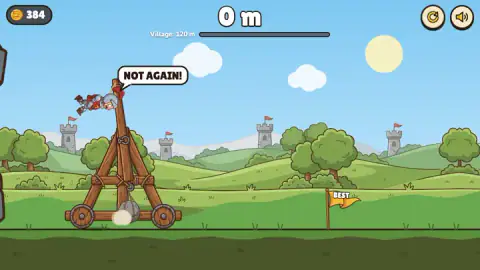
Look closely and the launcher is not a catapult at all. A catapult, in the Roman sense, stores its energy in twisted rope. This machine has a grey stone hanging high on the short end of a long beam before you fire, and after the shot that stone sits on the ground between the wheels while the beam stands straight up. That is a counterweight trebuchet, and the game draws it accurately.
Real ones worked exactly that way. Nothing is wound or tensioned; a heavy weight is lifted, and then allowed to fall. The falling weight swings the beam, the beam whips a sling on its long end, and the sling is what actually throws. Machines of this kind appeared in Europe in the late twelfth century, and the most famous was Warwolf, built for Edward I at the siege of Stirling Castle in 1304.
The detail that matters here is the release. One end of the sling is looped over a hooked pin at the tip of the beam, and the angle of that pin decides the instant the loop slips free. Set it wrong and a perfectly good machine throws its stone into the ground a few paces away, or straight up above itself. Crews adjusted that pin between shots, and getting it right was the difference between a wall coming down and an afternoon wasted.
Which is the whole of Knight Launch, moved from a metal hook onto your finger. It has turned the single hardest adjustment on a real siege engine into its one button, and shows you the result as a man in armour yelling "AAAAH!" on his way to the ground. It also explains the name on the first thing in the shop: on the real machine, a heavier falling stone was exactly how you bought more distance.
What we never reached
Honest inventory. Our record stood at 35 metres, well short of the village, so everything past that first stretch of grass is the game's description talking, not us. It promises haystacks to bounce off, cows to ricochet from, powder kegs to set off with a tap in mid-air and a royal cape you hold to open and glide, along a road running from the castle through the village, a dark forest, mountains, frozen peaks and dragon lands to something called the edge of the world. We saw hills, trees and small castles with red pennants, and that is all we can vouch for.
Two more gaps. We never bought an upgrade, so we cannot tell you how a level-one counterweight feels. And we played on a computer with a mouse, so the touch version is the listing's claim, not our experience.
What we can vouch for is the tone. The knight keeps up a commentary on the way out — "FOR THE KING!" on the hopeful launches, "NOT AGAIN!" on the ones that barely clear the beam — and a game that opens its failure screen with the word OUCH rather than a score is not asking to be taken seriously. It is asking for one more go, which is harder to refuse.
More things to send flying
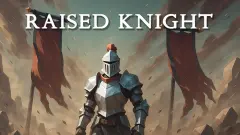
If the launch-and-upgrade loop is the pull here, Launch the Dummy! runs the same idea downhill in three dimensions. Golf Orbit is the one-button cousin, where a single perfect strike is the whole skill. Bomb the Castle keeps the medieval setting and the pull-back-and-release physics but points them at a rival fortress, and Raised Knight sends a knight after distance on foot. The rest are in arcade games.
Screenshots
How to play Knight Launch
- Hold the mouse button — or Space, or a finger on a touchscreen — to start the power meter climbing beside the trebuchet.
- Let go while the marker is inside the narrow gold band near the top of the meter, labelled PERFECT.
- Watch the flight. The metres covered are printed large across the top of the screen, and the bar underneath says how much of the journey to the village is left.
- Read the card when he stops. It gives the distance, your best, and the coins the flight earned.
- Spend them in the shop, or hit "LAUNCH AGAIN!" and try the timing again.
What only sitting in front of it teaches:
- The band is high, so the usual mistake is letting go early. It is not in the middle of the bar, where the eye expects it. Watch the top third and nothing else.
- The shop is not the bottleneck at the start. Our best launch happened with both upgrades still at level zero, and our worst with enough coins in hand to buy the first one thirteen times.
- The bar at the top counts down, not up. It says 120 metres before launch and 118 once you have flown two, so a falling number is good news.
- Your record is a thing in the world. An orange pennant marked BEST stands in the grass at your best distance, so every flight is a race against a flag you can see from the launcher.
- The game pauses itself. A grey pill reading "Click to keep playing" turns up over the launcher between flights. One click anywhere on the game wakes the meter up again.
Controls
| Hold and release the mouse button | Winds the power meter up and fires the trebuchet. Let go while the marker is inside the gold band near the top for a PERFECT launch |
|---|---|
| Space | The same hold and release on a keyboard. The result card also offers it as a shortcut for launching again |
| Hold and release a finger | The touchscreen equivalent, per the game's own listing. The on-screen instruction does not change on a phone |
| A tap in mid-air | Sets off a powder keg while you are flying, according to the game's listed instructions. We never flew far enough to meet one |
| Holding in mid-air | Opens the royal cape to glide, per the same listing. Also something our flights never got near |
| R, or the round restart button | Restarts the flight. The button sits in the top right corner next to the speaker |
Features
- One gold band on a vertical power bar decides every flight, and it sits near the top of the bar rather than in the middle
- The knight is fired from a counterweight trebuchet: a stone hangs high on the short arm before launch and lies on the ground between the wheels afterwards
- Distance is the currency. The result card spells the exchange out in words — nine metres flown paid twelve coins
- Two upgrades are on sale from the first landing: Counterweight at 25 coins, which reads Launch speed 86 to 98 km/h, and Polished Armor at 40
- The first target is a village 120 metres off, and the bar at the top counts the remaining metres down rather than up
- A pennant marked BEST is planted in the grass at your record distance, so your previous best is a thing you can see from the launcher
- The knight talks on the way out — NOT AGAIN, AAAAH, FOR THE KING — and the result screen opens with OUCH rather than a score
Game details
- Developer
- Partner studio
- Release date
- October 2026
- Last updated
- October 25, 2026
- Added here
- October 2026
- Technology
- HTML5 (2D)
- Platforms
- Browser (desktop), Browser (mobile & tablet, touch)
- Classification
- Arcade
- Saved progress
- Saving, when available, is managed by this game. Mava cannot confirm your level.
FAQ
How do you play Knight Launch?
You hold the mouse button, Space or a finger to wind up a trebuchet, and let go to fire the knight down a long stretch of grass. A vertical power meter fills while you hold, and a narrow gold band near the top of it is the window you are aiming for. The further he flies before he stops, the more coins the landing pays, and those coins buy upgrades that make the next launch stronger.
Where is the gold zone in Knight Launch?
Near the top of the power meter, not in the middle. It is drawn as a short dashed gold rectangle with the word PERFECT printed above it, and the game writes the instruction along the bottom of the screen in its own words — hold and release in the gold zone for PERFECT. Because the band is high up, the common mistake is letting go too early rather than too late.
How do you fly farther in Knight Launch?
Timing first, money second. Our record flight of 35 metres came with every upgrade still at level zero, and most of our launches ended at nine metres with a purse that could have bought the first upgrade thirteen times over. Get the release into the gold band, then spend. The listing also describes setting off powder kegs with a tap in the air and opening a cape to glide, neither of which we reached.
What do the upgrades cost in Knight Launch?
The two on offer from the very first landing are Counterweight at 25 coins and Polished Armor at 40. Counterweight is flagged BEST BUY and its line reads a launch speed going from 86 to 98 km/h; Polished Armor promises that you slide and tumble farther after you land. Both start at level zero, and the game's own description mentions more kegs and a longer-lasting cape further up the list.
How far is the first village in Knight Launch?
A hundred and twenty metres. The bar across the top of the screen reads Village 120 m before you launch and counts the remaining distance down as you travel — at two metres flown it read 118. The game's description sets out a longer road past that village through a dark forest, mountains, frozen peaks and dragon lands, but the village is the first thing you are asked to reach.
Are there ads in Knight Launch?
Yes, though our session saw fewer than expected. One the advert appeared over the game, and five separate times the game instead showed a notice reading that it had skipped the advert this time, with a button to carry on playing. The result card also offers a video in exchange for doubling the coins you just earned, which is optional and which we declined.
Why does Knight Launch keep saying click to keep playing?
That grey pill is the game pausing itself and asking for a click to resume, and it appears in the middle of the screen over the launcher. It arrived often in our session, usually between flights. Nothing is lost while it is up — the power meter simply will not move until you click once somewhere on the game area.
Is Knight Launch free, and who made it?
It is free and runs in a browser with nothing to install. The studio behind it is not recorded anywhere we can check, so this sheet names no author rather than guessing one. It reached our catalogue on 24 October 2026, which makes it days old at the time of writing rather than a back-catalogue title.