


About Ragdoll Fury
A combo counter is usually a flourish. In Ragdoll Fury it is the scoreboard.
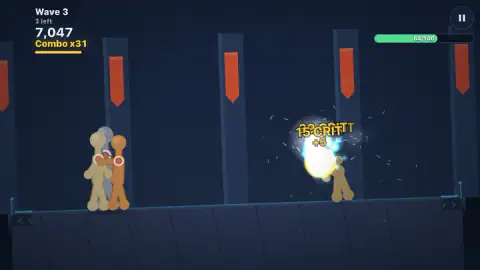
Three waves into our run the number in the corner read 3,213, earned the slow way: one enemy, one swing, one small gold number drifting up off a wooden chest. Then a chain held. By the time it broke, the label under the score said Combo x31 and the score said 7,047. That one unbroken run of hits was worth more than the two previous waves put together.
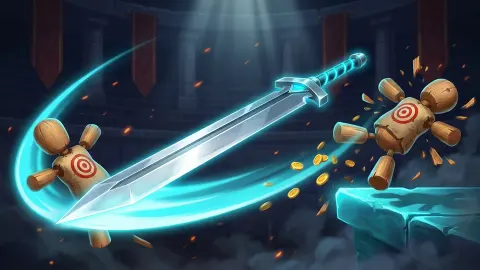
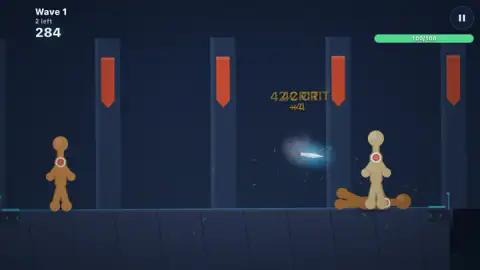
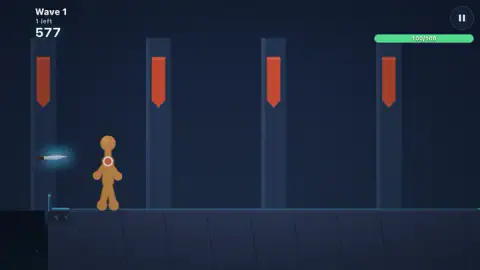
What you are swinging belongs to nobody. A knife hangs in the air with nothing holding it, lit blue, and it goes where you drag the pointer. The things it is for are wooden figures with a red-and-white bullseye painted on the chest. Hit one hard enough and it leaves the ground, sheds a spray of splinters and lands in a heap that stays there for the rest of the wave.
The one rule that governs all of it we found out the hard way, by not landing anything for the best part of a minute. Speed is the damage. A short drag, or a careful one, slides the blade past a figure and does nothing you can see. A long fast sweep across half the screen is the difference between a body standing and a body in the air.
Flagwin Studio made it, and it was published in July 2026. We reached wave 4 in a four-minute run: far enough to see the shape of the thing, nowhere near the end of it.
The card between waves is where the run is actually decided
Most arena games of this shape test how long you last. This one interrupts itself every wave to make you choose something, and the choice has teeth because of one quiet detail: your health does not come back.
We watched it across four waves. We ended wave 2 on 69 out of 100 and wave 3 opened on 69; we ended wave 3 on 64 and wave 4 opened on 64. Nothing is topped up, nothing is forgiven, and the only road back is through the card screen.
So here is what that screen puts in front of you. Three cards, a line saying which wave you just cleared, and a coin count — ours read 227. We were dealt Recovery, which trickles 1.2 health back per second, Evasion, a ten per cent chance to dodge a hit outright with a note that it caps at half, and Frost Edge, which staggers whatever you hit and slows it briefly. Each card carries a rarity badge: Evasion was marked Epic and outlined in purple, the other two Common.
Under them sit two buttons, and the prices say more than the cards do. Heal costs 76 coins. Reroll costs nothing. And in the corner of each card is a small cross tag priced at 52, which strikes that card out of the deal.
Read those prices together and a philosophy falls out. Changing your mind is free. What you pay for is health, and for narrowing the deal so a card you do not want stops taking up a slot. The game is relaxed about indecision and strict about consequences, which is the right way round for something that will not heal you between rounds.
It also means a wave cleared without taking damage is worth more than a wave cleared fast. Ours was the other kind: by wave 4 we had 24 health and a growing suspicion that we had spent our card screens badly.
Why nothing ever falls the same way twice
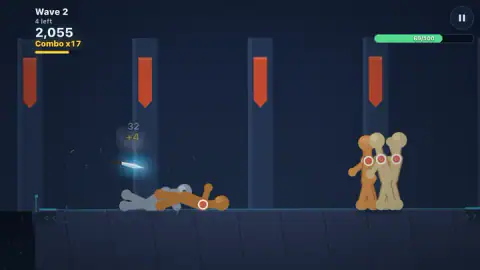
Look at the floor in any capture above and you will notice the game never tidies up. A figure that goes down stays down, exactly where it landed and in exactly the shape it landed in.
That is not laziness, and it is the thing the word in the title points at. For most of video-game history, a character that fell over played a death animation: a short sequence of hand-made frames, drawn once and played back the same way every time. It was cheap and reliable, and it meant the hundredth enemy you beat collapsed in precisely the same arc as the first.
A ragdoll throws that away. The figure is a set of solid pieces — head, torso, arms, legs — pinned together at joints that are only allowed to bend so far. When it stops standing, nothing plays back: the machine works out the fall as it happens, from the direction and the force of the hit, and the body folds up honouring those joint limits and nothing else. The name comes from how limp the early ones looked doing it, crumpling like a cloth doll into shapes nobody would have drawn on purpose. It has been in big games since the late nineties, when Jurassic Park: Trespasser made a mess of a great many things and is still remembered for being early to this one.
Which matters to you, not just to a programmer, for two reasons. Every collapse is a one-off, so a body is evidence about the hit that caused it: flat on its back took the blade square, folded against a pillar was travelling sideways. And because the pieces are solid, a falling body is still an object. It hits things, shoves things, piles onto whatever was already down there. That is the whole reason striking the near edge of a crowd pays better than picking off the back of it. You are not swinging at three enemies; you are swinging at one and letting it become the second swing.
The scenery is in on it. Figures shed wooden chips when struck, and the platform ends in darkness at both ends with a pair of cyan arrows marking the lip. The game says you can knock enemies clean off that edge. We never caught one going over, but knowing the lip was there changed which direction we swung in.
What we did not get to see
Four minutes gets you four waves, and the game is plainly built to run longer. Its own description promises armoured enemies and bosses, a wardrobe of blades and guns beyond the knife we used, and a weapon upgrade at wave 10 we were nowhere near. A small green crate sits on the floor from wave 4 onwards and we never worked out what it was for. Those are the game's claims and one open question, not our findings.
What we can tell you is how the first stretch feels. It is quiet: one sound as you enter and then almost nothing, no fanfare for a kill, no voice counting your chain. It is legible, with wave, count, score, combo and health all in two corners. And it gets the important thing right, which is that you feel a broken chain in the only number still moving.
More games by Flagwin Studio
Smash and Break is the studio's other destruction game and the closest thing to this one we have: a hundred objects and nothing to do but take them apart. Game Factory and Dream Home show the other half of what they make, builders rather than brawlers. If it is the physics you came for, Epic Sword Battle puts floppy fighters in a 3D arena, and Drunken Boxing turns the same wobbliness into the whole control scheme. The rest are in action games.
Screenshots
How to play Ragdoll Fury
- Click into the game from the opening screen. A sound plays as the first wave builds, and it was the only sound we heard all session.
- Drag across the screen to swing the blade. Fast and long. The pointer is the handle and your wrist is the engine.
- Clear the count in the top-left corner. Under the wave number sits a figure like 7 left: that is how many bullseyes are still upright.
- When the wave empties, the game stops and deals three cards under the heading Choose a Power. Click one. It is yours for the rest of the run.
- The next wave opens with its name across the middle of the screen in big letters, and your health bar exactly where you left it.
What four minutes taught us:
- Wind up, do not poke. Our first instinct was to click the enemy we wanted dead, which does nothing at all. Our second was a tidy little flick near the target, which also does nothing. Start the drag far from what you are aiming at and finish past it.
- Let the bodies work for you. A figure knocked off its feet travels, and it travels through whatever is standing behind it. Our longest chain came from hitting the near edge of a crowd rather than the figure at the back.
- Watch the bar, not the score. The health reading at the top right is green down to the sixties and red by the twenties, and it is the only warning you get.
- The combo is a clock, not a tally. The label disappears the instant you stop connecting. Keep moving even when the next target is out of range; a pause is a reset.
- The blade comes to rest. Stop dragging and the knife settles — sometimes in mid-air, once standing upright on a ledge at the very edge of the platform. It waits where you left it, which is rarely where you want it next.
Controls
| Drag across the screen with the mouse, or with a finger | Swings the blade. Long, fast drags were what landed damage for us; short or slow ones did nothing we could see |
|---|---|
| Clicking an enemy | We tried it repeatedly and never got a reaction. Every hit we landed came from a drag, not a click |
| One of the three cards on the Choose a Power screen | Takes that power for the rest of the run. The screen appears the moment a wave is cleared |
| Reroll, under the cards | Deals three different cards. It carried no price, unlike everything else on that screen |
| The round button in the top-right corner | Carries a pause symbol. We hit it once by accident and the run stopped dead until we clicked back into it |
| The keyboard | Arrow keys and letters got us nothing. Everything we did in four minutes, we did with the pointer |
Features
- Speed is the damage: the same blade that bounces off a figure on a slow drag sends it cartwheeling on a fast one
- A combo counter that is the real scoreboard — our single longest chain, thirty-one hits, was worth more than the two waves before it put together
- A card between every wave: three powers, one choice, and the deal is final until the next wave clears
- Coins buy you out of trouble on that screen — a heal cost 76, striking a card you do not want off the deal cost 52, and only the reroll was free
- Your health bar does not refill between waves. We walked into wave 4 on the same 64 points we finished wave 3 with
- Bodies stay where they fall, piling up on the floor, and no two of them land in the same shape
- Waves 3 and 4 both opened with seven to clear, against the handful the first wave puts in front of you
Game details
- Developer
- Flagwin Studio
- Release date
- July 2026
- Last updated
- October 23, 2026
- Added here
- June 2026
- Technology
- HTML5 (2D ragdoll physics)
- Platforms
- Browser (desktop), Browser (mobile & tablet, touch)
- Saved progress
- Saving, when available, is managed by this game. Mava cannot confirm your level.
FAQ
How do you play Ragdoll Fury?
You swing a blade by dragging across the screen, with a mouse on a desktop or a finger on a phone. The speed of the drag is what matters: a slow pass does nothing visible, while a long fast one knocks a figure clean off its feet. Each wave gives you a set number of enemies to clear, and the count sits under the wave number in the top-left corner.
What is the combo counter in Ragdoll Fury?
It is a yellow label under your score that counts consecutive hits, and it is where the points actually come from. We reached a chain of thirty-one in wave 3 and the score climbed from 3,213 to 7,047 while it lasted. The label vanishes the moment the chain breaks, and a small bar under it shrinks and grows independently of the number, which reads as the window you have left to land the next hit.
What are the power cards between waves in Ragdoll Fury?
Every time you clear a wave the game stops and offers three cards under the heading Choose a Power. The ones we were dealt after wave 3 were Recovery, which regenerates 1.2 health per second, Evasion, a ten per cent chance to dodge a hit entirely, and Frost Edge, which staggers and briefly slows whatever you hit. Each card carries a rarity label, and the Evasion card was marked Epic while the other two were Common.
Can you reroll the cards in Ragdoll Fury?
Yes, and the reroll is the one thing on that screen that costs nothing. A Reroll button sits under the three cards and deals a fresh set. Beside it is a Heal button that cost 76 coins, and each individual card wears a small cross tag priced at 52, which takes that card out of the running.
Does your health refill between waves in Ragdoll Fury?
No, and that is what makes the card screen tense. We finished wave 2 on 69 health out of 100 and wave 3 opened on exactly the same 69; wave 3 ended on 64 and wave 4 opened on 64. Damage is permanent unless you spend coins on a heal or pick a card that gives health back, so the choice between a stronger attack and staying alive is a real one.
Who made Ragdoll Fury?
Ragdoll Fury was published in July 2026. It is free to play in a browser with nothing to install.
How many waves does Ragdoll Fury have?
We do not know, and we would rather say so than guess. Our run reached wave 4 and stopped there with two enemies still standing. The enemy count per wave had climbed to seven by then and showed no sign of levelling off, and the game's own description talks about armoured enemies and bosses that we never met.
Does Ragdoll Fury work on a phone?
It is listed for desktop, mobile and tablet alike, and the control it is built around — dragging across the screen to swing — is a touch gesture before it is a mouse one. We played it with a mouse on a desktop, so how the blade feels under a thumb is the game's claim rather than something we can vouch for.